
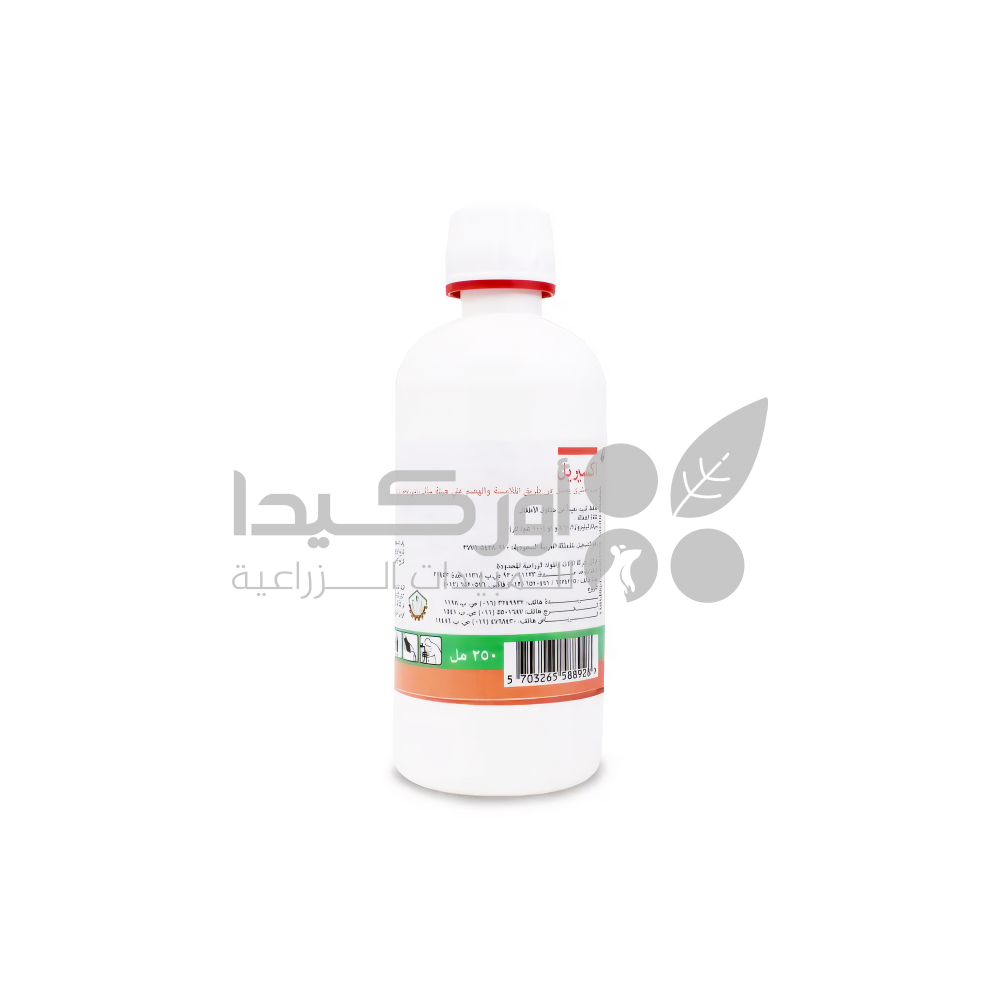

- Exyril 10 SE is a contact and ingestion insecticide containing the active ingredient cyantraniliprole at a concentration of 10.2%. It is used to control a wide range of insect pests on vegetable and fruit crops. It acts on ryanodine receptors in insect muscles, disrupting muscle function and causing rapid cessation of feeding, thus reducing damage to leaves, shoots, and fruits. It is effective against worms, thrips, aphids, whiteflies, leaf miners, leafhoppers, and fruit flies, depending on the recorded crop. Optimal effectiveness is achieved when applied early, at the onset of infestation, targeting larvae and nymphs in their early stages. It is also suitable for Integrated Pest Management (IPM) and resistance management programs when used in rotation with pesticides that have different modes of action.
- Product Features
- Cyantranilpril affects ryanodine receptors in insect muscles, causing a disruption in muscle control and halting the pest's activity and feeding.
- It works through contact and ingestion, affecting insects that are directly exposed to spraying as well as when they feed on treated plant parts.
- It helps to stop the insect's feeding early after exposure to the active ingredient, thus reducing continued damage to leaves, growth, and fruits.
- It features a wide insect spectrum that includes various types of worms, larvae, piercing-sucking pests, and tunnel-makers, according to recorded uses.
- It is highly effective on the early stages of the pest, so its use is beneficial at the beginning of egg hatching and the appearance of larvae or young nymphs.
- It belongs to the IRAC 28 group, making it suitable for inclusion in rotation and resistance management programs with pesticides that have different mechanisms of action.
- Technical specifications
- Trade name: Exirel
- Product type: Agricultural insecticide
- Active ingredient: Cyantraniliprole 10.2%
- Concentration: 10.2% w/w equivalent to 100 g/L
- Preparation form: SE – Oil-in-water emulsion
- Chemical group: Anthranilic Diamides
- Impact Mechanism Classification: IRAC Group 28
- Package size: 250 ml
- Manufacturer: FMC
- Odor: Odorless
- Country of origin: Germany
- Re-entry period: 12 hours after spraying
How to use:
Tomatoes, peppers, and eggplant
- Cutworms and fruitworms: 0.5–0.75 ml/liter of water — equivalent to 50–75 ml/100 liters of water.
- Manna: 0.9–1 ml/liter of water — equivalent to 90–100 ml/100 liters of water.
- Thrips: 0.9–1 ml/liter of water — equivalent to 90–100 ml/100 liters of water.
- Whitefly: 0.9–1 ml/liter of water — equivalent to 90–100 ml/100 liters of water.
- Tunneling agents: 0.9–1 ml/liter of water — equivalent to 90–100 ml/100 liters of water.
- The prohibition period before harvest: one day.
Cucumbers, cantaloupes, watermelons, and zucchini
- Worms: 0.5–0.75 ml/liter of water — equivalent to 50–75 ml/100 liters of water.
- Manna: 0.9–1 ml/liter of water — equivalent to 90–100 ml/100 liters of water.
- Thrips: 0.9–1 ml/liter of water — equivalent to 90–100 ml/100 liters of water.
- Whitefly: 0.9–1 ml/liter of water — equivalent to 90–100 ml/100 liters of water.
- Tunneling agents: 0.9–1 ml/liter of water — equivalent to 90–100 ml/100 liters of water.
- The prohibition period before harvest: one day.
Onions, garlic, and leeks
- Tunneling agents: 0.9–1 ml/liter of water — equivalent to 90–100 ml/100 liters of water.
- Thrips: 0.9–1 ml/liter of water — equivalent to 90–100 ml/100 liters of water.
- The prohibition period before harvest: one day.
Cabbage, cauliflower, broccoli, and radishes
- Diamondback moth: 0.5–0.75 ml/liter of water — equivalent to 50–75 ml/100 liters of water.
- Manna: 0.9–1 ml/liter of water — equivalent to 90–100 ml/100 liters of water.
- Thrips: 0.9–1 ml/liter of water — equivalent to 90–100 ml/100 liters of water.
- Whitefly: 0.9–1 ml/liter of water — equivalent to 90–100 ml/100 liters of water.
- Tunneling agents: 0.9–1 ml/liter of water — equivalent to 90–100 ml/100 liters of water.
- The prohibition period before harvest: one day.
grapes
- Worms and grape borer moth: 0.5–0.6 ml/liter of water — equivalent to 50–60 ml/100 liters of water.
- Leafhoppers: 0.6–0.75 ml/liter of water — equivalent to 60–75 ml/100 liters of water, with a minimum of 75 ml pesticide/hectare.
- Fruit fly: 0.75 ml/liter of water — equivalent to 75 ml/100 liters of water, with a minimum of 75 ml pesticide/hectare.
- Pre-harvest prohibition period: 10 days.
Citrus
- Worms: 0.25–0.4 ml/liter of water — equivalent to 25–40 ml/100 liters of water.
- Manna: 0.75–1 ml/liter of water — equivalent to 75–100 ml/100 liters of water.
- Thrips: 0.75–1 ml/liter of water — equivalent to 75–100 ml/100 liters of water.
- Fruit fly: 0.75–1 ml/liter of water — equivalent to 75–100 ml/100 liters of water.
- Pre-harvest prohibition period: 7 days.
Peaches, apricots, and nectarines
- Worms: 0.5–0.6 ml/liter of water — equivalent to 50–60 ml/100 liters of water.
- Thrips: 0.75–1 ml/liter of water — equivalent to 75–100 ml/100 liters of water.
- Fruit fly: 0.75 ml/liter of water — equivalent to 75 ml/100 liters of water.
- Pre-harvest prohibition period: 7 days.
Controlling the Mediterranean fruit fly by bait spraying
- Mediterranean fruit fly Ceratitis capitata: Use at a minimum rate of 100 ml exyril/hectare, with the addition of 5% hydrolysate protein as a food attractant.
- The prohibition period before harvest: one day.
Orchid advice
- For best results, begin using Exiril at the onset of infestation and target the young stages of the pest before they become denser. Adjust the amount of spray water according to the size of the foliage, paying attention to covering new growth and the undersides of leaves when controlling aphids, thrips, and whiteflies. The quality of coverage and the correct timing are more important than increasing the concentration. With repeated infestations, it is advisable to alternate with a pesticide from a different IRAC group (not group 28) to maintain the effectiveness of the control program.