

You walk through your tomato or potato field after three or four cool, damp nights and find large dark patches on the leaves that look as if boiling water was spilled on them, and a light white fuzz on the underside of the leaf. A few days later the stems blacken, the plants collapse and the smell of rot rises from the field. This is late blight.
This disease caused the Great Irish Famine in the mid-nineteenth century, and even today it can finish off a whole field within a week or two if it finds the right weather. The question on the mind of anyone who discovers it is: is there still time? The answer is yes, if you act the same day and use the right pesticides.
The disease: Late blight is caused by a fungus-like organism and shows as dark, water-soaked spots on leaves and stems and brown blotches on fruit.
The timing: It thrives on dew, fog and moderate temperatures, and spreads in just a few days when conditions are right.
The danger: It spreads from a single plant to a whole field within days, and it infects tubers and ruins them in storage.
The common mistake: Waiting until large spots appear instead of protecting in advance when disease-favorable weather is expected.
The rule: Resistant varieties, ventilation, morning irrigation and a preventive spray before heavy dew protect you more than trying to cure the disease after it has spread.
Why Don't Ordinary Fungicides Work on It?
Most of the losses we see do not come from a lack of spraying, but from spraying an ordinary fungicide that does not affect this organism at all. To understand why, you need to know what the causal agent is.
The cause is Phytophthora infestans, whose name literally means "plant destroyer." Although it is treated in everyday speech as a fungus, it is actually one of the oomycetes (water molds), a group closer in structure to brown algae than to true fungi, which also includes the causes of downy mildew and some causes of damping-off.
The cell wall of this organism is made of cellulose, not chitin, and its membrane does not depend on ergosterol as the membranes of true fungi do. That is why triazole fungicides such as difenoconazole, which are excellent against early blight and powdery mildew, offer it little. This is the most important thing a grower must understand before opening any container.
It reproduces in two ways: fast asexual spores (sporangia) carried by the wind, which either germinate directly or release swimming zoospores in a drop of water on the leaf, and tough sexual spores (oospores) that form only when two different mating types of the pathogen meet in the same field, and these can survive in the soil.
How to Confirm It Within Minutes
A quick diagnosis saves you precious days. Inspect the leaves from underneath, plus the stems, fruit and tubers, and if you are still unsure, a simple test in a plastic bag settles it overnight.
- Leaf spots: Irregular in shape, pale green or gray at first, looking wet or "boiled," then turning dark brown. The spot is not limited by the veins and grows quickly until it covers half the leaf in two or three days.
- The telltale sign: A ring of white, downy growth at the edge of the spot on the underside of the leaf, most visible early in the morning or after a humid night. Infection often starts at the tips and edges of the leaflets where dew lingers longest, and it can appear at any height on the plant, not only on the lower leaves.
- Stems and leaf stalks: Brown to black elongated lesions that make the stem brittle and easy to snap, so everything above the infection wilts and dries. In severe infections the plants collapse and look as if frost hit them.
- Tomato fruit: Large, glossy, olive-brown patches that look oiled, usually on the upper half of the fruit. The fruit stays firm at first, then rots from secondary bacteria. Both green and ripe fruit are affected.
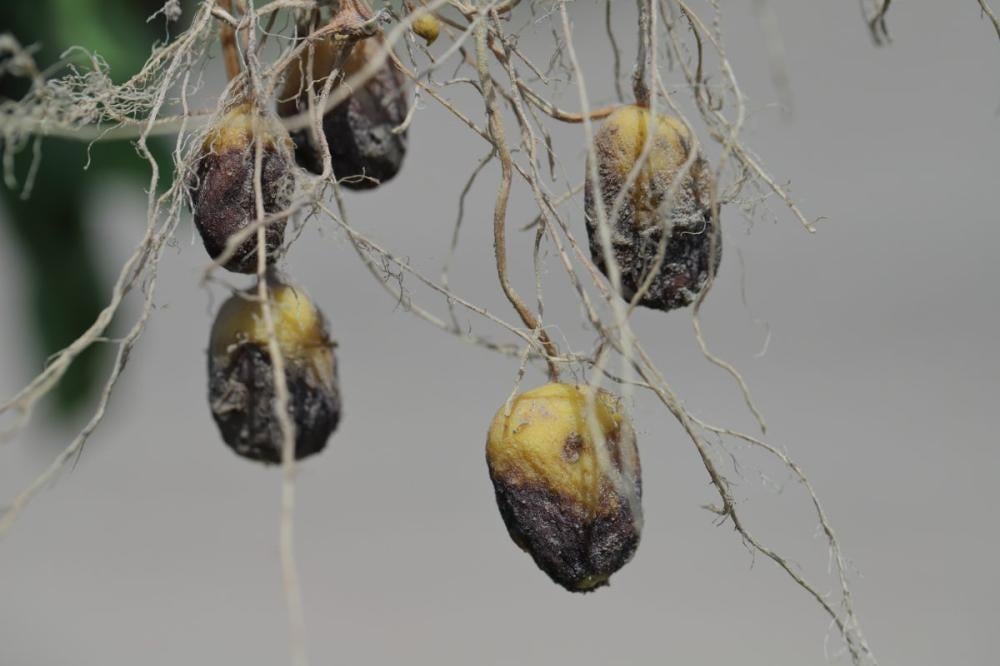
- Potato tubers: Brown to purple areas on the skin. If you cut the tuber, you find a dry, reddish-brown, granular rot beneath, usually no deeper than a centimeter. Soft secondary rots then enter and break the tuber down in storage.
The Bag Test
If you are unsure, put an infected leaf in a plastic bag with a damp paper towel, seal it and leave it overnight somewhere at a moderate temperature. Dense white fuzz on the edges of the spots in the morning strongly points to late blight.
Do Not Confuse It With
- Early blight: Small dry spots outlined by concentric rings with a yellow halo, starting on the older lower leaves and advancing slowly in warm weather.
- Gray mold: A dusty gray growth clearly visible on the surface of the tissue itself, not thin white fuzz at the edge of the spot on the underside.
- Cold or frost damage: It appears all at once on exposed parts, does not grow in the following days and is not accompanied by any downy growth.
The Weather That Ignites the Disease and Its Sources
Late blight is a disease of cool, humid weather. Guidance from US universities specializing in potatoes indicates that the most favorable conditions are nights between roughly 10 and 15 °C and days between 15 and 21 °C, with free water on the leaf from dew, rain or overhead irrigation.
- A film of water: The spore needs a film of water on the leaf, and under ideal conditions a few hours are enough for infection.
- A fast cycle: Symptoms appear after three to seven days, then the spot produces new spores and a new cycle begins roughly every five to seven days. That is why you see the disease "explode" suddenly.
- Wind spread: Wind carries spores tens of kilometers in cloudy weather, but they die quickly in dry air and sun: at 80% humidity they live only a few hours.
- The effect of high temperatures: New infection stops when the temperature goes above about 30 °C, and the disease nearly stops completely above 35 °C, but the pathogen stays alive inside infected tissue and returns to activity with the first cool, humid spell.
In hot, dry regions, this means the risk is concentrated in winter plantings, on foggy nights and nights of heavy dew, and inside greenhouses, where water vapor condenses on the leaves and roof at night. A closed greenhouse on a winter night can be more dangerous than an open field.
Where Did the Disease Come From on Your Farm?
- Infected seed potatoes: The most important source of all. An infected tuber sprouts a shoot that carries the disease to the soil surface.
- Discarded potato piles: Near the field, and volunteer plants sprouting from last season's tubers.
- Tomato transplants: Coming from an infected nursery.
- Solanaceous weeds: Such as black nightshade, and ornamentals such as petunias.
- Neighbors' fields: Airborne spores do not recognize fences, which is why we always advise informing your neighbors when infection appears.
Tomatoes and potatoes pass the disease to each other in both directions, so do not plant a tomato field next to an infected potato field, or the reverse.
The First 48 Hours After Discovering the Infection
With this disease, every day of delay means a new infection cycle. These steps, in order, limit the spread and protect what is still healthy:
- Pull up severely infected plants immediately: Preferably on a dry, sunny day. Put them in sealed bags or cover them with plastic in the sun until they are completely dead, and do not put them in compost or leave them beside the field. The pathogen dies when the tissue it lives in dies.
- For a light infection: Cut off the infected leaves and take them out in a bag, and do not shake them over healthy plants.
- Stop overhead irrigation: Completely, and if it is unavoidable, do it in the morning so the foliage dries quickly.
- Spray the healthy neighboring plants: The same day with the program below, covering the underside of the leaves.
- Pick full-size tomato fruit: Even if it is still green, and let it ripen indoors. Check it daily and discard any fruit that shows a spot.
- Do not enter the field with wet leaves: Clothing and tools carry spores from one row to another.
The Spray Program: What Works and What Does Not
The first rule is that late blight fungicides protect healthy tissue more than they cure infected tissue. A spot that has already appeared will not go away, and the goal is to stop the next cycle.
So the right program starts before the disease appears, when you expect a cool, humid spell, and the interval between sprays is shortened to five to seven days as long as the weather suits the disease.
Groups That Work on Oomycetes
- Multi-site contact protectants: Mancozeb (FRAC M3), chlorothalonil (M5) and copper compounds (M1). They are the backbone of any program because the pathogen does not easily develop resistance to them.
- Specialized systemic or local-systemic fungicides: Propamocarb (28), cymoxanil (27), mandipropamid and dimethomorph (40), fluopicolide (43) and oxathiapiprolin (49).
- Phenylamides: Such as metalaxyl and mefenoxam (4). They used to be the strongest, but many strains of the pathogen around the world have become resistant to them, so use them only mixed with a protectant and for a limited number of sprays.
- Strobilurins (11): They give good preventive protection if sprayed before infection, but they are not the first choice when infection is active.
- Do not rely on these alone: Triazoles (3) and boscalid and its relatives (7) have no effect on oomycetes.
What We Rely On From Orkida
At Orkida we chose, for late blight, fungicides aimed at oomycetes from different groups, with a copper protectant as the foundation of the program, and a sprayer that ensures the spray reaches where the disease starts:
- Previcur Energy 840 SL: From Bayer, propamocarb (FRAC 28) with fosetyl-aluminum (P07), two active ingredients aimed specifically at oomycetes. Propamocarb weakens the pathogen's cell membrane and disrupts mycelial growth and spore formation, while fosetyl moves up and down within the plant and activates its natural defenses. We use it on potatoes and tomatoes as a foliar spray within the program, and also as a drench to protect roots and the stem base from other Phytophthora species in the soil.
- Curenox 50% WP: From IQV of Spain, copper oxychloride (FRAC M1), a contact protectant that hits the pathogen's cell at multiple sites, so it does not easily develop resistance to it. It is the foundation on which we build the program: a preventive spray before a cool, humid spell, then sprays interleaved with the specialized fungicides. On tomatoes and potatoes we use it at the rate written on the label.
- Pyrastak 45 SC: From Astrachem, dimethomorph (FRAC 40) with pyraclostrobin (11). Dimethomorph disrupts the building of the cellulose wall of the oomycete cell and moves locally within the leaf, so it stops recent infections in their first days and reduces the formation of new spores on spots, while pyraclostrobin adds preventive protection on the surface. We use it on tomatoes and potatoes at the rate written on the label, with a 21-day pre-harvest interval.
- Vacomil Forte 65% WP: From Fabco, metalaxyl-M (FRAC 4) with copper hydroxide (M1) in one package, meaning the phenylamide comes mixed with its protectant, as it should be used. Metalaxyl-M is absorbed and moves up inside the plant, so it protects new growth that the spray did not reach. We reserve it for one or two sprays at the peak of risk, at the rate written on the label, with a pre-harvest interval of 7 days for tomatoes and 15 days for potatoes, and we do not rely on it alone because resistant strains may be present.
- Bellis 38% WG: From BASF, pyraclostrobin (11) with boscalid (7). Pyraclostrobin cuts energy production in the pathogen's cell and prevents its spores from germinating on the leaf surface, so we use it as a preventive spray before a cool, humid spell. Its advantage is that in the same spray it covers early blight and gray mold, which often accompany late blight in the same season.
- Eco Spray 20 L Electric Backpack Sprayer, Turbo Model: With an internal agitation system. A large share of late blight program failures comes from incomplete coverage of the underside of the leaves and the inside of the plant. It gives steady battery pressure, multiple nozzles, and an internal agitator that keeps wettable powders from settling in the tank during spraying.
A practical sequence: At the start of the season, or before a spell of risky weather, we start with Curenox, then alternate between Previcur Energy (28 + P07), Pyrastak (40 + 11) and Vacomil Forte (4 + M1), and we slot Curenox in between them or mix it with Pyrastak, so the same group is not repeated in two consecutive sprays.
We do not mix copper with Previcur Energy in the same tank, because fosetyl is not compatible with copper compounds. Bellis replaces Pyrastak when late blight is accompanied by early blight or gray mold, and the two are not sprayed back to back because they share group 11.
From our experience in the field, sticking to the label dose, the number of sprays and the pre-harvest interval written on the label protects the pesticide's effectiveness for next season as much as it protects the consumer, so do not double the dose thinking it makes up for the delay.
Special Protection: Potato Tubers and Greenhouse Tomatoes
After the spray program, each crop still has a particular weak point: in potatoes, the tubers underground; in greenhouse tomatoes, the moisture that condenses at night inside the house.
Potatoes: The Battle Does Not End at the Leaves
The most dangerous thing about late blight on potatoes is that it moves from the leaves to the tubers: spores are washed by water from infected leaves into the soil and swim until they reach the tubers, usually entering through the eyes.
- Good hilling: Mounding soil around the stems places a thick layer of soil between the tubers and the falling spores.
- Completely kill the foliage two to three weeks before harvest: If there is infection in the field, so the spores on the leaves die and the tuber skin hardens before they touch it.
- Harvest when the soil and plants are dry: And avoid wounding the tubers.
- Sort before storage: A single infected tuber in the middle of a damp pile opens the door to soft rots in the whole store.
- Do not keep tubers from an infected field to use as seed: This is the shortest route to carrying the disease into the next season.
Tomatoes in Greenhouses
- Ventilate at dawn: Open the house or run the fans early in the morning to push out saturated air before it condenses on the leaves.
- Drip irrigation: In the morning, not by sprinkling and not in the evening.
- Proper plant spacing and pruning of the lower leaves: To improve airflow within the row.
- Inspect the rows daily: During risk periods, especially the corners and aisles where dew collects.
- Resistant varieties: There are tomato varieties carrying genes for late blight resistance (often labeled Ph-2 or Ph-3). They do not replace spraying in severe weather, but they buy you precious time.
Frequently Asked Questions About Late Blight
Can a tomato plant that late blight has spread through be saved?
If the spots have reached the main stem and most of the leaves, it is best to pull it out immediately to protect the other plants. An early infection on a few leaves can be stopped by removing the infected parts and starting the spray program right away.
Are tomato fruit and potato tubers from an infected plant edible?
The disease does not infect humans. A fruit or tuber that looks sound can be used after the pesticide's pre-harvest interval has passed, but anything with spots should be discarded, because infected tissue opens the way for rots and other organisms, and it is not suitable for storage or canning.
Does the disease stay in the soil until next season?
Mostly it does not survive long in the soil without living tissue, and it relies on infected tubers, volunteer plants and refuse piles. The exception is when both mating types are present in the area, so oospores form that can survive in the soil. That is why crop rotation and disposing of residues remain essential.
I sprayed a fungicide and the disease did not stop. Why?
Usually for one of three reasons: a fungicide from a group that does not affect oomycetes, such as the triazoles; starting to spray after the disease had spread; or incomplete coverage of the underside of the leaves. The cause may also be a metalaxyl-resistant strain if it was the only fungicide used.
Does late blight affect peppers and eggplants?
Rarely. Its main hosts are tomatoes, potatoes and some solanaceous weeds. Peppers are attacked by another close species, Phytophthora capsici, which causes root and stem-base rot, and you will find details on root rots in the article on root rot.
Should I plant tomatoes in the same place next season?
It is best to keep tomatoes and potatoes away from the spot for at least one season, and to completely dispose of plant residues, abandoned tubers and volunteer plants before planting.
Learn about other crop diseases and pests in the Pest Library.