
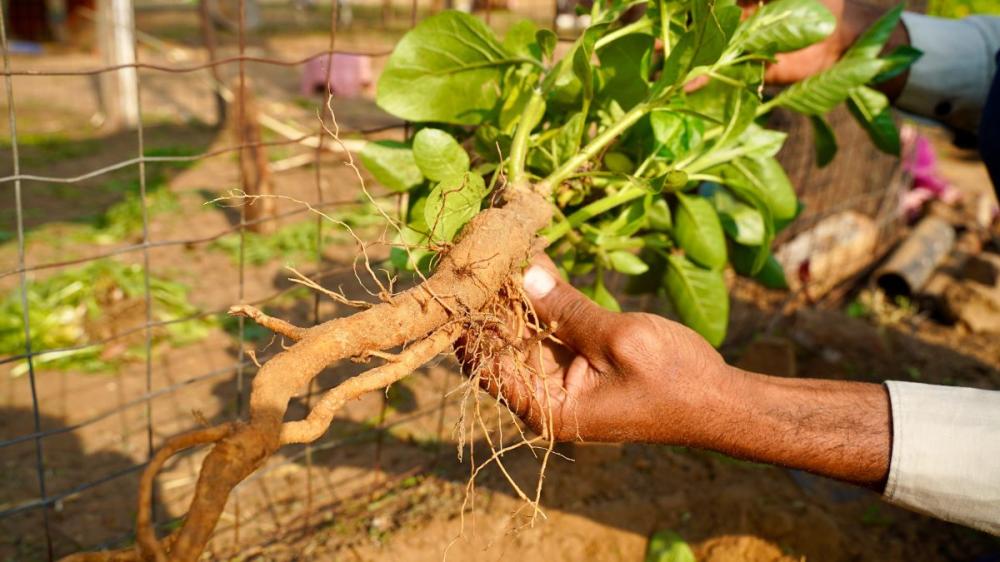

A plant wilts while the soil beneath it is wet. You water it more, thinking it is thirsty, and it wilts even further. This scene is the usual signature of root rot, whether in a vegetable field, a citrus tree or a potted houseplant. The problem is underground where you cannot see it, and the above-ground symptoms look exactly like thirst, so many people make the fatal mistake: more water.
In this article we explain what rots the roots (Phytophthora, Pythium and Rhizoctonia), the role of overwatering in opening the door to them, how to inspect the roots yourself, and what can be saved and what cannot.
The disease: Root rot happens when roots suffocate from excess water and die, and fungi and other organisms that harm the plant colonize them.
The symptom: Wilting and yellowing despite moist soil, and soft brown or black roots instead of firm white roots.
The first cause: Poor drainage and overwatering more than the fungus itself, because the fungus exploits roots that were already weakened.
The common mistake: Watering more because the plant seems thirsty, which speeds up root damage.
The rule: Fix drainage first, then trim damaged roots and replace the soil if needed, and do not add a pesticide before diagnosing the cause.
Root Rot: Excess Water First, Then Soil Organisms
Roots breathe. In waterlogged soil the pores fill with water instead of air, so fine roots suffocate and their tips die even without any disease. Dead or weak roots are the favorite meal of the soil organisms that cause rot, the most important of which are:
- Phytophthora: A fungus-like organism from the oomycetes that causes root and crown (stem base) rots in fruit trees, most orchard trees, citrus and ornamentals, and in tomatoes, peppers, eggplants and cucurbits. Some species like warmth and others like cool conditions.
- Pythium: Also an oomycete, it attacks the small fine roots and is the best-known cause of root rot in greenhouses, potted plants and hydroponics. The best-known species in greenhouses are P. irregulare, P. ultimum and P. aphanidermatum.
- Rhizoctonia (Rhizoctonia solani): A true fungus that causes dry, reddish-brown lesions on roots and the stem base, and is active in less humid conditions than the previous two.
- Fusarium and other fungi: They cause root rots, which differ from nematodes, which make galls on roots but cause similar wilting.
Where do they live? In the soil and root debris for years as dormant, thick-walled spores, and they spread by water: running and recycled irrigation water, water splash, mud clinging to tools, boots and equipment, and infected transplants.
Oomycetes form swimming spores that move through soil water toward the roots, which is why the more free water there is, the better their chances. Fungus gnats and shore flies also carry Pythium between pots and trays.
Symptoms: Above Ground Lies, Below Ground Tells You the Truth
What you see on the leaves looks like thirst or a nutrient deficiency, which is why looking at the foliage is not enough. The real diagnosis comes from inspecting the roots and stem base yourself.
On the Foliage
- Wilting that does not improve with watering: It actually gets worse, and the soil is wet.
- General yellowing: And pale, gray-green leaves, sometimes reddening or yellowing that resembles a nutrient deficiency, because the roots are not absorbing.
- Stunting and decline: Slow growth, dry branch tips in trees, and leaf drop.
- Death with the first heat wave: Trees often die with the first heat wave of the season, because the remaining roots cannot make up for transpiration.
On the Roots and Stem Base: Inspect Them Yourself
Pull up a weak plant (or take it out of its pot) and gently wash the roots:
- Healthy roots: White or cream-colored, firm, with many fine root hairs, and an earthy smell.
- Pythium rot: Soft, watery brown roots with dead tips, and if you pull a root between two fingers its outer skin slips off, leaving a thin thread in the middle. You may smell decay.
- Phytophthora rot: The large roots and the base are reddish-brown to dark, and the fine roots have vanished.
- Rhizoctonia rot: Dry, sunken, well-defined reddish-brown lesions on the roots or at the stem base, and the tissue is not watery-soft like Pythium.
In trees, inspect the crown area at the soil surface: dark bark, and sometimes a gummy exudate (the gummosis known in citrus). Scrape the outer bark shallowly with a knife: healthy tissue underneath is light green or white, and infected tissue is reddish-brown. A canker that encircles more than a quarter of the trunk's circumference is one that the tree rarely recovers from.
Examples by Crop
- Tomatoes, peppers and eggplants: Sudden wilting in greenhouses after heavy irrigation or in low parts of the field, with watery brown roots. Peppers are very sensitive to Phytophthora crown rot.
- Cucumbers and cucurbits: Plants collapse in greenhouses with rot at the base, especially with Pythium in high heat.
- Citrus and fruit trees: Gummosis, crown rot and gradual decline of the tree, with leaf drop and yellowing.
- Strawberries: Stunted plants that wilt in the heat, and the crown center is brown when split.
- Potted and ornamental houseplants: Lower leaves yellow and drop, a soft stem at the soil, a pot that stays wet for days, and often the saucer beneath it full of water.
Do Not Confuse It With
- Thirst: The soil is dry, the plant recovers after watering, and the roots are white.
- Nematodes: Galls and swellings on roots instead of rot, and they may occur together with it because their wounds open the way for rot.
- Fusarium wilt: The roots look relatively sound, and there is brown discoloration inside the stem vessels when you split it lengthwise.
- Salt burn: Root tips are burned and dry, and there is a white crust of salts on the soil surface.
The Disease Cycle and Infection Conditions
Dormant spores in the soil become active when the soil is saturated with water and the roots release their exudates around them. The swimming spores of oomycetes swim toward root tips and penetrate them, then the rot advances toward the larger roots and the stem base, and new spores form in the rotted tissue and return to the soil.
Extension references indicate that Phytophthora infection can begin after only 4 to 8 hours of soil saturation, meaning that one extra irrigation with poor drainage may be enough. These are the most important conditions that open the door to infection:
- Waterlogging: Overwatering, irrigating too frequently, pots without drainage holes, saucers full of water, and low parts of the field.
- Poor drainage: Heavy clay soil, hardpan layers below the surface, and dense decomposed growing media that trap water.
- Temperature: P. aphanidermatum is more active above roughly 25 °C, so hot greenhouses and warm irrigation water are an ideal environment for it, while P. ultimum is more damaging below 20 °C.
- Salts and over-fertilizing: Salts burn root tips, and excess nitrogen weakens the plant's defenses.
- Deep planting: Burying the crown or graft union under the soil, or piling mulch against the trunk.
- Root wounds: From transplanting, hoeing, nematodes and fungus gnat larvae.
The Solutions: Stop the Water First, Then Choose the Right Product for the Cause
Before any product: stop overwatering and fix drainage. No fungicide works in constantly saturated soil, and no fungicide brings a dead root back to life. A fungicide protects new roots until they grow, and the plant recovers only if enough roots remain.
Quick Rescue for Potted Plants
- Take the plant out of the pot and remove the wet soil.
- Cut off all the soft brown roots with clean scissors until you reach firm white tissue, and sterilize the scissors after the job.
- Replant in fresh, light, well-drained medium, in a clean or new pot with drainage holes.
- Water lightly only, and do not water again until the top of the soil has dried to a fingertip's depth or more.
Biological control and root support: Worldwide, Trichoderma and Gliocladium fungi and beneficial bacteria are used to protect the root zone, but they are effective only when disease pressure is low, and they weaken with overwatering and over-fertilizing.
Chemical control: Identify the cause first. Mefenoxam, propamocarb and fosetyl work on oomycetes (Pythium and Phytophthora) and do not work on Rhizoctonia or Fusarium, and they work better preventively than after the rot has spread.
Wide resistance to mefenoxam (FRAC 4) has been recorded in Pythium. A study in Pennsylvania found about 40% of isolates of two common species resistant to it. So alternate between groups and do not repeat the same product.
Orkida Products for Root Rot
At Orkida, for root rot we offer a biological booster to rebuild roots, and specialized fungicides for each cause: for oomycetes, for Rhizoctonia, and for trees whose roots are hard to reach with a fungicide. Choose according to what you found when inspecting the roots:
- BioHealth Myco WSG: From Humintech, mycorrhizae and beneficial bacteria with humic and fulvic acids, which stimulates root growth. The beneficial organisms in it colonize the root and compete with harmful fungi, helping protect against soil diseases, especially root rot. It is used as a dip for transplant roots or with irrigation. Suitable for prevention and for rebuilding roots after the problem is under control, and it is not mixed with fungicides or applied directly after them.
- Previcur Energy 840 SL: From Bayer, propamocarb (FRAC 28) with fosetyl (FRAC P07, low resistance risk), two systemic ingredients that move inside the plant down to the roots. We rely on it against root rots, soil rots and the gummosis caused by Phytophthora, on peppers, cucumbers, onions, melons and ornamentals, as a spray or as a soil drench and with irrigation water. The first choice for Pythium and Phytophthora rot.
- Uniform 446 SE: From Syngenta, mefenoxam (FRAC 4) with azoxystrobin (FRAC 11), applied to the soil only around the roots of transplants within three days of transplanting or after emergence, and not sprayed on leaves. It covers Pythium, Phytophthora, Rhizoctonia and other soil fungi, so it suits protecting transplants from the start when you do not know the cause precisely.
- Tachigaren 30% SL: From Mitsui Chemicals of Japan, hymexazol 30% (FRAC 32), a systemic given as a drench around the roots that works on Pythium and Fusarium together, so it covers part of the gap that oomycete fungicides leave. We rely on it for vegetables, nurseries and young fruit trees, at the rate written on the label as a drench for the root zone, with a 35-day pre-harvest interval in vegetables.
- Tolex 500 WP: From Delta Factory, tolclofos-methyl 50% (FRAC 14), the specialized treatment when the cause is Rhizoctonia: deep brown lesions on the stem at soil level and eaten-away roots. It is applied as a soil treatment before or during planting at the rate written on the label, it is also used for dusting seed potatoes, and it is not sprayed on foliage.
- Valit 80% WP: From Fabco, fosetyl-aluminum 80% (FRAC P07), one of the few materials that move within the plant both upward and downward, so if sprayed on the leaves of citrus and fruit trees it travels down to the roots and crown and protects them from the Phytophthora that causes gummosis and root rot, while also activating the tree's own defenses. We rely on it for trees whose roots are hard to reach with a drench, at the dose and spray interval written on the label during the risk period, and we do not mix it with copper compounds.
Practical rotation: Uniform at transplanting, then Previcur Energy or Tachigaren if you need a later treatment, and do not go back to Uniform in the same season. If the root inspection confirms Rhizoctonia, the treatment is Tolex.
For trees with gummosis we rely on Valit as a foliar spray. Follow the doses and pre-harvest intervals on each product's label.
And because some insects help the rot, we also offer:
- Koppert Yellow Sticky Cards: For monitoring and reducing fungus gnats in greenhouses and nurseries, as their larvae wound roots and carry Pythium. Their abundance is a clear sign that irrigation is excessive.
Prevention: Correct Irrigation Is the First Pesticide
Most cases of root rot start from excess water or poor drainage, so prevention starts with the way you irrigate and prepare the soil, then hygiene and monitoring what enters your field or home in the way of transplants and water.
Irrigation, Drainage and Planting
- Water by need, not by schedule: Check soil moisture with your finger or a moisture meter, and let the top layer dry slightly between waterings.
- Improve drainage before planting: Break hardpan layers, and plant on beds or raised mounds in heavy soils.
- Plant at the same depth as in the nursery: And do not cover the crown or graft union with soil or mulch.
- Keep irrigation water away from the trunk: Place drippers slightly away from the trunk, and move them outward as the tree grows.
Hygiene, Nutrition and Crop Rotation
- Hygiene: Remove dead plants with their roots, sterilize tools, trays and pots, and do not move mud from an infected field.
- Treat recycled irrigation water: Or water stored in open tanks, as it is a common route for spreading Pythium and Phytophthora.
- Do not overdo fertilizer: And monitor soil salinity.
- Check transplant roots before buying: Dense white roots, not brown.
- Crop rotation: After a Phytophthora outbreak in tomatoes, peppers or eggplants, stay away from these crops in the same place for a season or two.
Tips by Type of Cultivation
- Greenhouse vegetables: Monitor summer irrigation water temperature, since heat-loving Pythium thrives in warm water and poor drainage in bags and pots. In soilless culture, do not let bags or slabs stand in drainage water.
- Citrus and fruit trees: Choose rootstocks tolerant of Phytophthora where possible. Uncover the crown if it is buried, and keep mulch, weeds and irrigated turf away from the base of the tree. If there is a small canker at the crown, remove the soil around it down to the main roots and let it dry, with appropriate treatment.
- Indoor potted plants: Always use a pot with drainage holes, and empty the saucer a quarter of an hour after watering. Choose a pot of suitable size for the plant, since a pot that is too large stays wet for days, and reduce watering in winter and in low-light places.
Frequently Asked Questions About Root Rot
Can root rot be treated?
It can be stopped if discovered early and enough of the roots remain sound: stop overwatering, fix drainage, remove the rotten roots in pots, and use a fungicide suited to the cause. A plant whose roots or crown have mostly rotted rarely recovers.
How do I know my plant is wilting from rot and not thirst?
Touch the soil: if it is wet and the plant is wilted, it is most likely root rot or another root problem. Inspect the roots: healthy ones are white and firm, and rotten ones are soft brown with a skin that slips off.
Do hydrogen peroxide or cinnamon treat root rot?
They may be used in small household pots, but they do not treat the cause. Without stopping the overwatering, changing the medium and removing the rotten roots, the rot will come back. On farms and in greenhouses they are not a substitute for the proper program.
How often should I water so the root does not rot?
There is no fixed number; it depends on the plant, pot size, soil type and temperature. The rule: water when the top of the soil dries, with an amount that lets a little drain from the drainage holes, then do not leave water standing.
Is root rot contagious to other plants?
Yes, its organisms spread by water, soil and tools. Do not water a healthy plant with water drained from an infected pot, do not reuse the soil of a plant that died of rot, and sterilize tools and pots.
You will find more crop diseases and pests in the Pest Library.