
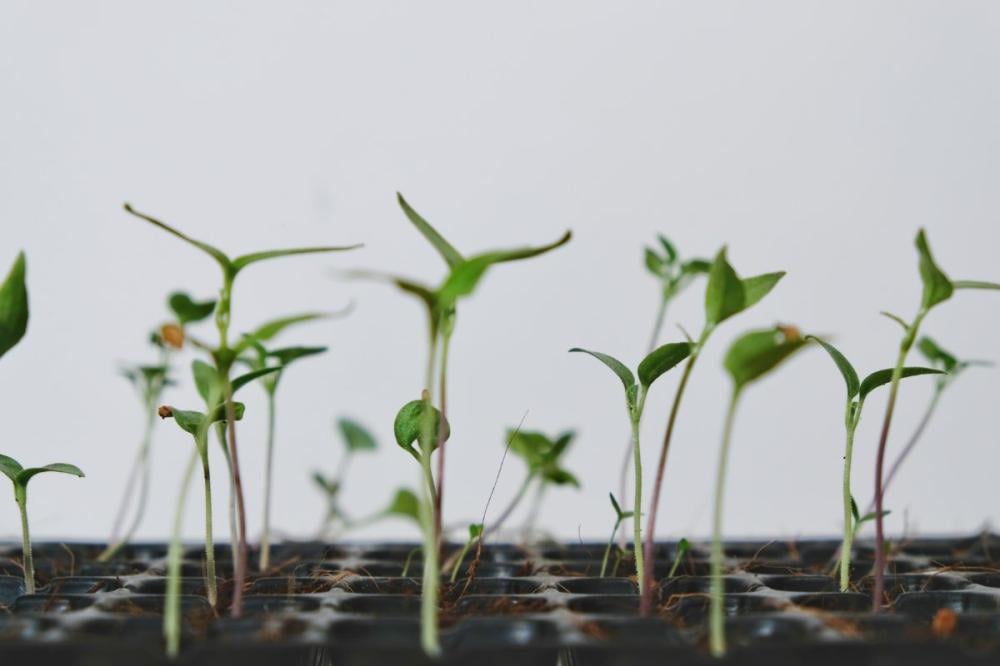

You planted a whole tray of tomato or pepper seeds and were happy with the even germination. Then you walked in one morning to find a group of seedlings lying on their faces as if someone had cut their stems at the soil line. The next day the patch widened. Or worse: two weeks passed and half the seeds had not come up, so you blamed the seed company.
In both cases the cause may be the same: seedling death or seedling collapse (damping-off), the most common problem facing nurseries and anyone who sows seeds at home. The good news is that this disease can largely be prevented, because its causes are mostly mistakes in watering, the growing medium and hygiene. The bad news is that a seedling that has collapsed does not recover.
The problem: The seed or young seedling germinates, then bends and wilts at soil level and dies within days.
The sign: A thin, water-soaked brown stem at the soil line makes the seedling topple over, and often a patch of seedlings is hit all at once.
The causes: Waterlogged soil, poor ventilation, dense sowing, and unsterilized trays or tools that carry soil fungi.
The common mistake: Watering again after the collapse appears. Excess water is the cause of death, not its cure.
The rule: A sterile, well-drained medium, treated seed, moderate watering and good ventilation are the reliable protection for seedlings.
Damping-Off: A Gang of Soil Organisms, Not a Single Fungus
Damping-off describes what happens, not the name of a single organism. It is caused mainly by:
- Pythium: A fungus-like organism from the oomycetes that loves water and swims with its spores in saturated media. Its species differ: Pythium ultimum is more damaging below roughly 20 °C, and Pythium aphanidermatum is more active above 25 °C, so nurseries in hot climates are not safe.
- Rhizoctonia (Rhizoctonia solani): A true fungus that causes dry, reddish-brown lesions at the soil surface.
- Other causes: Phytophthora and Fusarium also cause damping-off, Alternaria may arrive carried on the seed itself, and Botrytis attacks crowded seedlings in high humidity.
Where do they live? In soil, plant debris and used growing media, as dormant spores and hard resting bodies that persist for a long time. Their spores mostly do not fly through the air, but move with soil and water.
Ways they spread include used trays, an irrigation hose lying on the nursery floor, splashing water drifting from one tray to another, workers' hands, and garden soil that some people put in trays. The larvae of fungus gnats and shore flies also carry Pythium between trays.
Most affected crops: Almost everything grown from seed, most famously tomatoes, peppers and eggplants; cucumbers and cucurbits; cabbage, cauliflower and broccoli; lettuce; legumes; and annual flowers in nurseries.
Symptoms: Before and After Emergence
Damping-off can strike before you ever see the seedling, or days after it appears, or leave a late effect that shows at transplanting. These are its signs at each stage:
- The seed and radicle (before emergence): The seed or radicle rots before it emerges. All you see is weak, patchy germination. If you dig where a seed did not come up and find it soft, brown and rotten, the problem is usually not seed quality.
- The stem at the soil surface (after emergence): A water-soaked or dark, thin lesion at the soil line, so the stem becomes like a thread at that point and the seedling falls on its side with its cotyledons still green. With Rhizoctonia, a thin brown fungal strand resembling a cobweb may appear on the soil surface between seedlings.
- The roots: A few brown roots with rotted tips instead of dense white roots, and with Pythium the outer layer of the root slips off easily.
- The pattern of spread in trays: In flat trays, death appears in circular patches that widen day by day. In cell trays, infections are scattered because irrigation splash carries them.
- Wirestem (the late stage): Seedlings that survived may be affected weeks later by a thin, twisted, discolored stem at the base. The plant grows weak above it and breaks easily at transplanting. It is known in cabbage, cauliflower, broccoli, tomatoes and peppers, and is usually caused by Rhizoctonia.
Examples by Crop
- Tomatoes and peppers: Sudden collapse of seedlings in the trays a few days after emergence, and sometimes wirestem at transplanting.
- Cucumbers and cucurbits: Relatively large seedlings wilt and collapse with a water-soaked rot at the base, especially with heavy watering and a heavy medium.
- Cabbage and broccoli: Wirestem is one of their best-known problems.
- Direct-seeded legumes: Patchy emergence in cold, damp soil because of seed rot.
Not Every Collapse Is a Disease: Look-Alikes
- Fertilizer salinity: Over-fertilizing burns the roots so they look shriveled, and the seedlings wither without an obvious lesion at the base.
- Soil surface heat: In hot sun the surface layer in dark trays can heat up and scorch the stem where it touches, leaving a white or brown dry ring, not a soft one.
- Severe thirst: The whole seedling wilts and recovers after watering if the drought was not long.
- Poor light: Tall, thin, pale seedlings lean and fall, but the stem is sound.
- Pesticide sprayed at a high concentration: Small seedlings are very sensitive to phytotoxicity.
The Disease Cycle and the Conditions That Create the Disaster
Dormant spores in the medium or on trays become active when the germinating seed releases its sugars into the water around it, so they are attracted to it and attack the radicle or the tender stem at the soil line. Pythium forms swimming spores that travel in free water between cells, which is why excess water is the first driver.
Once the seedling stem hardens and develops woody tissue, its sensitivity drops greatly, so the critical period is the first days and weeks. These are the conditions that turn it into a disaster:
- Overwatering: And leaving the medium saturated for long periods. A medium that holds a very high share of water increases the damage from Pythium ultimum.
- Cold medium before emergence: Below roughly 20 °C, so germination is delayed and the seed stays exposed to rot longer.
- Dense or deep sowing: It weakens seedlings and traps moisture around them.
- Excess spray: Or condensed water dripping from the greenhouse roof onto the trays.
- High salts and over-fertilizing: They burn root tips and open the way for infection.
- Poor air, poor light and a poor medium: Weak air movement and light, and the use of garden soil or immature compost.
The Solutions: Know Your Enemy Before You Choose a Product
The choice of treatment depends on the cause, because Pythium fungicides do not work on Rhizoctonia and vice versa. In every case, treatment is mainly preventive, and it does not succeed while mistakes in watering and hygiene continue.
Biological Control
Biological agents such as the fungus Trichoderma harzianum, the fungus Gliocladium virens and some strains of Bacillus and Streptomyces are used worldwide in the growing medium or as a drench at sowing to protect seeds and seedlings.
But trials indicate that they help when disease pressure is low, and that overwatering or over-fertilizing weakens their effectiveness. They are therefore part of prevention, not a cure for a collapsing tray. Our store does not currently carry a specialized biological fungicide for damping-off.
Chemical Control and Rotating FRAC Groups
A common mistake: Pythium and Phytophthora fungicides do not work on Rhizoctonia, and vice versa. It is best to use the fungicide preventively at sowing or transplanting, because control is difficult once rot has begun.
Note that Pythium quickly develops resistance to mefenoxam (FRAC 4). A study in Pennsylvania found about 40% of isolates of two common Pythium species in greenhouses to be resistant to it. So do not repeat the same group, and alternate between products with different modes of action.
Orkida Products for Damping-Off
At Orkida we offer soil treatments that cover the main causes: fungicides for Pythium and Phytophthora, and a specialized fungicide for Rhizoctonia, so you can choose by cause and rotate between groups:
- Previcur Energy 840 SL: From Bayer, combining propamocarb (FRAC 28) and fosetyl (FRAC P07), specialized against the oomycetes (Pythium and Phytophthora) that cause root and soil rots, and used as a spray or through irrigation water as a soil drench. A suitable choice for transplant trays and nurseries struggling with Pythium under excess humidity.
- Uniform 446 SE: From Syngenta, mefenoxam (FRAC 4) for Pythium and Phytophthora, with azoxystrobin (FRAC 11), which covers Rhizoctonia and other soil fungi. It is applied to the soil only, around the roots of transplants within three days of transplanting or after emergence in direct seeding, and it is not sprayed on leaves.
- Tachigaren 30% SL: From Mitsui Chemicals of Japan, hymexazol 30% (FRAC 32), a systemic given as a soil drench that the roots absorb, and it works on Pythium and Fusarium, which cause damping-off. We use it as a drench around the roots after sowing, or as a treatment for nursery transplants, at the rate written on the label for vegetables, with a 35-day pre-harvest interval. Its group differs from those of Uniform and Previcur Energy, so it is a suitable partner in rotation.
- Tolex 500 WP: From Delta Factory, tolclofos-methyl 50% (FRAC 14), specialized for Rhizoctonia specifically, that is, the fungus that Pythium and Phytophthora fungicides do not affect. We use it as a soil treatment before or during sowing at the rate written on the label when the cause is deep brown lesions on the stem at the soil surface, and it is not sprayed on foliage.
Practical rotation: If you start with Uniform at transplanting, make the next soil treatment, if you need one, Previcur Energy, not Uniform again, or Tachigaren if Pythium or Fusarium is the problem. If you are sure the cause is Rhizoctonia, Tolex is the specialized treatment.
Young seedlings are extremely sensitive, so never exceed the label dose, and we prefer testing on a few trays first if the variety is new to you.
And among the helper tools we offer for nursery hygiene and monitoring pests:
- Virkon S: From Lanxess, a broad-spectrum disinfectant based on potassium peroxymonosulfate that kills fungi, bacteria and viruses on surfaces, tools and equipment by oxidation. Use it to sterilize trays, tools and nursery benches after washing them, not on plants.
- Koppert Yellow Sticky Cards: For monitoring and reducing fungus gnats above the trays, since their larvae wound roots and help spread Pythium. Hang them slightly above plant level and raise them as the plants grow.
Prevention: A Clean Nursery Protocol
Most cases of damping-off start from a contaminated medium, used trays or excess watering. So prevention here is an integrated work protocol: from preparing the seeds and trays to managing watering and temperature after sowing.
Preparing Seeds and Trays
- Reliable seed: Preferably treated with a fungicide by the supplier.
- Fresh growing medium: A ready-made, light, well-drained mix (peat moss and perlite, for example), not garden soil and not a used medium.
- New or sterilized trays: Do not reuse trays from a batch where the disease appeared, since organic matter stuck in their corners is hard to remove, and do not put clean trays on a dirty nursery floor.
- Moisten the medium before filling: And fill the cells without compacting, and do not stack filled trays on top of each other.
- Sow at the right depth: And do not crowd the seeds.
Germination, Irrigation and Care
- A suitable germination temperature: Bottom heat between roughly 21 and 24 °C speeds germination and shortens the critical period.
- Water in the morning: And only as much as needed, preferably from below in small trays, and let the surface dry slightly between waterings.
- Air and light: Good ventilation, a light fan and enough light for strong seedlings, and preventing condensed water from dripping on the trays.
- Do not fertilize early or heavily: A seedling lives on the seed's reserves in its first days.
- If the disease appears: Dispose of the whole tray, not only the fallen seedlings, since seemingly healthy seedlings next to them may be infected.
Tips by Crop and Nursery Type
- Tomatoes, peppers and eggplants: Reduce watering as soon as the cotyledons appear, and keep air moving above the trays. Check the stem base before transplanting, and discard any seedling with a thin, discolored stem.
- Cucurbits: Their seeds are large and rot easily in cold, saturated medium, so do not sow before the medium warms up, and do not flood the trays with water right after sowing.
- Cabbage, cauliflower and broccoli: Wirestem is common in them, so do not transplant into cold, saturated soil, and do not bury the stem deeper than its level in the tray.
- Commercial nurseries: If irrigation water is recycled or comes from an open tank, treat it before use, since it is a common route for spreading Pythium. And separate the new-tray area from the area of large seedlings and returns.
Frequently Asked Questions About Damping-Off
Can a seedling be saved after it falls?
No, because the stem has rotted at the base. What can be saved is the rest of the seedlings: move the affected tray away, reduce watering, improve ventilation, and treat the neighboring trays preventively if needed.
Do cinnamon or hydrogen peroxide prevent damping-off?
They are popular home remedies, but they do not replace a sterile medium, proper watering and hygiene. The first cause of the disease is excess water, and any treatment will fail while overwatering continues.
Why didn't the seeds germinate even though they are new?
They may have rotted before emergence because of Pythium, especially if the medium was cold and saturated. Dig up a few empty spots: a soft brown seed is a sign of rot, and a firm, sound seed means a problem with temperature or seed quality.
Should I use garden soil in the trays?
It is not recommended. Garden soil carries soil fungi and compacts in trays, so it traps water. Use a ready-made, light, well-drained growing medium.
Are the small black flies above the trays dangerous?
They are fungus gnats. The adults themselves do no harm, but their larvae in the damp medium feed on fine roots and help spread Pythium. Seeing many of them is a sign that watering is excessive.
Learn more about crop diseases and pests in the Pest Library.