
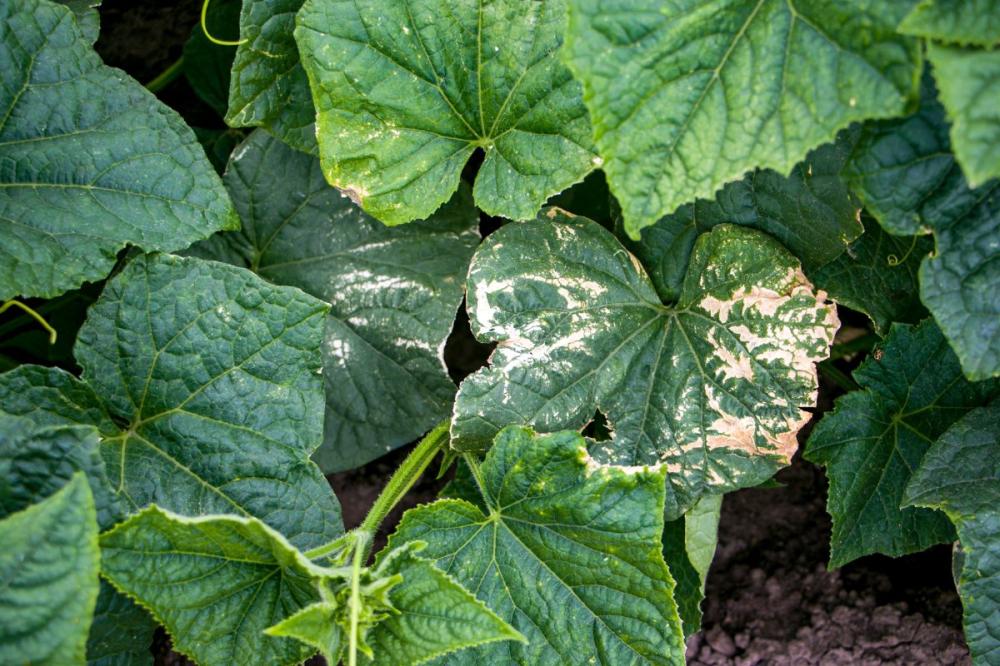

You walk past your zucchini or cucumber plants in the morning and find white patches on the leaves, as if someone had sprinkled flour on them. You wipe them with your finger and they come off, so you think it is dust. A week later the whole leaf is covered, and after two weeks the lower leaves begin to yellow and dry and the fruit gets smaller.
This is powdery mildew, one of the most widespread plant diseases in vegetables, grapes, strawberries and ornamentals, and the first reason it spreads so fast is that most growers do not spray until the mildew has covered half the leaves. In this article we explain how to recognize it early, how to tell it apart from downy mildew, which many people confuse with it, and why the fungicide that worked for you last year stops working this year.
Appearance: a fine white powder covering the leaf surface that can be wiped off with a finger; it is a fungus that lives on the surface, not inside the tissue.
The difference: powdery mildew is active in relatively dry weather with temperature swings, unlike downy mildew, which needs high humidity.
The danger: it weakens photosynthesis, curls leaves, reduces yield and deforms fruit if left untreated.
Common mistake: watering the leaves, thinking it washes the disease off, which may increase the spread of the type that likes moisture.
The rule: ventilation, pruning and resistant varieties, with an early spray at the first white spot, protect the plant before it spreads.
Powdery mildew: specialized fungi that live on living plants
Powdery mildew is not a single fungus but a group of fungi from the order Erysiphales, and almost every group of crops has its own species:
- Podosphaera xanthii: infects all cucurbits, from cucumber and zucchini to watermelon, melon and squash.
- Erysiphe necator: grape powdery mildew, which attacks leaves, green shoots and small clusters.
- Leveillula taurica: infects tomato, pepper and eggplant; it is a group of species that infect more than a thousand plant species, and it behaves differently, as we explain under symptoms.
- Other species: on strawberries, roses, pome fruits and ornamentals.
These fungi are obligate parasites, meaning they live only on living plant tissue and do not grow on dead residue. Their threads spread over the leaf surface (or inside it in the case of Leveillula) and send small sucking organs into the cells to draw out nutrients.
So the leaf does not die quickly; it weakens gradually: photosynthesis falls, fruit gets smaller and has less sugar, and fruit is exposed to the sun after the leaves drop.
How does it survive between seasons? In grapes the fungus stays in dormant buds and on the bark as small fruiting bodies, so the new season starts from inside the vineyard itself. In vegetables it usually depends on nearby living hosts: infected fields and other crops, weeds, ornamentals, or neighboring greenhouses, from which the wind carries its spores long distances.
Symptoms and how to tell it from similar problems
The distinctive sign of powdery mildew is a white powder that wipes off, but the form of the infection varies with the part of the plant and the crop. Some diseases and pests resemble it, and the right diagnosis decides the right fungicide.
- On leaves: pale yellow spots first, then a round white powdery growth that usually appears on the upper surface and over time on the lower one too. The spots expand and merge until they cover the leaf, then the leaf yellows and dries. Older and shaded leaves are infected first.
- The wipe test: when you wipe the spot with a finger the powder comes off and slightly green or yellowish tissue remains underneath.
- On stems, petioles and shoots: the same white growth on leaf petioles and stems in cucurbits. In grapes, dark patches appear on green shoots and their marks remain on the wood after it matures.
- On grape berries: small berries are infected, so their skin stops growing while the flesh keeps enlarging, and the berries crack and later rot.
- On strawberry and cucurbit fruit: in strawberries the fruit loses its shine and becomes leathery. In cucumber and melon the fruit may sometimes be infected, while in zucchini the loss usually comes from weakened leaves, not from fruit infection.
A special case: internal powdery mildew on tomato and pepper
This is where many growers make mistakes. The fungus Leveillula taurica grows inside the leaf tissue and forms its spores only on the lower surface. What you see from above are irregular pale yellow spots, so the grower thinks it is a nutrient deficiency.
Turn the leaf over: if you find light white fuzz leaning toward gray or brown under the yellow spots, it is internal powdery mildew. Infected pepper leaves drop heavily. This fungus needs about 18 to 21 days from entering the leaf until symptoms appear, so you may buy healthy-looking seedlings that are already infected.
Powdery mildew or downy mildew?
Powdery mildew is a true fungus, while downy mildew is a fungus-like organism of the oomycetes, and most fungicides that control one are of no use against the other. The right diagnosis saves you a wasted spray and a week of losses: (downy mildew)
- Where it grows: powdery mildew is usually a white powder on top of the leaf. Downy mildew is yellow spots on top of the leaf, with gray or purple fuzzy growth only underneath.
- Shape of the spots: powdery mildew spots are round and expand without limit. Downy mildew spots in cucurbits are angular and bounded by the veins, so the leaf looks divided into yellow squares.
- The finger test: powdery mildew powder wipes off. Downy mildew does not wipe off because the problem is inside the tissue.
- Weather: powdery mildew needs only atmospheric humidity without wetness. Downy mildew needs actual wetness on the leaf for hours.
Other things that may look like it
- Red spider mite: many tiny yellow dots with silky threads under the leaf, not a powder.
- Mealybugs: white cottony masses that move if you touch them and gather in leaf axils and on stems.
- Spray residue, dust or honeydew: they do not expand and do not yellow the tissue underneath.
See our articles on red spider mite and mealybugs.
The disease cycle and the conditions that speed it up
The wind carries spores to the leaf, where they germinate, penetrate the epidermis and begin feeding, then form new spores on the surface of the spot, which the wind carries again. The cycle is short, so if conditions allow, a few spots can turn into an infected field within a few weeks.
The surprise is that this disease does not need rain. Most fungal diseases need free water on the leaf for their spores to germinate, but powdery mildew is an exception: its spores germinate in high atmospheric humidity without water droplets, and free water may even harm them. That is why it spreads in conditions that are dry by day and humid at night, and in greenhouses and shaded gardens.
- Temperature: mild weather suits it, roughly between 20 and 27 degrees Celsius, with high humidity at night.
- Growth density: dense planting and weeds block air movement and create shade and humidity.
- Shade: inner and lower shaded leaves are infected first.
- Excess nitrogen fertilization: it produces soft, dense growth.
- A big difference between day and night temperature: in greenhouses, because it raises humidity at night.
Solutions: biological first, then chemical with planned rotation
Success in controlling powdery mildew depends on three things: starting early, choosing the right method for the severity of the infection, and rotating fungicides so the fungus does not build resistance.
Biological control and gentle alternatives
Biological agents used worldwide against powdery mildew include, most famously, the fungus Ampelomyces quisqualis, which parasitizes the mildew's own threads, and strains of Bacillus bacteria that compete with and suppress the fungus. Preventive tools such as sulfur, potassium bicarbonate and horticultural oils are also used.
These methods work when started early with a light infection, and they do not stop a widespread one. There is currently no specialized biological fungicide for powdery mildew in our store, but microfine sulfur is available, so in the program below we rely on it as a protectant alongside systemic fungicides and preventive measures.
When should you spray?
Agricultural extension recommendations for cucurbits are very practical: every week inspect five mature leaves in several places in the field, and start spraying when you find infection on roughly one leaf in fifty. That means you spray when you see just a few spots, not when the field turns white. In grapes, start preventively at the beginning of vegetative growth, because infection of small clusters cannot be cured after it happens.
Resistance: why does a fungicide that worked before fail?
Powdery mildew fungi are among the fastest to develop resistance. Wide resistance to the strobilurin group (FRAC 11) has been recorded in cucurbit powdery mildew in many parts of the world, along with reduced sensitivity to triazoles (FRAC 3), and resistant isolates to some SDHI fungicides (FRAC 7) have appeared. The practical rules:
- Do not repeat the same FRAC group in two consecutive sprays, and do not exceed two sprays per season for a single group.
- Watch the mixtures: Ortiva Top, Score and Miravis Duo all contain difenoconazole (group 3), and Ortiva Top and Flint are both from group 11.
- Cover both the upper and lower leaf surfaces, especially in pepper and tomato.
- Follow the dose on the pack and the pre-harvest interval written on each product's label, because they are calculated to protect the crop and those who eat it, and spray early in the morning or before sunset.
Suitable fungicides from the Orkida store
At Orkida we choose powdery mildew fungicides from different FRAC groups, so you can build a complete rotation program without repeating the same group. These are the main ones and when we use each:
- Vivando 50 SC: from BASF, active ingredient metrafenone (FRAC 50), specialized for powdery mildew on grapes, cucumber, zucchini and strawberries, and it moves within the leaf to protect both surfaces. Its group differs from strobilurins and triazoles, so it is a cornerstone of the rotation program.
- Miravis Duo 200 SC: from Syngenta, combining pydiflumetofen (FRAC 7) with difenoconazole (FRAC 3), suitable when powdery mildew comes with leaf spots or blights.
- Flint WG: from Bayer, trifloxystrobin (FRAC 11), preventive and curative on vegetables, grapes and fruit trees. Use it once within the program and do not follow it with another strobilurin fungicide.
- Score 250 EC: from Syngenta, difenoconazole (FRAC 3), systemic and suitable for powdery mildew, rust and leaf spots in vegetables, grapes and pome fruits.
- Ortiva Top 325 SC: from Syngenta, azoxystrobin (11) with difenoconazole (3), a broad-spectrum choice when more than one leaf problem occurs on the crop.
- Gatten 5% AC: flutianil (FRAC U13), a Japanese active ingredient specialized in powdery mildew, working preventively and curatively and moving within the leaf to protect new growth. Its real value is that its group is shared with no other fungicide on this list, so it is a trump card in rotation on cucurbits, grapes, strawberries, pepper and tomato, at the dose written on the label.
- Cosavet: from SML, microfine sulfur 80% (FRAC M2), a multi-site protective contact fungicide. It is the oldest powdery mildew fungicide and still works because the fungus does not develop resistance to it. We rely on it for early preventive spraying and between systemic fungicides to ease the pressure on them, at the dose written on the label, and we test it first on a few cucurbit plants because some varieties are sensitive to sulfur.
An example rotation program for cucurbits: Vivando (50), then Flint (11), then Gatten (U13), then Miravis Duo (7+3), then back to Vivando, with a preventive Cosavet spray at the start of the season or between any two sprays when needed.
In this order no group is repeated in two consecutive sprays. We shorten the interval between sprays during active infection and lengthen it in preventive spraying.
Prevention: how to make your field an uncomfortable place for the fungus
Preventing powdery mildew means denying it shade, still air and soft growth, and catching it at the first spot. Some measures suit all crops, and some are specific to each crop.
General measures for all crops
- Choose resistant or tolerant varieties: and read the resistance codes on the seed packet.
- Widen the spacing: remove weeds and trellis the plants so wind can move between them.
- Adjust nitrogen fertilization: according to the soil analysis.
- Inspect weekly: the lower and shaded leaves are the first alarm bell.
- Remove severely infected leaves: at the start, and dispose of crop residues after harvest.
- Do not use overhead water spraying as a treatment: it is true that it harms powdery mildew spores, but it opens the door to downy mildew and bacterial diseases.
Crop-specific measures
- Cucurbits (cucumber, zucchini, watermelon, melon): resistant varieties are widely available and are the first line of defense. Start inspecting at the beginning of flowering, because the disease usually appears while the plant is in the fruiting stage, and in greenhouses reduce night humidity with ventilation.
- Tomato, pepper and eggplant: check the lower surface of leaves with yellow spots, and do not rely on looking from above. Buy seedlings from a trusted nursery and inspect them well, because the long incubation period hides the infection, and use systemic fungicides or ones that move within the leaf, because the fungus is inside the tissue.
- Grapes: start the preventive program at the beginning of growth, since infection of small clusters cannot be cured. Green pruning and removing extra shoots improves ventilation and spray penetration into the vineyard, and remove shoots that appear completely whitened at the start of the season, since they usually come from infected buds.
Frequently asked questions about powdery mildew
Does powdery mildew pass from cucumber to tomato?
Usually not. Powdery mildew fungi are specialized, and the fungus that infects cucurbits differs from the one that infects grapes or tomatoes. But Leveillula taurica has a wide host range and infects tomato, pepper and eggplant together.
Is sulfur or potassium bicarbonate enough?
They help with light infections if used early, but sulfur may burn some cucurbits in extreme heat and must not be mixed with oils. In moderate and severe infections you need a systemic fungicide within a rotation program.
I sprayed twice and the mildew has not gone away. Why?
The white patches on infected leaves may stay visible even after the fungus has stopped, so the measure is that no new spots appear on the young leaves. If spread continues, it is most likely that there is resistance to the group used, that coverage did not reach the underside of the leaves, or that spraying started late.
Can I eat the fruit from a plant infected with powdery mildew?
Yes, the fungus does not make the fruit toxic, but it will be smaller and less sweet. What matters is not to pick before the safety interval of the fungicide you sprayed has passed.
What is the difference between powdery mildew and downy mildew in brief?
Powdery mildew is a white powder that wipes off with a finger, usually appears on top of the leaf and does not need wetness. Downy mildew is angular yellow spots on top of the leaf with gray-purple fuzz underneath, and it needs wetness, and each has different fungicides.
To learn about other crop pests and diseases, browse the pest library in the Orkida store: pest library.