
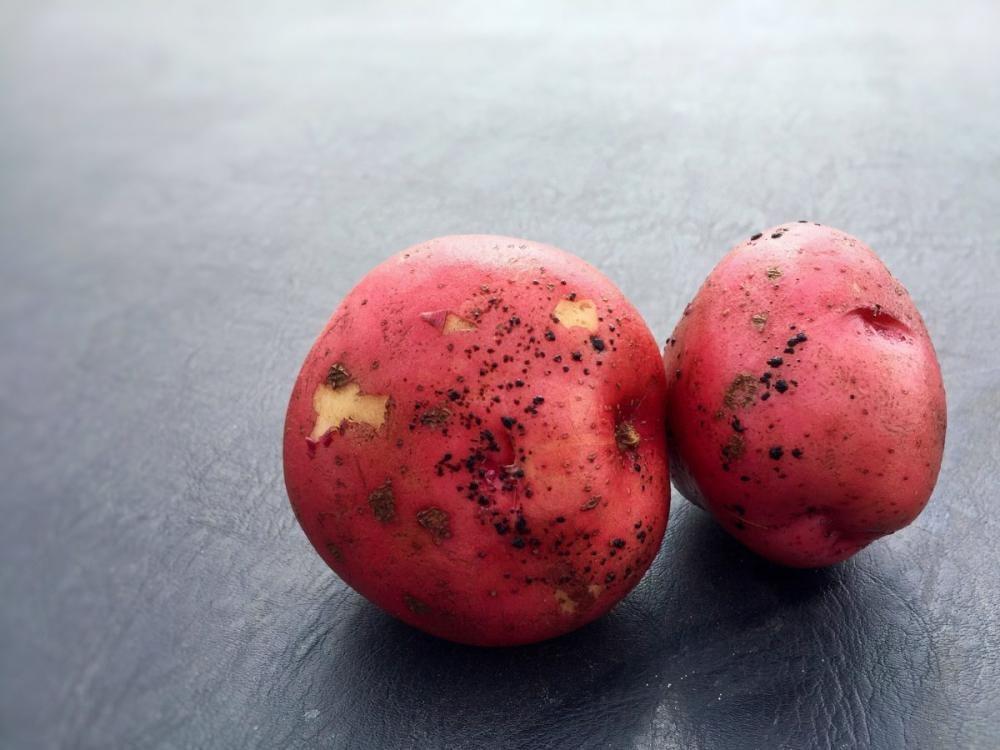

You dig next to a weak potato plant whose growth has stalled and find a sunken brown canker on the underground stem, and on the harvested tubers hard black patches as if someone had sprinkled them with charcoal, which do not come off easily when you rub them with your fingernail. And in the nursery, a cucumber or pepper seedling wilts from the soil line after you thought it had escaped damping-off. The culprit in both cases is usually the same: Rhizoctonia.
Rhizoctonia is a multi-talented soil fungus. It causes damping-off, root and stem rot, stem canker and black scurf on potatoes, and it opens the door to other fungi. Its most important trick is that it does not need an exotic environment: all it needs is cold, damp soil and a seed or tuber that is slow to emerge. We explain how to recognize its many forms and how to protect your land and your seed.
The fungus: Rhizoctonia is a soil fungus that attacks seeds, seedlings and stems at soil level and damages roots.
The sign: A reddish-brown canker on the stem at soil level, and wilting and choking of young seedlings.
The scurf: On potatoes it shows as hard black masses stuck to the tuber that look like soil but do not wash off.
The conditions: Infection is worst in cold, damp soil and with early and deep planting, and lower in warm, well-drained soil.
The rule: Good drainage, crop rotation, clean seed and shallower planting prevent infection more than treating it afterwards.
What Is Rhizoctonia?
The causal agent is the fungus Rhizoctonia solani, which has different anastomosis groups (AG) that specialize in different crops. AG-3 is known for potatoes, while others attack vegetables, cotton, rice and turf. The fungus lives in plant debris and in the soil, and under harsh conditions turns into hard black bodies (sclerotia) with a thick coating that protects it from other organisms.
The fungus does not enter the root through the vessels as wilt fungi do, but attacks the soft tissues near the soil: sprouting buds, young roots and the stem base. That is why it is most dangerous to seedlings and young transplants, and its effect weakens as the plant advances and the stem becomes woody.
Its Symptoms on Vegetables and Seedlings
In nurseries and greenhouses the infection takes several forms, and what they share is that they begin at the point where the stem meets the soil. These are the main signs:
- Stem choking at the soil: A narrow, thin brown zone around the seedling stem, so the seedling topples and dies, while the roots sometimes remain sound.
- Root rot: Dry, sunken, brown to black roots, not soft and foul-smelling like bacterial rots.
- Rusty spots on the stem: Sunken reddish-brown cankers that widen, encircle the stem and slowly choke it.
- Fruit rot of cucurbits: Fruit touching the soil in cucumbers and zucchini is hit by dry, sunken brown spots.
- Weak, stunted growth: Patches of small plants appear in the field for no clear reason and without sudden wilting.
When you pull up a diseased plant you often find brown strands stuck to the soil around the root, and clods of soil wrapped in fungal threads that do not separate easily.
Black Scurf and Canker in Potatoes
Potatoes are Rhizoctonia's best-known victim, because the fungus attacks them in two stages: at sprouting and at harvest. In them the disease shows in successive forms that the grower may not connect.
- Bud death: The fungus eats the sprouting buds before they leave the soil, so emergence is delayed or empty gaps appear in the row.
- Stem and stolon canker: Dry, sunken brown lesions on the underground stem and on the stolons, which limit starch transport to the tubers and may girdle the stem and kill the plant.
- Aerial tubers: Small tubers form at the stem nodes above the soil when the stem base is choked.
- Black scurf: Hard, irregular black patches on the tuber skin, ranging from flat dots to raised masses. They are the fungus's sclerotia, and they do not penetrate the tuber flesh, but they lower appearance and price and carry the disease to the next season.
- Tuber deformity: Cracking, flaking and a rough skin that some call elephant hide when infection is severe.
A common mistake is delaying harvest after the tubers mature, because the sclerotia grow larger and more numerous the longer the tuber stays in cold, damp soil.
Rhizoctonia, Pythium or Fusarium?
A seedling dead at the soil surface may carry the name of any of three fungi, and a fungicide that is good for one may not suit another. These practical differences give you a first guide before the lab:
- Rhizoctonia: A dry, sunken brown canker at the soil, roots ending in narrow tail-like tips, brown strands on the soil, and it appears in cold soil.
- Pythium: Soft, clear, watery tissue that collapses at a touch, and it blackens in waterlogged soils and moderate temperatures.
- Fusarium: Yellowing leaves and discolored vessels, and it intensifies in high temperatures.
In practice these fungi often occur together in the same soil, which is why we lean toward dual-action soil fungicides in nurseries.
When Does the Disease Explode?
Rhizoctonia is the fungus of the cold spring. Extension references say the most severe infections come after planting in cold, damp soil, around 18 °C or lower, when the seed is slow to emerge and its tender tissues stay exposed to attack for weeks. It also increases in waterlogged soils with poor drainage, and when seeds or tubers are buried deep.
That is why many growers see the disease in early-planted transplants, and after rain or heavy irrigation, then it eases as temperatures rise. However, the sclerotia remain in the soil and on the tubers, waiting for the next cold season.
Rhizoctonia in Other Crops
The fungus is not limited to potatoes. Its many groups attack different crops and appear under names that confuse growers.
- Beans and legumes: Stem canker at the soil, root rot and delayed emergence.
- Cucumbers and cucurbits: Rot of fruit touching the soil and root rot in transplants.
- Rice and corn: Sheath blight, an oval spotting on the lower sheaths that extends upward.
- Turf: Circular brown patches that widen in warm, humid weather, known as leaf blight.
- Leafy vegetables and transplants: Basal rot and seedling collapse.
How Do We Reduce Rhizoctonia in the Soil and Seed?
There are no commercially resistant varieties for black scurf in potatoes, so defense rests on three pillars: clean seed, planting that speeds emergence, and soil where the fungus does not build up.
- Choose sound, certified seed: Tubers covered with black scurf carry the fungus to clean land.
- Pre-sprout the tubers before planting: A sprouted tuber emerges from the soil quickly and escapes the fungus's attack on tender buds.
- Plant in warm, well-drained soil: Avoid planting in cold, saturated ground, and do not bury the seed deep. A thin cover of soil is enough.
- Destroy volunteer plants and crop residues: Forgotten tubers and harvest debris preserve the sclerotia for next season.
- Harvest on time: After the vines die and the skin hardens, and do not leave the tubers in cold, damp soil.
- Introduce a crop rotation: Three years with grass crops such as barley and corn, or onions, reduces the inoculum, while watching out for other host crops.
- Improve drainage and aeration: With leveling, raised rows and well-decomposed organic matter.
For nurseries, use a sterilized growing medium and clean trays, and see damping-off to understand how Rhizoctonia's action resembles Pythium's, and root rot for the causes that occur together with it.
Preparing Seed and Nursery Before Planting
Most of what happens in the field is decided days before planting. These short steps reduce the fungus carried on tubers and transplants to a minimum:
- Sort the tubers: Discard any tuber with dense black masses or cankers, and do not cut infected tubers with a knife that carries infection to others.
- Treat the seed: With a suitable dust or spray before planting on dry tubers, then let them dry in the shade before bagging.
- Prepare the nursery: Use a sterilized medium, clean trays and sound irrigation water, and do not crowd the seeds.
- Transplant at a suitable age: A small, tender transplant is more vulnerable, so its root zone is drenched with a preventive fungicide right after transplanting.
- Keep field records: Note the locations of infection and previous crops so you avoid repeating them in the near rotation.
These measures cost only a short time, whereas neglecting them results in infested land that takes seasons to clean.
The Products We Rely On
Rhizoctonia is a surface fungus that is controlled by protecting the root and buds from the moment of planting, not after the canker appears. We choose between a fungicide that contacts the soil and tubers, and a systemic fungicide that is drenched around the transplant. In every case, follow the label dose and the pre-harvest interval.
- Tolex 500 WP: Tolclofos-methyl, a non-systemic that protects the surface of roots and tubers. We use it in soil treatment before planting and in dusting or spraying tubers before planting, to reduce black scurf and bud death.
- Uniform 446 SE: Azoxystrobin with mefenoxam, drenched around transplants after transplanting, covering Rhizoctonia along with other soil fungi. We choose it for nurseries and greenhouses with a disease history.
- Azostop 446 SC: Azoxystrobin with metalaxyl-M, combining control of Rhizoctonia, Pythium and Phytophthora. We prefer it when the land is infested with more than one fungus at the same time, as in mixed damping-off.
Frequently Asked Questions
Is black scurf harmful to people who eat potatoes?
It does not harm health. It is fungal bodies on the skin that do not penetrate the flesh, and they disappear with peeling. But it lowers marketing quality and carries the fungus to next season's land if infected tubers are used as seed.
How do I tell black scurf from common potato scab?
Black scurf is fixed black masses on the surface that can be scraped off with a fingernail, leaving a sound surface, whereas common scab is rough, corky, sunken patches in the skin itself.
Can Rhizoctonia be treated after symptoms appear?
Damage already done to the stem and roots does not reverse. Root-zone fungicides protect new roots and slow the spread, but prevention before planting is what saves the season.
Is Rhizoctonia the same as damping-off?
It is one of its causes. Damping-off is a term that covers Pythium, Rhizoctonia and Fusarium, and each fungus leaves a different sign. Rhizoctonia leaves a dry, sunken brown canker at the soil.
What is the best time to plant potatoes to reduce the disease?
When the soil is warm enough for fast emergence. Early planting in cold, wet ground gives the fungus a longer chance to attack.
Does the fungus move from the nursery to the field?
Yes, transplants carrying the fungus move with their soil ball into the field, so we start protection in the nursery and make sure the medium and trays are sterilized.