
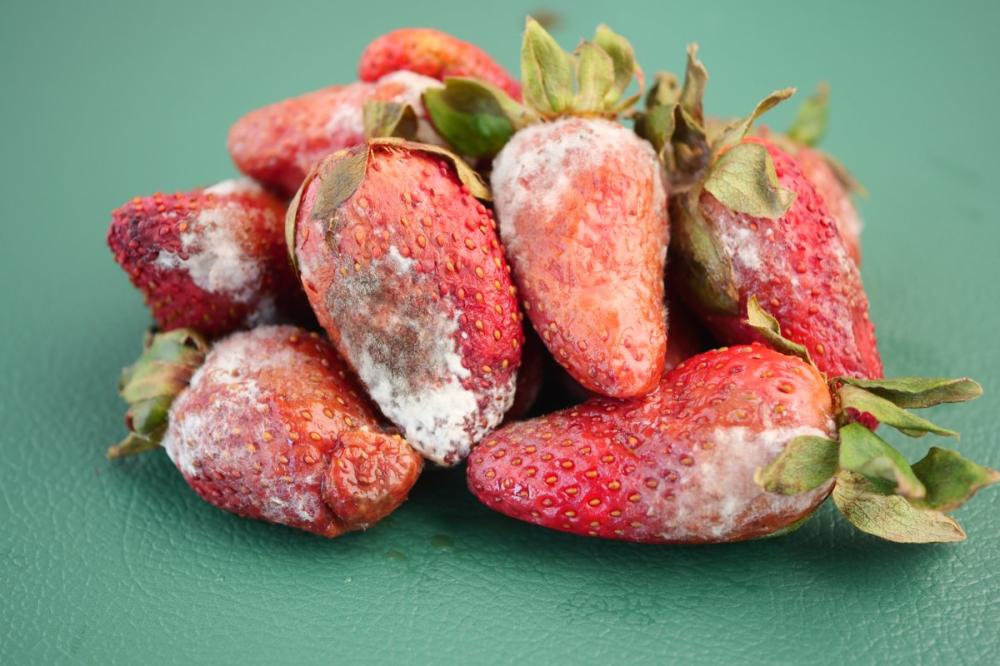

You pick a strawberry that looks sound, and after a day in the refrigerator you find it covered in a fine gray dust that flies off when touched. Or you walk into the greenhouse in the morning and find a strong tomato stem suddenly wilted from the top, with a brown, ringed spot at the base of a leaf you pruned two weeks ago. The culprit in both cases is the same: gray mold, caused by the fungus Botrytis cinerea, one of the most destructive fungi of vegetables, fruit and flowers, before and after harvest.
What sets Botrytis apart is that it needs no particular crop and no particular season. A weak or wounded tissue, high humidity and still air are enough. So beating it is a matter of managing the environment first, then a suitable fungicide with strict rotation, because it is one of the fungi most able to resist fungicides.
Disease: Gray mold (Botrytis) is a fine gray dust covering flowers, fruit and leaves, which flies off when touched.
Conditions: It thrives with high humidity, still air and mild cool weather, and it infects strawberry, grape, tomato and roses.
Entry point: It usually enters through wounds, drooping flowers and dead tissue, then spreads by touch and air.
Common mistake: Leaving fallen flowers and dead tissue under the plant, since they are the fungus's food and its source of renewal.
Rule: Lower the humidity, ventilate the space and remove infected parts immediately, then treat as suits the crop.
Gray mold: an opportunistic fungus that feeds on almost everything
Botrytis infects hundreds of plant species: tomato, pepper and eggplant, cucumber and other cucurbits, strawberry and grape, lettuce, roses, cut flowers, potted plants and bulbs. Its spores are present in greenhouse air almost all the time, and it is a necrotrophic fungus: it kills the cells first and then feeds on their contents, which is why it advances quickly in soft tissue.
Where does it hide between seasons? In fallen plant debris, dead leaves and flowers, infected bulbs and cuttings, and in the soil as small, hard black bodies (sclerotia) that resist drought and cold until a new opportunity arises. From these sources, spores are released in huge numbers, carried by air currents, water splash and workers' hands.
It is by nature a weak pathogen, easily attacking stressed plants and wounded or aging tissue: pruning cuts, wilted flower petals stuck to the fruit, yellowing lower leaves, and cracked or pressed fruit.
Symptoms on the plant and how to tell them from other rots
Gray mold looks different on leaves, stems, flowers and fruit, and it also varies from crop to crop. Knowing these forms helps you distinguish it from other rots that resemble it.
By plant part
- Leaves: Gray-brown spots that often follow the veins and expand in a V shape from the leaf edge or tip, quickly covered with a velvety gray layer, then the leaf wilts.
- Stems: Pale brown, oval cankers that start from a pruning wound or from the base of an infected leaf, forming concentric rings. If one girdles the stem, everything above it wilts.
- Flowers: Small round spots on the petals, then the flower wilts and rots, and from there the infection moves to the fruit.
- Fruit: A soft, watery rot that often starts at the calyx or the blossom end, covered with a dark gray layer from which dust flies off when touched.
Examples by crop
- Tomato in greenhouses: Stem cankers at pruning sites are the most dangerous because they kill the whole plant. On green fruit you may see ghost spot: a small, pale ring a few millimeters across with a dark dot in the center, produced by a spore that began to germinate and failed. The fruit does not rot, but the spot does not ripen normally and reduces market value if numerous.
- Cucumber: A rot that begins at the tip of the small fruit where the wilted flower stayed, and cankers on the stem where dead leaves were left attached.
- Strawberry: A soft brown rot that starts near the calyx and is then covered with gray dust. Many infections begin at flowering and stay latent until ripening or storage.
- Grape: Cluster rot near ripening, especially in varieties with tight clusters, where berries split and wetness is trapped between them.
- Lettuce: Part of the basal rot group, it infects leaves in contact with the soil and can kill the whole head.
- Roses, cut flowers and potted plants: Spots on petals that make the flower unsaleable, and cuttings that die from an infection carried over from the mother plant.
Do not confuse it with these rots
- White mold (Sclerotinia): A dense white, cottony growth, not gray, with relatively large black bodies the size of a rice grain or larger forming in or on it.
- Rhizopus rot: A very soft fruit that leaks liquid, with a coarse growth like long hair ending in black dots, usually appearing after harvest.
- Penicillium rot: Blue-green in color, not gray.
- Early blight (Alternaria): Dry dark spots with rings on leaves, without the flying gray dust.
The decisive sign of Botrytis: a gray to brown velvety growth from which dust flies when you shake the plant or touch the fruit.
The infection cycle and the conditions it loves
A spore lands on the plant and needs moisture and food to germinate. It finds food in wounds, exudates from wilted petals and pollen grains, and it finds moisture in water droplets or even in saturated air: spores can germinate on a dry plant if relative humidity exceeds about 93%.
After entry, the fungus kills cells and forms new spores within a few days, starting a new cycle. Spores that land on a fruit or flower under dry conditions may remain dormant on its surface and germinate later when humidity rises, as happens when flowers or fruit are moved into cold storage.
- High relative humidity: 90% and above, with wet plant surfaces.
- Night condensation: When greenhouse temperature falls to the dew point at night, droplets form on leaves and fruit, and this is the most dangerous moment.
- Mild to cool temperatures: It increases in winter and on cold nights, and its activity declines in greenhouses when temperature is above roughly 21°C.
- Wounds and dead tissue: After pruning, cracked fruit, stuck petals.
- Dense vegetative growth: It creates a humid climate inside the plant, and excess nitrogen produces soft tissue.
- Overhead irrigation: And water splash.
In hot, dry daytime weather you might think Botrytis will not be a problem, but inside closed greenhouses at night the situation changes completely: high humidity, condensation and relatively low temperature.
Solutions: biological, then chemical with strict rotation
Controlling Botrytis rests on early prevention, not late treatment. Biological means protect wounds and flowers, and fungicides need strict rotation because this fungus is one of the fastest to build resistance.
Biological control
Biological agents used worldwide against Botrytis include strains of Bacillus bacteria, Trichoderma fungi and Clonostachys rosea (formerly known as Gliocladium), which work by competing with the fungus on wounds and petals and suppressing it.
Their advantage is that they leave no residues and build no resistance, but they are preventive and need an early start and good humidity management. There is currently no specialized biological fungicide for Botrytis in our store, so we rely on environmental prevention together with the fungicides below.
Fungicides: Botrytis is the resistance champion
A study of nearly 400 Botrytis isolates from greenhouses in Michigan, USA, found that 64% of them were resistant to at least four FRAC groups, and more than a quarter were resistant to six groups. The highest resistance rates were to the benzimidazole group (FRAC 1), the strobilurins (FRAC 11, about 80%) and boscalid (FRAC 7, about 67%), while they were lower for groups 9, 12 and 17. The figures are from a specific region, but they reflect the global picture.
Rotation rules:
- A cap for each group: One or two sprays at most per group per season, and never two sprays in a row from the same group.
- Timing: Spray preventively or at first appearance, especially before periods of high humidity and at the start of flowering for strawberry and grape.
- Coverage: Full coverage of flowers, fruit, stem bases and pruning sites.
- Ventilation first: A fungicide does not replace ventilation, so if humidity stays above 90% every night, the disease will come back.
Gray mold fungicides in the Orkida store
At Orkida, for gray mold we chose fungicides from groups to which resistance is still lower, plus a third, broad-spectrum option when more than one disease occurs together. These three are enough to build a complete rotation program:
- Switch 62.5 WG: From Syngenta, it combines cyprodinil (FRAC 9) and fludioxonil (FRAC 12), two actives with different mechanisms in one pack, both from groups to which resistance is still lower. We rely on it for tomato, strawberry, grape, eggplant, cucurbits, lettuce and ornamentals, with a pre-harvest interval of 7 days for tomato and 5 days for strawberry.
- Teldor 50 SC: From Bayer, fenhexamid (FRAC 17), specialized against Botrytis and brown rot, preventive and curative on tomato, pepper, grape, strawberry and peach. The pre-harvest interval on tomato is only 3 days, which makes it suitable close to picking. An ideal partner for Switch in rotation.
- Bellis 38% WG: From BASF, boscalid (FRAC 7) with pyraclostrobin (FRAC 11), which covers Botrytis, powdery mildew and blights together. Because resistance to both groups is widespread in Botrytis, use it once per season when you need protection from more than one disease, not as the primary gray mold fungicide.
A suggested program for greenhouse tomato: Switch (9+12), then Teldor (17), then Bellis (7+11) when powdery mildew or blight is present alongside, then back to Switch. We space the sprays according to disease pressure and greenhouse humidity, following the dose and pre-harvest interval written on the label.
Prevention: environment management is half the cure
There are no gray mold-resistant varieties, so environmental prevention is the foundation, not an add-on. The goal is to deprive the fungus of the humidity, wounds and dead tissue it lives on.
General measures
- Prevent night condensation: Open the vents or turn on heating at sunset, before temperature drops to the dew point, not after droplets form.
- Move the air: With horizontal fans inside the greenhouse to dry surfaces.
- Control vegetative growth: By pruning and spacing so a humid climate does not form inside the plant.
- Keep water off the leaves: Drip irrigation instead of overhead spraying, and in the morning, not the evening.
- Sanitation: Remove infected leaves, fruit and debris in sealed plastic bags, and do not leave them in the aisles, since they are a spore factory.
- Strengthen cell walls: With balanced nutrition rich in calcium, and do not overdo nitrogen.
- After harvest: Cool the fruit quickly, avoid wounding it, and do not pack it wet.
Crop-specific tips
- Tomato: Prune with a sharp knife or snap the leaf stalk flush with the stem without leaving a stub, since the stub is the most common gateway for stem cankers. And prune in the morning on a sunny day so wounds dry before night.
- Cucumber: Remove dead leaves from the stem as they appear, especially in cold periods, and remove small aborted fruit before it rots on the plant and passes the infection to the stem.
- Strawberry and grape: Start protection at flowering, not when rot appears. In grape, thin the leaves around the clusters to improve ventilation and avoid wounding the berries, and cover strawberry beds with plastic or straw so the fruit does not touch wet soil.
- Cut flowers and potted plants: Remove wilted flowers as they appear, and do not spray water on flowers. Take cuttings from healthy mother plants, and watch for raising humidity when moving flowers into cold storage.
Frequently asked questions about gray mold
Can a tomato plant with a stem canker be saved?
If the canker is small and has not girdled the stem, removing the infected leaves around it, drying the environment and spraying a suitable fungicide may stop its progress. But if it girdled the stem and everything above wilted, the upper part will not recover, and it is best to remove the plant in a bag to prevent spreading spores.
Why do strawberries rot after picking even though they were sound?
Because infection usually happens at flowering and stays latent inside the fruit, then becomes active at ripening or in storage. Protection starts at flowering, and rapid cooling after picking slows the development of the rot.
Are ghost spots on tomato dangerous?
They do not cause rot and do not make the fruit inedible, but they are a sign that Botrytis spores are plentiful in the air and humidity is high, meaning the risk of cankers and real rot is near.
Are protective fungicides enough on their own?
No. Botrytis always comes back if humidity stays high, condensation continues and infected debris remains in place. A fungicide buys you time, but ventilation, correct pruning and sanitation settle the battle.
Does gray mold infect houseplants?
Yes, especially crowded flowering ornamentals in poorly ventilated places. Remove wilted flowers, do not spray water on leaves and flowers, and improve air movement around them.
Find other crop diseases and pests in Orkida's Pest Library.