
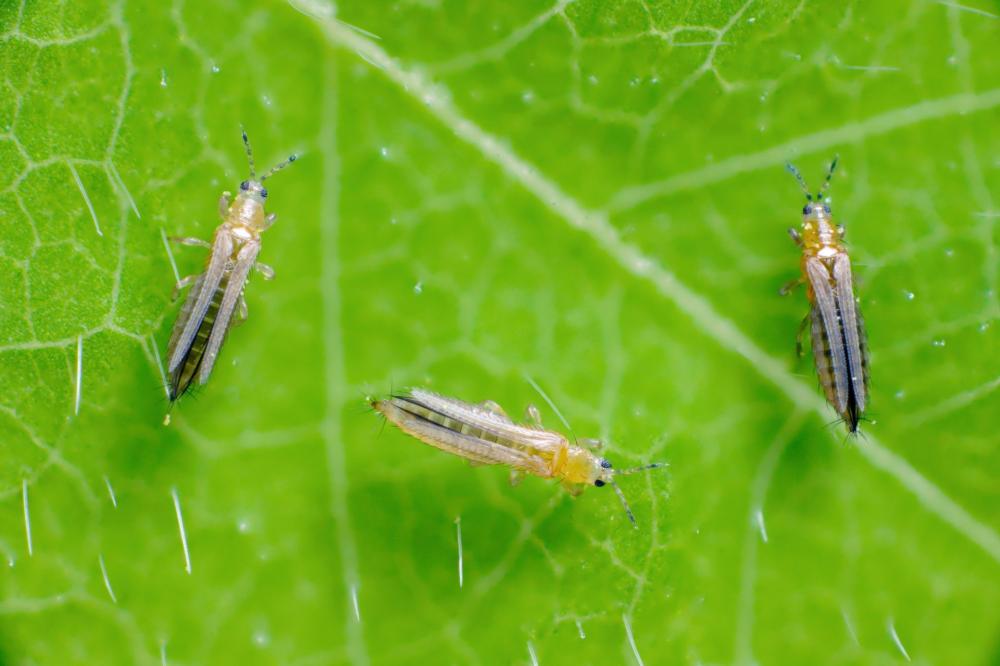

You shake a pepper flower over a white sheet and thin small insects fall and move fast, and you notice shiny silver patches and tiny black dots on the leaves. This is the thrips, an insect less than two millimetres long that hides inside flowers and buds, feeds on plant cells and transmits dangerous viruses like tomato spotted wilt virus (TSWV), so a light infestation becomes a large loss. A part of its cycle in the soil and its quick resistance make it hard to control by repeated spraying with one product. In this guide we explain how to detect it before damage shows, its symptoms on each crop, and how to build a plan combining blue trap monitoring, farm hygiene and the right insecticide with rotation.
The danger of thrips lies not only in the direct damage they cause but also in being a major vector of several plant viruses, such as Tomato spotted wilt virus (TSWV), which leads to heavy losses in sensitive crops. With their rapid reproduction and the possibility of several generations in a single season, controlling thrips becomes a real challenge that calls for integrated management.
Appearance: A tiny, very slender insect (less than 1 mm), yellow or brown, hiding in flowers and buds.
Sign: Silvery or brown patches on leaves and flowers, with deformed fruit and flower drop.
Damage: They suck cell sap and transmit plant viruses such as Tomato spotted wilt virus.
Spread: They multiply in hot, dry weather, and their short life cycle allows a new generation every few weeks.
Rule: Use blue sticky traps for early detection, and rotate active ingredients to avoid resistance.
Symptoms of Infestation
- Silvery patches or pale streaks on leaves caused by sap sucking.
- Leaf curling and dry leaf edges.
- Deformed flowers and poor fruit set.
- Deformed or underdeveloped fruit, such as tomatoes and strawberries.
- Transmission of plant viruses that cause wilting and reduced yield.
- Most affected crops
- Tomato: The crop most susceptible to thrips.
- Pepper: Causes flower drop and poor growth.
- Onion and garlic: Silvery spots and leaf deformation that reduce bulb size.
- Cucumber and zucchini: Poor growth and low fruit set.
- Strawberry: Deformed leaves and fruit.
- Flowering crops and roses: Loss of market value because of deformed flowers.
Thrips Life Cycle
- Eggs: Laid inside leaf or flower tissue and difficult to see.
- Nymphs: Hatch after 3–5 days, feed directly on plant sap, and begin causing damage.
- Pupa: Nymphs move to the soil or sheltered places to pupate, and this stage does not feed.
- Adult: Emerges after about two weeks, measures less than 2 mm, and begins to reproduce rapidly.
- The full thrips life cycle takes about 15–20 days in summer, so it produces repeated generations in a single season and makes control harder.
Economic Damage
- Reduced vegetative growth and lower crop yield.
- Deformed fruit that is hard to market.
- Heavy losses when viruses are transmitted.
- Higher costs for repeated control and difficulty eliminating the pest completely.
Prevention Methods
- Remove surrounding weeds, because they are a main shelter for thrips.
- Install tight insect netting on greenhouses to keep the insect out.
- Plant less susceptible varieties when available.
- Stick to balanced irrigation and fertilization to keep plants strong.
- Use blue sticky traps to monitor infestation early and reduce insect numbers.
How Do You Detect Thrips Early?
- Shake flowers or leaves over a white sheet of paper, and small slender insects will appear and move quickly.
- Use blue or yellow sticky traps to monitor insect numbers before obvious damage appears.
- Shiny silvery patches on leaves with tiny black dots, which are the insect’s droppings.
- Deformed flowers and young fruit, and fruit surfaces turning rough or scaly.
Thrips and Virus Transmission
Direct damage is not the whole story. Some thrips species transmit serious viruses such as Tomato spotted wilt virus, so even a light infestation can affect the crop. That is why early control and removing host weeds around the field are an important part of the plan.
Integrated Control Plan
- Start with weekly monitoring using traps and direct inspection of flowers.
- Clear the field of weeds and plant debris that shelter the insect.
- When infestation appears, spray a suitable insecticide with good coverage of the flowers and the underside of the leaves.
- Repeat the spray after the interval recommended on the label, because stages in the soil and buds are not reached by the first spray.
- Rotate active ingredients, as thrips are known to develop resistance quickly.
Common Mistakes in Thrips Control
- Waiting until obvious symptoms appear on the fruit.
- Spraying too late without covering the flowers and buds.
- Using the same insecticide several times in a row.
- Leaving weeds around the field.
Active Ingredients for Thrips Control
- Spinosad: Use at the rate stated on the label.
- Abamectin: Use at the rate stated on the label.
- Imidacloprid: Use at the rate stated on the label.
- Emamectin benzoate: Use at the rate stated on the label.
- Lambda-cyhalothrin: Use at the rate stated on the label.
Practical Tips for Farmers
- Thrips are very small and hard to see, so inspect leaves regularly, especially the underside.
- Start control as soon as the first symptoms appear, and do not wait.
- Rotate between active ingredients to avoid resistance.
- Combining chemical control with cultural prevention gives the best results.
Thrips Insecticides from Global Brands Available at Orkida
- Radiant 120 SC by Corteva: Insecticide for thrips and caterpillars, 250 ml pack.
- Plesiva Pro by Syngenta: Systemic insecticide for whiteflies, aphids, and thrips, 250 ml pack.
- Exirel 10 SE by FMC: For Tuta absoluta, thrips, aphids, and whiteflies, 250 ml pack.
- Brigadier 200 SC by FMC: For aphids, thrips, whiteflies, and mealybugs, 1 liter pack.
- Biobest Blue Sticky Board: For monitoring and controlling thrips, 10 boards.
You can find all the options in the Thrips Insecticides category. Start with blue traps for early monitoring, and rotate active ingredients to reduce resistance.
How to Read the Blue Traps
Hang blue sticky traps near flowers at plant-top height, replace them weekly and count insects. A rise in count from one week to the next means it is time to spray, even if fruit shows no symptoms yet. Compare counts between field edges and the middle to know where thrips enter.
Why Flowers Must Be Covered When Spraying
Thrips hide inside flowers, between petals and in growth buds, and spray covering leaves only does not reach them. Focus on flowers, buds and the underside of leaves, and repeat the spray at the label interval to target stages that hatch after the first application. Rotate between chemical groups, and visit one of our branches with a photo of the infestation and we will guide you to the right product for your crop.
Frequently Asked Questions About Thrips
How do I tell thrips apart from spider mites?
Thrips are slender insects that fly or jump when disturbed and leave silvery patches and black specks, whereas spider mites spin fine webbing and cause small yellow dots on the leaf.
Do thrips attack flowers and fruit?
Yes. They feed on flowers and young fruit and may cause deformation and scarring, which lowers fruit quality and price.
When should I spray for thrips?
It is best to spray when the insect first appears in monitoring rather than after the damage has spread, while following the dose and interval stated on the label.
Why does spraying sometimes fail?
Because the insect hides inside flowers and buds, part of its life cycle takes place in the soil, and repeating the same insecticide builds resistance.