
Fungal diseases are among the most common problems facing plants in fields and gardens because they spread rapidly and directly affect growth, crop quality, and yield. Many farmers focus on the brand name of the pesticide, while the true factor determining successful control is the active ingredient and its mechanism of action within the plant and fungus. Understanding the active ingredients helps in selecting the appropriate pesticide at the right time and developing a balanced control program that reduces the emergence of resistance and maintains pesticide effectiveness for a longer period.
Before choosing any fungicide, always ask yourself: Where did the disease appear? And how does it spread? Because the answer determines the appropriate substance.
What is the active ingredient in the fungicide?
The active ingredient is the chemical compound directly responsible for affecting the fungus, preventing its growth, or eliminating it. The same active ingredient may be found in multiple commercial products under different names, but the basic mechanism of action remains the same. Therefore, understanding the active ingredient is more important than memorizing product names, because choosing a pesticide depends on its mechanism of action within the plant and the type of disease it targets, not just on the packaging or brand name.
How do fungal diseases appear on plants?
Fungal diseases are not practically divided only by the name of the fungus, but the farmer often notices them according to where the symptoms appear on the plant, and this helps in choosing the correct method of control.
Fungal diseases appearing on the leaves and foliage
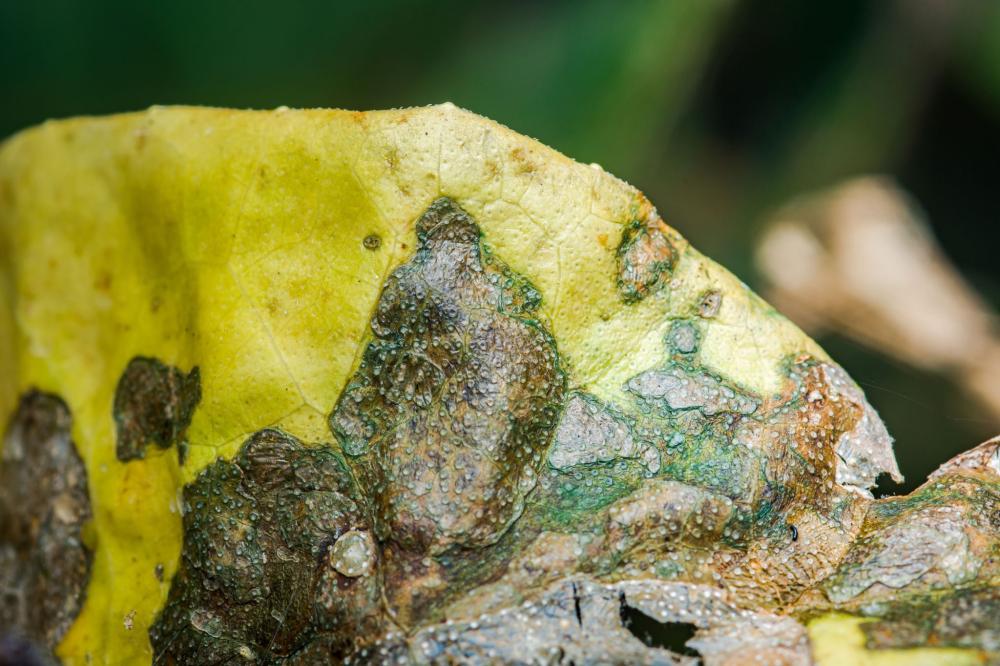
These diseases appear as spots, yellowing, a white coating, or fungal growth on the leaves, and spread rapidly in high humidity and poor ventilation. Examples include powdery mildew, downy mildew, leaf spots, and rust . This type of disease usually requires fungicides that provide good leaf coverage with early preventative or curative action.
Fungal diseases related to roots and soil
Infection often begins in the root zone or at the base of the stem, and symptoms appear as wilting and stunted growth despite the presence of water. The pathogens live in the soil and directly affect the roots' ability to absorb water. Common root rots include Phytophthora, Pythium, Rhizoctonia, Fusarium, Verticillium Wilt, and Sclerotinia . Control depends on improving drainage and using systemic or specialized fungicides that reach the root zone.
Fungal diseases affecting flowers and fruits
These diseases often appear during the flowering stage or near harvest and directly affect crop quality and marketability. Among the most common are gray mold (Botrytis cinerea), fruit rots, blossom blight, black rot, anthracnose, and various other flower and fruit rots . These diseases thrive in high humidity and poor ventilation, or when moisture remains on flowers and fruits for extended periods; therefore, early prevention is crucial for successful control.
Fungal diseases affecting the leg and internal tissues
These diseases include stem rot, stem blight, Fusarium wilt, Verticillium wilt, Sclerotinia stem rot, and Alternaria blight . These diseases affect the plant's internal tissues and can impede the transport of water and nutrients, causing general weakness or plant death if not addressed early. Therefore, close monitoring and a comprehensive protection program are necessary.
Types of active ingredients according to their mechanism of action within the plant
Protective pesticides
It works on the plant surface, forming a protective layer that prevents fungal spore germination and spread. It does not treat infections once they occur, but it is essential in prevention programs, especially before conditions become favorable for disease spread. Some of the most common are mancozeb, copper compounds, sulfur, and chlorothalonil , which are known for reducing the chances of resistance developing.
Systemic pesticides
It is absorbed into the plant and moves with the sap, allowing it to halt the progression of the infection even after it has begun. It is used when symptoms appear or when disease spread is expected, and it has the advantage of being able to reach parts that surface sprays cannot.
Translaminar pesticides
It penetrates the leaf tissue and moves from surface to surface within the leaf itself without fully spreading throughout the plant. It provides strong coverage for foliar diseases and is frequently used in advanced prevention programs.
Just because a pesticide is systemic doesn't mean it's always the strongest. The choice of substance depends more on the stage of the disease and the location of the infection than on the strength of the pesticide alone.
The difference between preventative and curative pesticides
Preventive fungicides stop infection and are used before disease appears, while curative fungicides halt fungal development after infection has begun. The best control programs rely on a combination of both types, not just one.
Why is it important to know the chemical group (FRAC)?
The FRAC classification describes the mechanism of action of the active ingredient within the fungus. Repeated use of the same chemical group leads to resistance and a decrease in the pesticide's effectiveness over time; therefore, a successful program always relies on alternating between different groups, not just changing the product name.
The chemical group refers to the method of action within the fungus, not the strength of the pesticide, so changing the trade name does not mean you have changed the mechanism of action.
How do you link the type of disease to the appropriate active ingredient?
Choosing the right fungicide starts with understanding where the infection is located and what type of disease it is, because each chemical group plays a different role.
Leaf diseases such as powdery mildew and leaf spots often respond to combinations of fungicides like triazole and strobilurin , while root and soil diseases such as Phytophthora and Pythium require specialized agents like phenylamide that can reach the root zone. In contrast, multi-action fungicides such as mancozeb and copper are used as a preventative measure to reduce infection spread and prevent the development of resistance.
Success depends not only on the choice of active ingredient, but also on the timing of spraying and the quality of coverage inside the plant.
Key chemical groups and active ingredients
Triazole Group (Triazoles – FRAC 3)
It works by preventing the formation of the fungal cell wall and is considered one of the most important systemic substances with a therapeutic effect.
Tebuconazole: A systemic agent effective against powdery mildew and rust, and it helps to stop the development of the disease within the plant when used early.
Difenoconazole — Difenoconazole: Effective against leaf spots and diseases and provides a good protection period.
Propiconazole — Propiconazole: Broad-spectrum, rapidly absorbed, and used in several crops.
Hexaconazole: Provides good stability against whitening and rusting in humid conditions.
Myclobutanil: Strong against powdery mildew and is widely used in trees and horticultural crops.
Strobilurins group (Strobilurins – QoI / FRAC 11)
It disrupts fungal respiration within the cell, so its effect is often protective with the ability to slow the development of infection in its early stages.
Azoxystrobin: Broad-spectrum and used against a large number of leaf diseases.
Pyraclostrobin: A powerful substance that helps maintain the vitality of the vegetative system.
Trifloxystrobin: It is characterized by its stability on the leaf surface and is used preventively.
Kresoxim-methyl: Effective against linens and stains when used early.
Picoxystrobin: Suitable for field crops and fast-acting.
Fluoxastrobin: Provides strong leaf protection within advanced programs.
Famoxadone: It is often used in mixtures to increase the spectrum of control.
Phenylamides group (FRAC 4)
A specialized group for combating downy mildew and soil diseases, moving inside the plant to provide strong internal protection.
Metalaxyl: A systemic agent that is very effective against Phytophthora, Pythium and root rots.
Mefenoxam — Similar to metalaxyl but purer and gives higher stability in some formulations.
SDHI Group (FRAC 7)
These are modern groups that disrupt energy production within the mushroom through a different mechanism, making them an excellent choice for alternation and resistance breaking.
Boscalid: Provides good protection against leaf diseases and fruit rots.
Fluxapyroxad: A modern, potent substance with good stability.
Penthiopyrad combines preventive and early therapeutic effects.
Multi-site pesticides
It affects more than one process within the fungus, so it is difficult for fungi to develop resistance to it and it is considered an important basis in prevention programs.
Mancozeb — Mancozeb: A broad-spectrum preventative agent used as the basis for control programs.
Copper compounds: effective against some fungal and bacterial diseases.
Sulfur: An important option for controlling powdery mildew within prevention programs.
How do you choose the active ingredient according to the condition?
In preventative stages, it is preferable to use multi-action fungicides or preventative pesticides to protect the plant before disease appears. At the onset of infection, systemic agents such as triazole are suitable for halting fungal development within the plant. In cases of soilborne diseases and downy mildew, specialized fungicides such as metalaxyl are used, while combinations such as strobilurin and SDHI help maintain foliage health within a balanced program.
Common mistakes in using fungicides
One of the most common mistakes is repeating the same active ingredient or the same FRAC group several times consecutively, leading to resistance and weakened outcomes. Furthermore, relying solely on treatment without prevention makes disease control more difficult and increases management costs.
Technical advice
The best fungal control program begins with prevention, followed by early curative intervention when needed, with continuous rotation between different chemical groups. This approach maintains pesticide effectiveness, reduces crop losses, lowers long-term control costs, and ensures consistent plant protection throughout the season.