
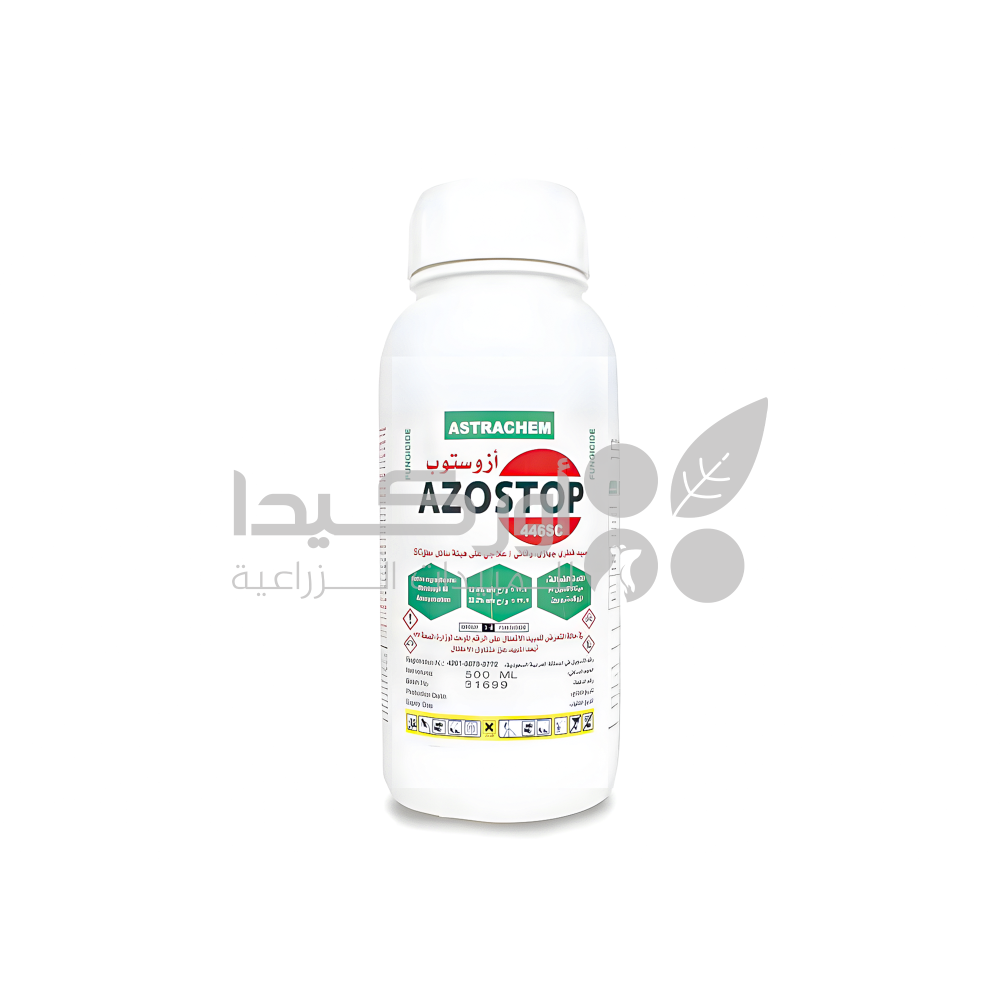

- Azostop 446 SC is a systemic preventive and curative fungicide formulated as a suspension concentrate (SC), containing azoxystrobin 32.2% and metalaxyl-M 12.4%. It was developed to control some of the most damaging soil-borne fungi that attack roots and the stem base, causing damping-off, poor growth and root rot – which reduce plant stand and yield. Combining two active ingredients with different modes of action, it provides broad preventive and curative protection against soil diseases, protects roots during early growth, improves plant establishment after transplanting and supports a strong root system that absorbs water and nutrients more efficiently.
Key Features
- Systemic fungicide specialized in soil and root diseases.
- Contains azoxystrobin and metalaxyl-M for a wider control spectrum.
- Effective against Pythium, which causes damping-off and root rot.
- Effective against Phytophthora, which causes root diseases and wilting.
- Effective against Rhizoctonia solani, which causes root and stem-base rot.
- Provides preventive and curative protection at the same time.
- Helps build a healthy root system and improves plant vigor.
Specifications
- Trade name: AZOSTOP 446 SC
- Type: Systemic fungicide
- Formulation: Suspension concentrate (SC)
- Active ingredient 1: Azoxystrobin 32.2%
- Active ingredient 2: Metalaxyl-M 12.4%
- Mode of action: Systemic – preventive – curative
- Chemical group: Strobilurin + phenylamide
- Manufacturer: ASTRACHEM (Astra Agricultural Chemicals)
- Pack size: 500 ml
Directions for Use
- Vegetables
- Target disease: damping-off caused by Pythium.
- Rate: 0.5–0.75 ml per 1 L of water (equal to 50–75 ml per 100 L of water).
- Application: with irrigation water or as a soil treatment around the roots.
Tomato
- Target disease: Phytophthora.
- Rate: 0.5–0.75 ml per 1 L of water (equal to 50–75 ml per 100 L of water).
- Application: with irrigation water or as a soil treatment around the root zone.
Potato
- Target disease: Rhizoctonia solani.
- Rate: 1.5–2 ml per 1 L of water (equal to 150–200 ml per 100 L of water).
- Application: with irrigation water or as a soil treatment.
When Do You Need Azostop?
- When seedlings die after emergence or right after transplanting.
- When young plants show weakness and stunting.
- When plants turn yellow despite regular irrigation and fertilization.
- When symptoms of root or stem-base rot appear.
- When the same field has a recurring history of soil-borne diseases.
Symptoms It Controls
- Pre- and post-emergence damping-off.
- Root rot.
- Stem-base rot.
- Poor growth and stunting.
- Wilting caused by root damage.
- Yellowing and poor nutrient uptake.
Important Notes
- For best efficacy, the solution must reach the root zone.
- Light irrigation after treatment helps spread the fungicide around the roots.
- Good soil drainage improves control efficiency.
- Avoid overwatering – excess moisture encourages Pythium and Phytophthora.
- Rotate with fungicides from different groups when used repeatedly.
Pre-Harvest Interval
- Vegetables: 1 day before harvest.
- Tomato: before fruit starts to ripen.
- Potato: 14 days before harvest.
Orkida Tip
- If the problem returns every season in the same part of the field, the cause is usually not the fungus alone but also excess soil moisture or poor drainage. Use Azostop early, improve irrigation management and don't leave water standing around the roots for long periods – successful root-rot control starts with the soil before it starts with the fungicide.