
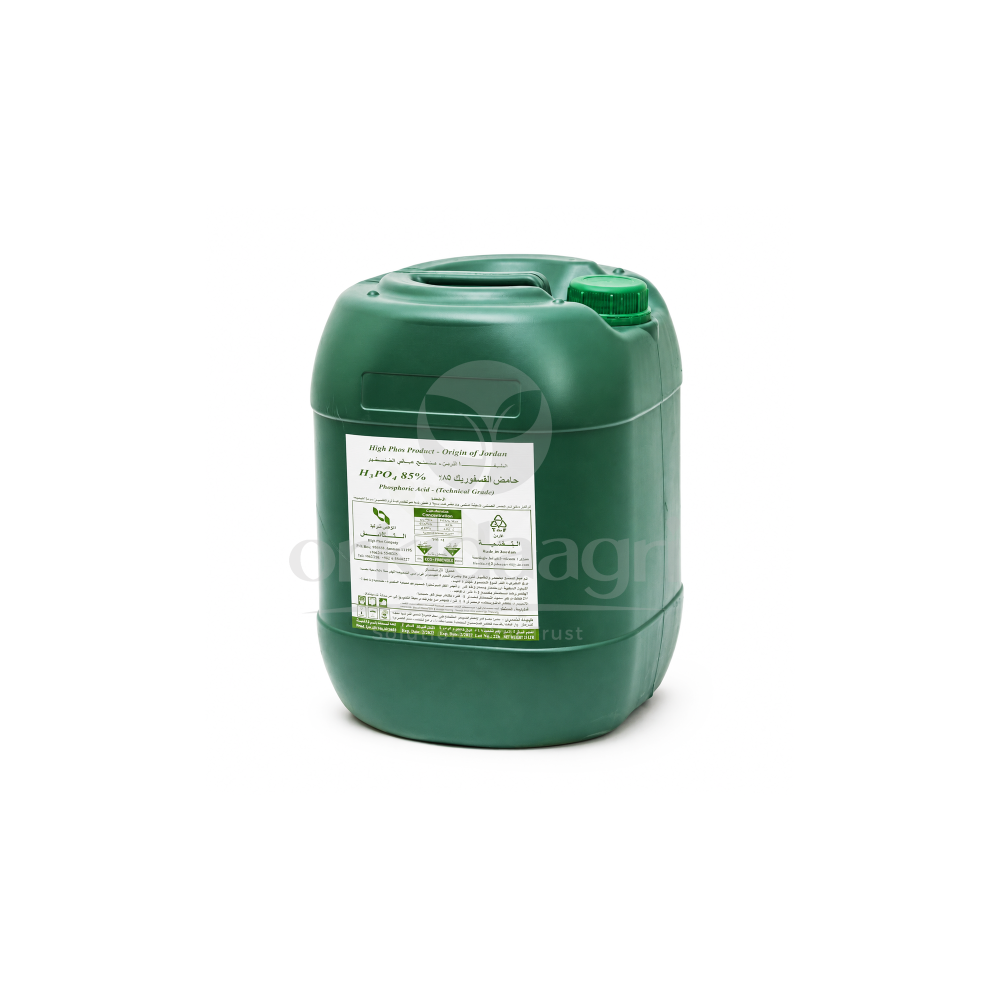
- Al Takamul Phosphoric Acid 85% is a high-phosphorus liquid fertilizer designed to support root growth, stimulate flowering and fruit set, and improve plant growth across a wide range of crops. It contains 85% phosphoric acid (H₃PO₄), equivalent to 61.5% phosphorus pentoxide (P₂O₅), providing a concentrated, fast-acting source of phosphorus at the stages when plant demand peaks. It also helps lower irrigation water pH, improves nutrient availability and reduces lime scale in irrigation networks, raising fertilizer efficiency and boosting growth and yield — especially in the alkaline soils and water common in Saudi Arabia.
Key Features
- Highly concentrated, fast-acting phosphorus source that builds a strong root system and a vigorous start.
- Stimulates flowering and fruit set and supports energy transfer within the plant, improving fruit quality and yield.
- Helps lower irrigation water pH, improving nutrient availability and uptake.
- Helps clean drip lines and emitters of lime scale and salts, keeping the irrigation network efficient.
- Suitable for most crops; dissolves quickly and is easy to apply through different irrigation systems.
- Raises the efficiency of fertilization programs for stronger growth and better crop quality.
Specifications
- Trade name: Al Takamul Phosphoric Acid 85%
- Type: Liquid phosphorus fertilizer
- Composition: Phosphoric acid (H₃PO₄) 85%
- Phosphorus pentoxide (P₂O₅): 61.5%
- Chemical formula: H₃PO₄
- Physical form: Clear liquid
- Grade: Technical Grade
- Density: 1.45 g/mL
- pH: approx. 2
- Application: With irrigation water (fertigation)
- Solubility: Fully water-soluble
- Country of origin: Jordan
- Manufacturer: Technical Company for Compound Fertilizers (TCF)
- Pack size: 17 liters
Suitable Crops
- Vegetables
- Fruit trees
- Date palms
- Cereals and field crops
- Alfalfa and forage crops
- Greenhouse crops
Directions for Use
- Fruit trees – to strengthen roots and improve flowering and fruit set: apply 100 mL per tree with irrigation water every two weeks, depending on tree age and size.
- Vegetables – to support root growth and vegetative growth: apply 1–3 L per hectare with irrigation water, split into several applications across growth stages as needed.
- Forage and alfalfa – to speed regrowth after cutting: apply 2 L per hectare with irrigation water after each cut.
- Cereals and field crops – to support root formation and growth: apply 1–3 L per hectare from the start of tillering to stem elongation.
- To lower irrigation water pH: add gradually to the irrigation water based on a water analysis until the target pH is reached, measuring regularly; avoid random dosing.
Best Timing
- After transplanting.
- At the start of vegetative growth.
- Before flowering.
- After fruit set.
- When phosphorus-deficiency symptoms appear.
- When irrigation water pH needs to be lowered.
Phosphorus Deficiency Symptoms
- Weak root growth.
- Slow vegetative growth.
- Poor flowering and fruit set.
- Stunted plants.
- Poor fruit formation and lower yield.
- Dark green or purplish leaves in some crops.
Compatibility
- Compatible with most water-soluble fertilizers.
- Do not mix directly with calcium-containing fertilizers or alkaline products.
- Run a compatibility test before mixing with any other fertilizer or pesticide.
Precautions
- Apply diluted in irrigation water; never use the concentrate directly.
- Always add acid to water, never water to acid, to avoid a heat reaction.
- Do not use as a foliar spray unless recommended by the manufacturer's instructions or an agronomist.
- Wear gloves and safety goggles during preparation and use.
- Store in a cool, dry, well-ventilated place away from direct sunlight and out of reach of children.
Orkida Tip
- For best results, use Al Takamul Phosphoric Acid 85% within a balanced fertilization program, especially at high-phosphorus-demand stages such as after transplanting, before flowering and after fruit set. Analyze your irrigation water and soil regularly to fine-tune the rate and monitor pH, maximizing nutrient uptake, protecting your irrigation network and improving crop quality and yield.