
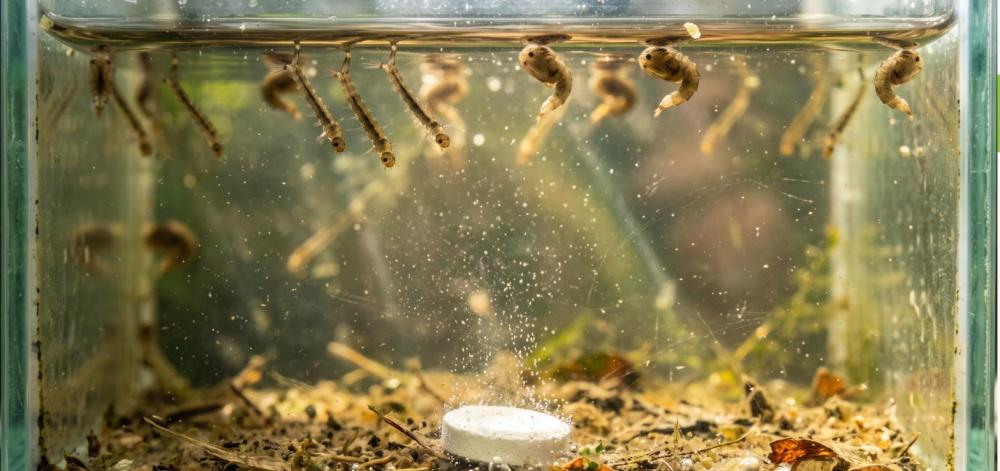

S-methoprene does not kill adult mosquitoes, and it does not even kill the larva straight away. Its job is smarter than that: it stops the larva from completing its development and emerging as a mosquito. That is why it is used in water tanks, basins and stagnant water where mosquitoes breed.
This article explains what S-methoprene is, how it works, where to use it, and how to tell it is working, because its result does not show the same way as a normal insecticide.
- Group: insect growth regulators, juvenile hormone analogues (IRAC group 7A).
- Targets: mosquito larvae in water.
- Result: mosquitoes do not emerge from the water as adults.
- Common forms: tablets that dissolve in water, granules or liquid.
How does S-methoprene work?
The larva grows and turns into a pupa and then an adult mosquito, and this change is controlled by a hormone called juvenile hormone. S-methoprene mimics this hormone and disrupts the growth signals. The larva develops as far as the pupa stage, and then the pupa dies before the mosquito emerges.
So you will not see dead larvae right after applying it, and that is normal.
Where to use it
- Non-drinking water tanks and ground basins.
- Neglected ornamental ponds and fountains.
- Drain openings and inspection chambers with standing water.
- Tyres, barrels and containers where rainwater collects.
- Small marshy spots around farms and rest houses.
How to use it
1. Find the breeding sites
Look for any standing water that stays more than a week. You will see larvae near the surface moving in a wriggling motion, and pupae shaped like a comma.
2. Drain what you can
The first step is always: turn over containers, rinse barrels and drain useless water. S-methoprene is for the water you cannot remove.
3. Add tablets according to the water volume
The amount depends on the volume and depth of the water, and the label sets the number of tablets per volume. Do not use more or less.
4. Repeat on schedule
The tablets work for a set period in the water, and the label states when to retreat. Where water is constantly replaced, you need to retreat sooner.
How do you know it is working?
- Do not judge by the larvae: you may see them moving normally after treatment.
- Watch the pupae and moulted skins: if you see dead pupae and no mosquitoes emerging, the treatment is working.
- Watch adult mosquitoes around the site after about two weeks: they should drop.
Is S-methoprene enough on its own?
No, it is part of a plan:
- For adult mosquitoes already present: spraying or fogging depending on the place.
- For larvae: S-methoprene or Bti bacteria.
- For the source: draining standing water and covering tanks.
Safety
- Do not put it in drinking water unless the label clearly allows it.
- Store the tablets in a dry, locked place away from children.
- Wear gloves when handling them.
Products from Orkida
- Bioprene tablets, 1 kg: water-dissolving tablets with S-methoprene 0.5% for controlling mosquito larvae in tanks, basins and standing water.
Frequently asked questions
Why didn't the larvae die after I added the tablets?
Because S-methoprene does not kill the larva directly. It lets it develop to the pupa, and the pupa is what dies. Wait and watch for mosquito emergence.
What is the difference between it and Bti bacteria?
Bti bacteria kill the larva itself within one to two days. S-methoprene stops the mosquito from emerging from the pupa. Both are used for larval control, and some people rotate between them.
Does it harm fish?
Follow the label for quantity and places, and do not use it in fish ponds unless the label allows it.
How often should I apply it?
According to the duration stated on the label and how often the water is replaced.