
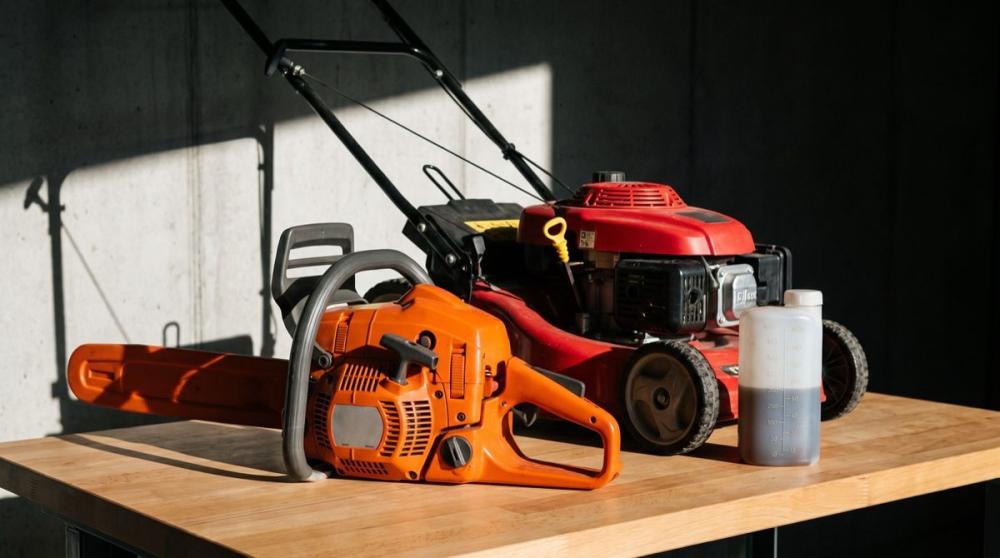

When you buy a chainsaw, a petrol sprayer or a lawn mower, the first question you hear is: is the engine two-stroke or four-stroke? The difference is more than a name. It changes how you fuel the machine, its weight, its noise, its maintenance and how long the engine lasts.
This article explains the difference simply, how to tell which engine you have, how to mix fuel and oil with exact numbers, and which type suits each machine.
How does each engine work?
Two-stroke engine (2T)
It completes its cycle in one revolution of the crankshaft. Every revolution has a power stroke, there are no valves, only ports in the cylinder wall, and lubrication comes from the oil mixed into the petrol itself, so there is no separate oil tank.
Four-stroke engine (4T)
It completes its cycle in two revolutions: intake, compression, combustion and exhaust. It has valves that open and close, a separate oil sump like a car engine, and the petrol goes in pure without mixing.
The difference in daily use
Weight and size
- Two-strokes are lighter and smaller for roughly the same power, which is why you find them on machines you hold in your hands or carry on your back.
- Four-strokes are heavier because of the valves and oil sump.
Working at any angle
- Two-strokes run tilted or even upside down without a problem, because the oil is in the fuel. This matters on a chainsaw that cuts from every angle.
- Traditional four-strokes do not like steep angles, because the oil sits in a sump under the engine.
Fuel and oil
- Two-stroke: you must mix oil into the petrol at the ratio in the manual.
- Four-stroke: pure petrol, with oil in its own tank that you change regularly.
Noise, smoke and fuel use
- Two-strokes are louder and smokier, and use more fuel because part of the mix leaves with the exhaust.
- Four-strokes are quieter, cleaner and more economical.
Power and torque
- Two-strokes deliver high power at high revs, which suits cutting, blowing and spraying.
- Four-strokes have stronger, steadier torque at low revs, which suits long, steady work such as mowing and pumping water.
Maintenance and lifespan
- Two-strokes are simpler with fewer parts, but the wrong mix ruins them quickly.
- Four-strokes last longer with daily use, and their maintenance includes regular oil changes, air filter cleaning and spark plug checks.
How to mix fuel and oil for a two-stroke
The ratio is in the machine's manual. The most common are:
- 1:50 ratio: 20 ml of oil per litre of petrol, meaning 100 ml of oil for 5 litres.
- 1:40 ratio: 25 ml of oil per litre of petrol, meaning 125 ml of oil for 5 litres.
- 1:25 ratio: 40 ml of oil per litre of petrol, meaning 200 ml of oil for 5 litres.
Mixing steps
- Use a clean can dedicated to the mix.
- Pour in half the petrol first, then all the oil.
- Shake the can well, add the rest of the petrol and shake again.
- Write the ratio and date on the can.
- Mix only enough for two weeks to a month at most, because old mix loses quality and causes hard starting.
Which oil should you use?
Oil made for air-cooled two-stroke engines (2T). Do not use car oil, because it does not burn properly and causes carbon on the spark plug and exhaust.
Four-stroke maintenance
- Check the oil level before every start with the dipstick, with the machine on level ground.
- Change the oil according to the manual. For example, the Honda GX160 engine needs its first change after the first month or 20 hours of use, then every 3 months or 50 hours.
- Clean the air filter regularly, especially in dusty conditions.
- Never put two-stroke mix in its tank, as it causes smoke and carbon.
How to tell which engine you have
- Is there a separate oil filler and a dipstick? It is usually a four-stroke.
- Does the fuel cap show a ratio such as 1:50 or 2T? It is a two-stroke.
- Check the manual or the model name, which usually says 2-Stroke or 4-Stroke.
Which type for which machine?
Usually two-stroke
- Chainsaws.
- Petrol backpack sprayers and mist blowers.
- Leaf blowers.
- Brush cutters and grass trimmers.
- Hedge trimmers and earth augers.
Usually four-stroke
- Lawn mowers.
- Petrol water pumps.
- Generators.
- Tillers and cultivators.
Mistakes that ruin the engine
- Pure petrol in a two-stroke: the piston scuffs and seizes within minutes.
- Too much oil in the mix: heavy smoke, a fouled spark plug and loss of power.
- Leaving the mix in the tank for months: it clogs the carburettor.
- Running a four-stroke low on oil: the engine overheats and wears fast.
Products from Orkida
- EFCO Italian Petrol Chainsaw 35 cm, MTH400: a light two-stroke engine for pruning and firewood.
- REDMAX Japanese Petrol Chainsaw 35.2 cc, 40 cm: two-stroke for farms and gardens.
- MARUYAMA Japanese Petrol Backpack Sprayer 25 L, MS0835W: a two-stroke backpack sprayer for farms.
- MARUYAMA Japanese Petrol Backpack Mist Duster 30 L, MD-9030: for dusting and spraying large areas.
- TROY-BILT American Petrol Backpack Leaf Blower 51 cc: two-stroke for cleaning gardens and paths.
- EFCO Italian Petrol Lawn Mower Allroad Plus 4, 196 cc, LR 53 TK: with an Emak four-stroke engine and self-propulsion for large areas.
Frequently Asked Questions
Which is more powerful, two-stroke or four-stroke?
At the same size, a two-stroke gives more power and weighs less. A four-stroke has steadier torque and lasts longer with long daily use.
How much oil for 5 litres of petrol?
At 1:50 you need 100 ml, at 1:40 you need 125 ml, and at 1:25 you need 200 ml. Use the ratio written in your machine's manual.
Can I use car oil in the mix?
No. Use a 2T oil made for air-cooled two-stroke engines.
Why does my two-stroke give off a lot of blue smoke?
Usually there is too much oil in the mix, or the air filter is blocked. Go back to the correct ratio and clean the filter.
Does a four-stroke engine need mixing?
No. It runs on pure petrol, with the oil in its own tank.