
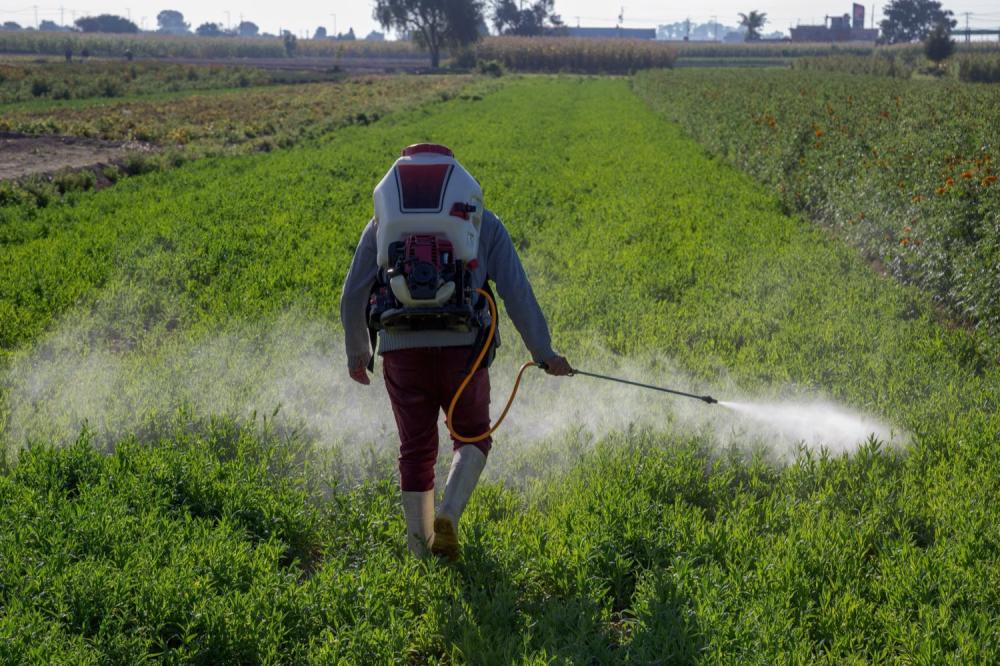

Agricultural pesticides are not one product. There are insecticides, fungicides, miticides for spider mites, and herbicides, and none of them does the job of another. Most of the problems farmers bring to our branches come from the right pesticide used on the wrong pest, or the right pesticide at the wrong timing or rate.
This guide explains the types of agricultural pesticides, the difference between systemic and contact products, what the codes on the label mean, and how to choose and spray the right product for your crop.
Types of agricultural pesticides by target
The first question before buying any pesticide is: what exactly is the pest? The product type is decided by the problem, not by the crop.
Agricultural insecticides
They target insects that suck sap or eat leaves and fruit:
- Sucking insects: aphids, whitefly, thrips and mealybugs. A systemic product usually works best because it reaches the sap they feed on.
- Caterpillars and larvae: leaf and fruit worms, Tuta absoluta and leafminers. They need a product that enters the leaf tissue, or an insect growth regulator that stops larval development.
Full details in our insecticide guide.
Fungicides
They treat fungal diseases such as powdery mildew, downy mildew, blights and root rot.
- Protective: shields the plant before the fungus gets in, sprayed before symptoms or as soon as conditions favour the disease.
- Curative (systemic): enters the plant and stops the fungus after infection has started.
Active ingredients and how each group works are in our fungicide article, and disease symptoms in the plant diseases guide.
Miticides (acaricides)
Red spider mites and other mites are not insects, so many insecticides do not kill them. Some insecticides even kill their natural enemies and make the outbreak worse after spraying.
- Choose a product labelled acaricide or miticide.
- Note that some kill only the mobile stages, while others also kill eggs, which changes how many sprays you need.
Herbicides
They fall into two main groups:
- Non-selective: kill any green plant they touch; used on paths and on land before planting.
- Selective: kill a specific type of weed (grasses or broadleaf weeds) without harming the crop they are registered on.
More in our herbicide article.
Nematicides
Nematodes are microscopic soil worms that cause root galls, weakness and wilting. They are treated through the soil or with irrigation water. See our nematode article.
Systemic vs contact pesticides
- Systemic: absorbed by the plant and carried in the sap, reaching new growth and pests hidden under leaves. Longer-lasting and less affected by washing off.
- Contact: kills only the pests it touches, so it needs full coverage of both leaf surfaces.
- Translaminar: enters the sprayed side of the leaf and reaches the other side, which matters for leafminers and mites under the leaves.
What do the codes on the pesticide label mean?
- EC: emulsifiable concentrate, turns milky in water.
- SC: suspension concentrate, shake the pack well before use.
- WP: wettable powder, pre-mix with a little water first.
- WG or WDG: water-dispersible granules, less dusty than powders.
- SL: soluble liquid, dissolves fully in water.
The number next to the code is the active ingredient concentration, for example 18 means 18 grams per litre, or a percentage when marked with %.
How to choose the right agricultural pesticide
- Identify the pest precisely: photograph the damage up close and check under the leaves. Misdiagnosis is the biggest reason sprays fail.
- Check the crop is on the label: a product registered on tomatoes is not necessarily safe on cucumbers or strawberries.
- Check the pest stage: eggs and young larvae are far easier to control than adults.
- Respect the pre-harvest interval: the time between the last spray and harvest, printed on the label.
- Rotate chemical groups: do not repeat the same active ingredient spray after spray, as pests build resistance quickly, especially whitefly and spider mites.
How to spray agricultural pesticides correctly
- Timing: early morning or before sunset, away from heat and strong wind.
- Rate: stick to the label rate. A higher dose does not work better; it can scorch the plant and speed up resistance.
- Coverage: focus on the underside of the leaves, where most sucking insects and mites live.
- Mixing order: when tank-mixing, fill half the tank with water, add powders and granules (WP, WG) first, then suspensions (SC), then emulsifiable concentrates (EC), and soluble liquids (SL) last. Test the mix in a small jar first.
- Protection: gloves, mask and goggles, and no eating or drinking while spraying.
- Bees: do not spray during flowering if the label warns about bees.
The sprayer also affects the result; see our guide to types of agricultural sprayers.
Common mistakes with agricultural pesticides
- Spraying an insecticide on spider mites and waiting for results.
- Using a curative fungicide after the disease has spread through the whole plant.
- Tank-mixing products without checking they are compatible.
- Repeating the same product every week until it stops working.
- Harvesting before the pre-harvest interval ends.
Products from Orkida
- Vertimec 1.8% EC by Syngenta
- Voliam Targo by Syngenta
- Miravis Duo by Syngenta
- Flint by Bayer
- Previcur Energy by Bayer
- Touchdown by Syngenta
- Fusilade Max by Syngenta
You can also browse each category: agricultural insecticides, fungicides, miticides and herbicides.
Agricultural pesticide FAQs
What is the difference between agricultural and household pesticides?
Agricultural pesticides are registered for use on crops and have a pre-harvest interval, while household (public health) pesticides are for insects inside homes and buildings. Do not use one in place of the other.
Can I mix an insecticide with a fungicide?
Usually yes if the label does not forbid it, but test the mix in a small jar first and follow the mixing order.
How often should I spray?
It depends on the pest and product. Most sucking insects need two sprays 7 to 10 days apart; read the label and rotate active ingredients between sprays.
Why did the pesticide not work?
The most common reasons are misdiagnosis, poor coverage under the leaves, resistance from repeating the same product, or spraying in the heat.