
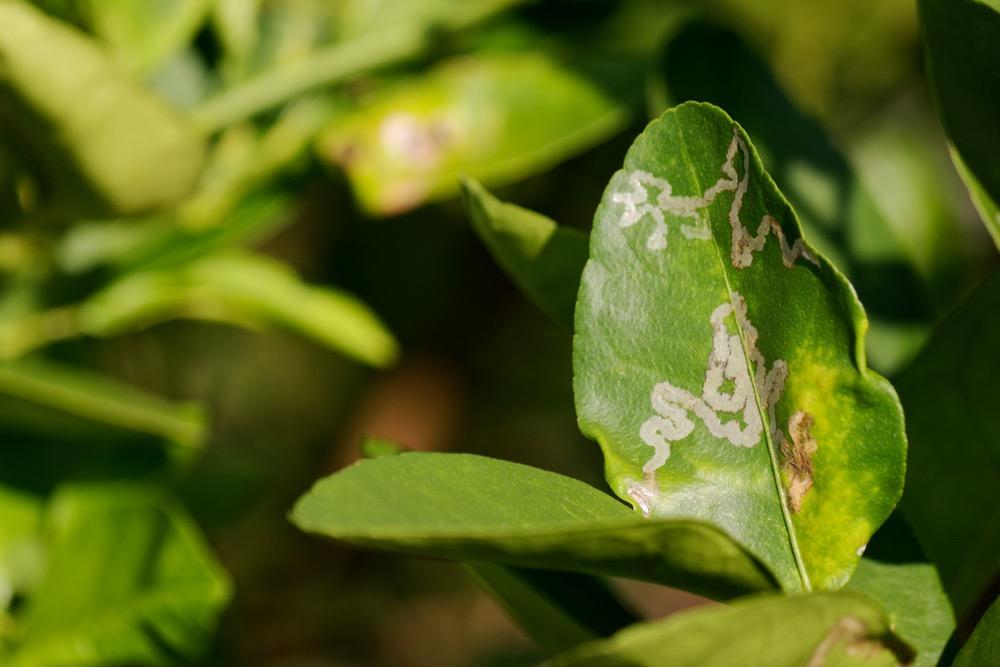

You notice silver winding lines on tomato or cucumber leaves like a drawing, then leaves dry and drop early, and you see no insect on the leaf surface. This is the sign of leaf miners, a small fly that lays eggs inside the leaf so the larvae dig tunnels between its two surfaces, away from any surface spray. They are most dangerous in greenhouses and warm weather where generations follow each other within weeks, and tunnels open the door to fungal disease. In this guide we explain how to recognize infestation early, how to tell it from leaf diseases, when spraying pays off, and how to build a plan combining monitoring, cultural measures and the right insecticide.
The larvae feed inside the leaf tissue, forming winding tunnels that deform the leaves and weaken the plant.
Their danger increases in greenhouses and warm regions, where they multiply quickly and cause large production losses.
Species common in Saudi Arabia include:
- Liriomyza trifolii (American serpentine leafminer) – spreads in greenhouses.
- Liriomyza sativae (vegetable leafminer) – spreads in open fields and tolerates high temperatures.
- These species are found in most regions of the Kingdom, especially Qassim, Riyadh, Jeddah, and Taif, and are among the most dangerous pests of protected vegetables.
Pest: A small fly whose larvae dig fine winding tunnels inside the leaf tissue between the two surfaces.
Sign: Interconnected silvery lines on the leaves, then dry patches and leaf drop in severe infestations.
Damage: They reduce the area available for photosynthesis, so plants weaken and yield drops, and the tunnels open an entry for diseases.
Difficulty: The larvae are protected inside the leaf, so surface spraying is less effective and an insecticide that penetrates the tissue is preferred.
Rule: Sticky traps for the adults, a suitable insecticide for the larvae, and early removal of infested leaves.
Symptoms of Infestation
- You can recognize a leafminer infestation from the following signs:
- The appearance of winding silvery or white lines inside the leaf tissue.
- The presence of small black dots (larval droppings).
- Gradual yellowing and drying of leaves.
- General weakness of the plant and delayed growth or flowering.
- In severe cases, leaf drop and a major decline in yield.
Insect Life Cycle
- The insect passes through four stages:
- Eggs: The female lays eggs inside the leaf, and they hatch within 2–3 days.
- Larva: It digs tunnels inside the leaf and feeds on the plant sap.
- Pupa: The larva pupates in the soil or on the leaf within 5–7 days.
- Adult: A small fly that lives about two weeks and starts a new cycle.
- In hot weather, the insect can complete several generations a month.
Crops at Risk
- Tomato
- Cucumber
- Beans and peas
- Potato
- Onion
- Flowers and ornamental plants
Damage to Plants
- Reduced photosynthesis efficiency.
- Weak growth and early leaf drop.
- Deformed plant appearance and lower crop quality.
- A greater chance of fungal infection because of dryness.
Prevention and Control Methods
- First: Cultural control
- Remove infested leaves early and burn them outside the farm.
- Use insect-proof netting (Mesh 50) in greenhouses.
- Install yellow sticky traps to monitor the adult insect.
- Avoid excessive nitrogen fertilizers.
- Improve ventilation and reduce humidity.
- Inspect seedlings thoroughly before planting.
Second: Chemical Control
- When infestation appears, use insecticides that are effective translaminar (penetrating leaf tissue) or systemic to reach the larvae inside the leaf.
- Rotate between active ingredients to avoid resistance.
- Spinosad (24%)
- Dose: At the rate stated on the label.
- Function: Penetrates the leaf and kills the larvae inside the tunnels.
- Pre-harvest interval: As stated on the label.
- Abamectin (1.8%)
- Dose: At the rate stated on the label.
- Function: Causes rapid paralysis of the insect and stops its feeding.
- Pre-harvest interval: As stated on the label.
- Cyantraniliprole (20%)
- Dose: At the rate stated on the label.
- Function: A modern insecticide from the diamide group that disrupts muscles and stops movement immediately.
- Advantages: Safe for natural enemies and long-lasting.
- Pre-harvest interval: As stated on the label.
- Imidacloprid (35%)
- Dose: At the rate stated on the label.
- Function: A preventive systemic insecticide against sucking insects and leafminers.
- Pre-harvest interval: As stated on the label.
- Spray repetition: According to the interval written on the label and the severity of infestation.
How Do You Tell Leafminers from Leaf Diseases?
- Winding silvery or white tunnels inside the leaf tissue are the clearest sign of infestation.
- When you carefully open a tunnel, you find a small larva and black droppings, which are not found with fungal diseases.
- Small, regularly spaced punctures on the leaf surface are left by females when feeding and laying eggs.
- Leaves dry out and drop early when the infestation density is high.
Why Is the Larva Hard to Reach?
The larva lives inside the leaf between the two layers of tissue, so contact insecticides do not reach it easily. Success therefore depends on targeting the adults before they lay eggs, and on insecticides that enter the leaf tissue or act through local translocation, together with early monitoring using yellow sticky traps.
Practical Control Plan
- Place yellow sticky traps from the start of the season to monitor the insect.
- Remove heavily infested leaves and dispose of them away from the field.
- Start spraying when the first tunnels appear, not after they have spread across the whole plant.
- Choose an insecticide suitable for the crop and follow the dose and interval written on the label.
- Rotate between active ingredients to avoid resistance.
- Clean the field of weeds and residues from the previous crop.
Common Mistakes in Leafminer Control
- Spraying after most leaves are already full of tunnels.
- Using only a contact insecticide against larvae that are inside the leaf.
- Ignoring traps and monitoring.
- Leaving infested leaves in place.
Orkida’s Advice for Farmers
- Because leafminers live inside the leaf tissue, they cannot be eliminated by surface spraying alone.
- We therefore recommend using penetrating or systemic insecticides while rotating between active ingredients.
- Monitor the crop regularly and always inspect the lower leaves, because early detection is the secret to successful control.
Leafminer Insecticides from Global Brands Available at Orkida
- Vertimec 1.8% EC by Syngenta: Insecticide and miticide for mites and leafminers, 250 ml pack.
- Agrimec Gold by Syngenta: Insecticide and miticide for mites and leafminers, 100 ml pack.
- Voliam Targo by Syngenta: Systemic insecticide for Tuta absoluta larvae and leafminers, 250 ml pack.
You can find all the options in the Leafminer Insecticides category. Follow the dose and pre-harvest interval, and rotate active ingredients to reduce resistance.
How to Monitor Leaf Miners Before They Spread
Early monitoring is the cheapest and most effective tool. Hang yellow sticky traps at plant-top height from the start of the season and count adults weekly. A sudden rise means tunnels will appear within days. Inspect a sample of lower and middle leaves weekly and carefully open a tunnel: a larva and black frass inside confirms the infestation.
Crop Hygiene and Infestation
Pupae drop from leaves to the soil, so clearing fallen leaves from greenhouse floors, leaving no residues of the previous crop, and removing weeds that shelter adults all help. Contaminated seedlings are also the first source of infestation on many farms, so inspect them before planting.
When Is Spraying Worthwhile?
Spraying works better when adults first appear in traps and the first tunnels show, not after leaves are full. Choosing a translaminar or systemic product that reaches the larva inside the leaf, rotating active ingredients per the label, reduces resistance and protects natural enemies. If you have a photo of the infestation, visit one of our branches and we will guide you to the right product for your crop.
Frequently Asked Questions About Leafminers
Can a leaf be saved after a tunnel appears?
The infested part of the leaf does not return to normal, but early control protects the new leaves and prevents the infestation from spreading to the rest of the plant.
What is the best time to spray?
At the start of infestation and when adults appear in the traps, while sticking to the right timing in the early morning or evening.
Does the infestation affect the fruit?
It weakens the leaves and lowers the plant’s photosynthesis efficiency, which affects fruit size and quality when the infestation becomes severe.
How do I prevent the insect from returning?
Through field sanitation, removing infested leaves, using traps, rotating between insecticides, and avoiding planting susceptible hosts in the same place season after season.