
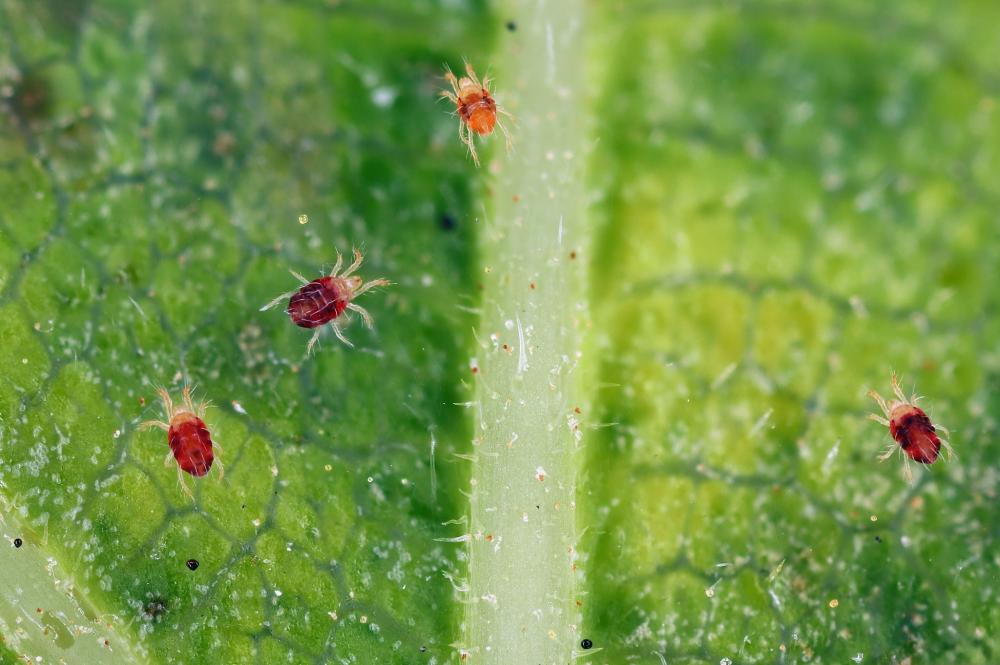

You notice tiny yellow dots on cucumber or strawberry leaves as if pricked with a needle, and if you turn the leaf you find thin silky threads and creatures smaller than a pinhead. This is the red spider mite, not an insect but an arachnid mite, so ordinary insecticide does not work and it needs a dedicated miticide. It thrives in heat and dryness, and numbers multiply within days because its cycle completes in under two weeks, and it builds resistance quickly if the same product is repeated. In this guide we explain its main types, how to detect it early, why it returns, and how to build a plan combining humidity, ventilation, predators and rotation between miticides.
Its danger comes from:
- Its rapid reproduction (repeated generations during the season).
- Its strong activity in hot, dry weather.
- Its attack on vegetable, fruit, and ornamental crops.
- Its production of silken webbing that protects it and helps it spread.
Appearance: A tiny microscopic mite, red or orange, living on the underside of leaves and spinning fine silken webs.
Sign: Fine yellow dots on the leaves, then bronzing and drying, with silken webbing in severe infestations.
Conditions: It spreads quickly in hot, dry weather, and its numbers multiply within a few days.
Damage: It sucks cell sap, which weakens photosynthesis, causes leaves to drop, and lowers fruit quality.
Rule: Spraying the underside of the leaves is important, and rotate between miticides because this pest quickly develops resistance.
Main Types of Spider Mites
- Two-spotted spider mite (Tetranychus urticae)
- The most widespread worldwide. It attacks tomatoes, cucumbers, strawberries, grapes, citrus, and ornamental plants. It is recognized by two dark spots on either side of the body.
- European red mite (Panonychus ulmi)
- Infests apples and grapes. It overwinters as red eggs on branches and is common in temperate regions.
- Citrus red mite (Panonychus citri)
- Specialized on citrus (orange, lemon, grapefruit). It causes yellowing and general weakness of the trees.
- Carmine spider mite (Tetranychus cinnabarinus)
- Spreads on cotton and on crops such as corn, peanuts, and beans. Its color is redder than the two-spotted mite.
- Red mite on palms
- Appears in dry regions. It causes yellowing of the fronds, weak growth, and lower date yield.
How Do You Detect a Spider Mite Infestation on Your Plant?
- Fine yellow dots on the leaf surface.
- Gradual yellowing, then drying and dropping of leaves.
- Thin silken webbing under the leaves or between branches.
- Very small red or orange mites visible to the eye or under a lens.
- General weakness of the plant and a drop in yield.
- Most susceptible crops
- Tomato, cucumber, zucchini.
- Strawberry.
- Grapes.
- Citrus.
- Apples and pears.
- Palms.
- Ornamental plants.
Spider Mite Life Cycle
- Eggs: Small, transparent or red, and they hatch within a few days.
- Nymphs: They start out transparent and then turn yellow or red.
- Adults: Less than 1 mm long, red or orange in color.
- Cycle: Only 10–14 days in summer, leading to repeated generations.
- Some species, such as the European and citrus mites, overwinter as red eggs on branches.
Impact on the Crop
- Reduced ability of the plant to photosynthesize.
- Weak vegetative growth and early leaf drop.
- Lower fruit quality and size.
- High losses in greenhouses and large farms.
Prevention and Ways to Reduce Infestation
- Dispose of infected plant residues after harvest.
- Maintain suitable humidity inside greenhouses.
- Improve ventilation to reduce dry conditions.
- Use natural enemies such as the predatory mite Phytoseiulus persimilis.
- Inspect the underside of leaves regularly to detect infestation early.
Active Ingredients for Spider Mite Control
- Abamectin: Use at the rate stated on the label; kills adults through rapid paralysis.
- Clofentezine: Use at the rate stated on the label; stops eggs from hatching and prevents nymph development (early preventive).
- Hexythiazox: Use at the rate stated on the label; effective against eggs and early larvae and gives long-lasting protection.
- Etoxazole: Use at the rate stated on the label; a growth-inhibiting miticide that prevents nymphs from developing into adults.
- Bifenthrin: Use at the rate stated on the label; a fast contact miticide for adults, suitable when the infestation is severe.
Practical Tips for Farmers
- Rotate active ingredients and do not repeat the same insecticide all season.
- Start with the preventive active ingredients (clofentezine, hexythiazox, etoxazole).
- Use the fast-acting ingredients (abamectin, bifenthrin) when the infestation is severe.
- Focus your spray on the underside of the leaves.
- Repeat the spray according to the interval written on the label and the severity of infestation.
- Relying on integrated control (preventive, biological, and chemical) is the best way to keep it under control.
The White Sheet Test: How to Confirm in a Minute
Place a white sheet under an infested branch and shake it gently, then watch the sheet with a magnifier or the eye: tiny red or yellow dots moving slowly are red spider mites. Do not confuse them with static pollen dust. Focus on lower and middle leaves, and start from the hottest, driest edges in the greenhouse.
Between Prevention and Treatment: When to Act
The most successful times are when the first yellow dots appear and before silk threads show, because threads mean large numbers and all stages are present. Start with materials that stop egg and nymph hatching, then use a fast-acting one when needed, and rotate the group each spray. Because the mite lives under the leaf, focus coverage there. Visit one of our branches with an infested leaf and we will guide you to the right product for your crop.
Spider Mite Control Products from Global Brands Available at Orkida
- Vertimec 1.8% EC by Syngenta: Insecticide and miticide for mites and leafminers, 250 ml pack.
- Agrimec Gold by Syngenta: Insecticide and miticide for mites and leafminers, 100 ml pack.
- Telstar 100 EC by FMC: A miticide, 1 liter pack.
- Athena 118 EW by FMC: A miticide, 500 ml pack.
You can find all the options in the Miticides (Spider Mites) category. Rotate between active ingredients because spider mites develop resistance quickly, and follow the pre-harvest interval.
Frequently Asked Questions About Spider Mites
How do I know a plant has spider mites?
Fine yellow dots on the leaves and thin silken webbing underneath them, then the leaf dries and drops over time. Check the underside of the leaf with a magnifying glass.
When do they spread the most?
In hot, dry weather and low humidity, so infestations increase in summer and inside poorly ventilated greenhouses.
Is a regular insecticide enough?
Usually not. A mite is not an insect but an arachnid, and it needs a dedicated miticide. Read the label carefully and repeat the spray according to the instructions.
Does spraying with water help?
Spraying water on the underside of leaves raises humidity and reduces their activity temporarily, but it is only a helper and does not replace treatment.