
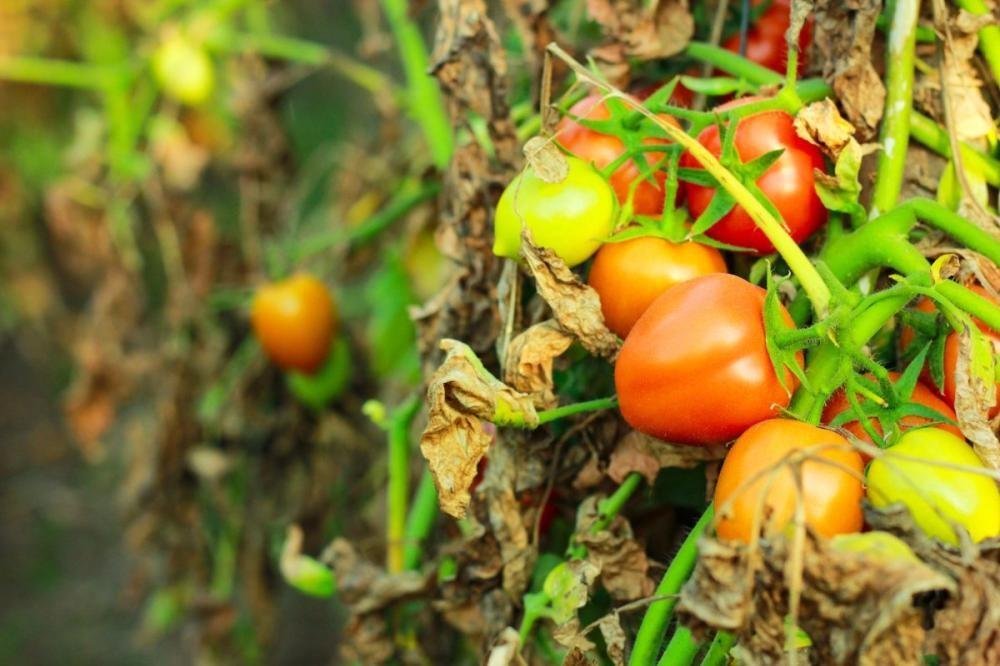

In the greenhouse you notice a single tomato plant whose leaflets have wilted on one side of the leaf only, with scorched margins on the lower leaves surrounded by yellowing, even though irrigation is regular. Two weeks later the same scene repeats in plants along the same row, in the same direction the worker walks while pruning.
This recurring story is the signature of bacterial canker of tomato, one of the most serious tomato diseases in greenhouses, because what spreads it is not wind or insects but the pruning knife and the hand. A plant that already shows canker symptoms cannot be cured; the whole goal is to protect the plants that are not yet infected, and to cut the disease's path to next season.
Disease: Tomato bacterial canker causes small dark spots on leaves and raised lesions on fruit with a white halo.
Transmission: It spreads through contaminated seed, water splash, tools, and touch during pruning and picking.
Conditions: It intensifies in warm, humid weather with overhead irrigation and dense foliage.
Common mistake: Pruning and picking while plants are wet, which spreads the disease from one plant to the next.
Rule: Clean seed, drip irrigation, and disinfected tools, with preventive copper fungicides, are the foundation of protection.
An Enemy That Lives Inside the Vessels
In this article we explain how to tell it apart from other wilt diseases, how it enters the greenhouse, and what to do the day you discover it. But we start with understanding the cause and where it lives inside the plant.
The cause is the bacterium Clavibacter michiganensis (formerly known as C. michiganensis subsp. michiganensis). It enters the plant through wounds, pruning cuts, and natural openings in the leaves, or it arrives ready-made inside the seed, then settles in the xylem vessels that carry water, multiplies there, and forms a sticky layer that blocks the vessels. The result is wilting that worsens over time until the plant collapses.
The disease has two forms that must be distinguished:
- Systemic infection: The bacteria are inside the vessels and spread through the whole plant. It comes from infected seed or transplants, or from pruning and grafting. This is the devastating infection, and nothing removes the bacteria from the vessels.
- Secondary surface infection: Bacteria carried by water splash to the surface of leaves and fruit, causing spots on leaves and "bird's-eye" spots on fruit. It is less damaging, and it is the form that preventive spraying can limit.
The most dangerous thing about this disease is that symptoms can be delayed by two to seven weeks after infection, so transplants carrying the bacteria pass without any sign, and workers spread it throughout this period.
The disease intensifies at temperatures of roughly 24 to 32 degrees Celsius (75 to 90 F) with high humidity, and under suitable conditions symptoms appear within about a week.
Signs That Distinguish Bacterial Canker
Canker symptoms appear on leaves, stems, fruit, and seedlings; the most distinctive are one-sided wilting with scorched margins, discoloration inside the stem, and bird's-eye spots on fruit:
- Leaflet wilting and scorch: Leaflets wilt on one side of the compound leaf or one side of the plant, starting from the lower leaves, with scorched leaf margins (growers call it scorch or firing) that are brown and surrounded by a clear yellow halo, and the leaf curls upward. The leaves die and dry but stay hanging on the plant.
- Secondary-infection spots on leaves: Small, raised white spots like blisters that turn brown.
- Stem cankers: Light streaks on the stem that crack over time into long brown cankers, which is where the disease gets its name.
- Stem-cut test: Cut the stem near the base and you will find yellow to reddish-brown discoloration in the vessels just under the bark, and as the disease advances the pith becomes mealy, granular, or hollow. Press the cut stem: a sticky yellow liquid may ooze out.
- Bird's-eye spots on fruit: Small raised spots about 3 to 6 mm across, with a brown center surrounded by a bright white halo. This is a nearly diagnostic sign of the disease.
- Internal fruit discoloration: Fruit may look marbled or netted, and the inner flesh may turn yellow to brown near the stem end.
- On seedlings: Small raised white spots on the leaves, blackened leaf margins, stunting, and wilting that may end in death. Many infected seedlings show no symptoms even after transplanting.
Do Not Confuse It With
- Fusarium wilt: Yellowing that starts on the lower leaves and often on one side too, with brown discoloration in the vessels, but without the scorched margins with a yellow halo, and without stem cankers or bird's-eye spots on the fruit.
- Bacterial wilt (Ralstonia): Rapid wilting of the whole plant while the leaves are still green. Place a piece of the cut stem in a glass of clear water: if milky white strands stream out into the water within minutes, it is more likely bacterial wilt than canker.
- Bacterial spot and bacterial speck: Spots on leaves and fruit only, without wilting and without vessel infection. The fruit spots of bacterial speck are smaller and lack the white halo.
- Early blight: Brown spots with concentric rings like a target, starting on the lower leaves, and not causing one-sided wilting.
The symptoms are very similar, so when in doubt send a sample (a stem with early symptoms and spotted fruit) to a plant pathology lab to confirm the diagnosis before making big decisions such as removing whole rows.
How It Enters the Greenhouse and How It Spreads
Almost everything starts from an infected seed or transplant. The share of seeds carrying the bacteria may be very low, but a single seed is enough to produce a large number of infected transplants in the nursery, because the bacteria move between seedlings with overhead irrigation, seedling clipping, and handling.
Spread accelerates sharply after grafting, because the graft wound introduces the bacteria directly into the vessels. After transplanting, workers' hands do the rest:
- Pruning and removing suckers and leaves: A knife or fingers that touched an infected plant carry the bacteria to the next plants on the same row.
- Twining and clipping: Twining plants around strings and fixing clips.
- Working on wet plants: Harvesting and working while the plants are wet.
- Water: Water splash from overhead irrigation or rain, and recycled irrigation water in soilless culture.
How long do the bacteria survive? Here is the secret of why it returns every season. US extension references indicate that it survives up to three years in undecomposed tomato plant residue, and up to seven months on stakes and tools.
It lives in infected seed for at least five years, on plastic and concrete surfaces in the greenhouse for at least a month, and in rockwool for at least a year. In soil alone its survival is relatively short, a few weeks, unless the soil contains plant residue.
The Day You Discover Infection: An Action Plan
Because the disease is carried by hands and tools, the plan rests on two things: getting the source of infection out quickly, and changing the way people work so that workers do not carry it to the remaining rows.
Isolating the Infection and Organizing Work
- Mark the infected plants: With colored tape, and identify the suspect rows.
- Remove infected plants with their roots: In sealed bags inside the greenhouse before carrying them out, together with the neighboring plants on the same row even if they look healthy, since they are probably infected without symptoms.
- Change the work order: Workers start each day with the healthy rows, and infected rows come at the end of the day; nobody goes back from them to the healthy rows on the same day.
- The two-knife system: Each worker carries two knives or pruners, working with one while the other sits in disinfectant solution, swapping them between every plant and the next in suspect rows, so the disinfectant has time to kill.
Hygiene, Irrigation, and Preventive Spraying
- Gloves changed or disinfected: And hand washing after touching an infected plant, plus a foot bath at the greenhouse entrance.
- Stop pruning and working on wet plants: And keep pruning and leaf removal in infected rows to a minimum.
- Stop overhead irrigation: Rely on drip, and reduce humidity with ventilation.
- Preventive copper spraying: On healthy plants it reduces secondary infection on leaves and fruit, but it does not reach the bacteria inside the vessels and does not cure an infected plant. Some tomato varieties are sensitive to copper scorch in high heat, so try it on a small number of plants first.
Prevention Starts Before Transplanting
Since most infections start from a seed or transplant, the most important decision is made before any plant enters the greenhouse: where the seeds come from, and how transplants are managed in the nursery.
- Seeds: Buy tested seed free of Clavibacter from a reputable company. For grafted transplants, the seed of both the rootstock and the scion must be tested.
- Do not keep seed from infected plants: If you produce your own seed, hot water treatment at 50 degrees Celsius (122 F) for 25 minutes at a constant temperature reduces the bacteria inside the seed, then the seeds are cooled and dried in the shade. This treatment may reduce germination and seed life, and does not eliminate the bacteria completely, so monitor the seedlings afterward.
- Inspect transplants before accepting them: Reject any batch with blackened leaf margins or wilting, and avoid transplants that were clipped or had their tops cut in the nursery, because this cutting moves the bacteria between seedlings.
- In the nursery: New or disinfected trays, watering from below or by drip instead of overhead sprinkling; the nursery stage is the most important stage for preventing the disease because its conditions are ideal for spread.
Between Two Seasons: Do Not Hand the Disease to the Next Crop
The bacteria live a long time in residues, tools, and growing media, so cleaning between seasons is what prevents their return. These are the steps after the last harvest:
- Remove residues: Pull out the plants with their roots after the last harvest, and take all residues out of the greenhouse; do not leave them to decompose inside.
- Strings and supports: Dispose of used strings and clips, and wooden stakes, because porous wood cannot be reliably disinfected.
- Growing medium: Replace the rockwool and growing medium, and do not reuse it after a season with infection.
- Wash, then disinfect: Wash the structure, floors, benches, drip lines, and tanks with water and detergent to remove organic matter, then disinfect them.
- Crop rotation: Rotate away from tomato, pepper, eggplant, and potato for at least two to three years in open fields, and get rid of weeds of the nightshade family such as black nightshade, and volunteer tomato plants.
What Control Is Available, and What Does Not Work
There are currently no tomato varieties resistant to bacterial canker on the market, and chemical options are very limited: copper compounds to limit secondary infection, and in some countries agricultural antibiotics registered for transplants only; all are preventive, not curative.
So your strongest weapon remains cleanliness and disinfection, with copper coming after it as protection. This is what we rely on at Orkida for this disease:
- Virkon S (5 kg): From LANXESS, an oxidizing disinfectant based on potassium peroxymonosulfate that kills bacteria, fungi, and viruses on surfaces and equipment. We use it at the concentration written on the label for dip solutions for knives and pruners in the two-knife system, for foot baths at entrances, and for disinfecting trays, benches, harvest carts, the structure, and floors between seasons. The solution is prepared fresh and renewed during work, and it is not sprayed on plants.
- Virkon S 10 kg: The same disinfectant in a larger pack, more economical for farms with several greenhouses where foot baths and dip solutions are prepared daily and a thorough disinfection is done between seasons.
- Kudos: From Cosaco (USA), copper hydroxide 53.8% (FRAC M1). Copper ions kill bacteria on the leaf and fruit surface before they enter through wounds and natural openings, so we use it as a preventive spray on healthy plants in rows next to the infection and after pruning, every 10 to 14 days, at the dose written on the label for tomato. Its role is to reduce secondary infection and bird's-eye spots on fruit, not to cure a plant whose vessels the bacteria have reached.
For any preventive copper spray, following the label dose and the pre-harvest interval is what protects the plant from scorch and the fruit from residues.
Frequently Asked Questions About Tomato Bacterial Canker
Can an infected tomato plant be treated?
No. The bacteria live in the water-carrying vessels and no pesticide reaches them. An infected plant is a source of infection for its neighbors, and removing it along with the adjacent plants is the right decision, especially in greenhouses.
Are tomatoes with bird's-eye spots safe to eat?
The bacteria do not make people sick, and the spots are mostly superficial, so the fruit is edible but loses its market value. Do not use it to extract seed.
Does bacterial canker affect pepper?
Yes, it also affects pepper and eggplant although tomato suffers the most, so switching from tomato to pepper is not enough as a crop rotation.
Is a chlorine solution enough to disinfect pruners?
Diluted household bleach is effective if fresh and the tool is left in it for at least a minute, but it loses strength quickly in the presence of organic matter and corrodes metals. Oxidizing disinfectants made for the purpose are better suited to daily use.
If the disease appears this season, will it return next season?
It will if residues, strings, stakes, and old growing medium remain. The bacteria live in residues for up to three years, but thorough cleaning, disinfection, replacing the medium, and changing the seed source cut the cycle.
Why does the disease appear on a single row in the greenhouse?
Because the worker walks along the row and prunes one plant after another with the same knife. Infection spreading along the row in the direction of work is a strong sign that the disease is moving by tools and hands.
You will find the rest of crop diseases and pests in the Pest Library.