
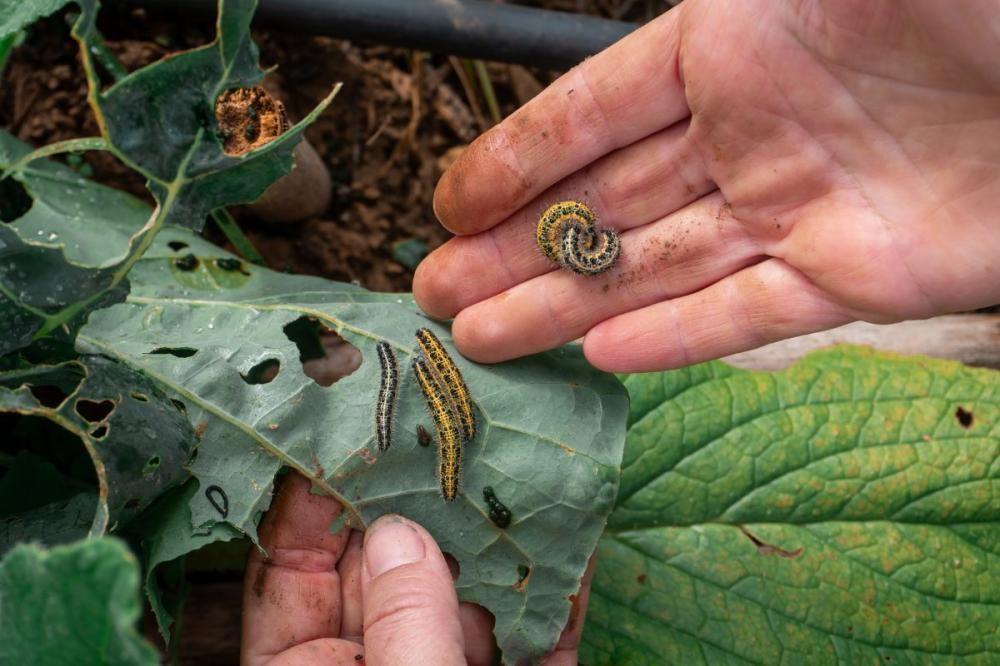

A cabbage and cauliflower grower stands in front of his field and finds small transparent windows in the leaves, while thin green larvae wriggle and dangle on a silk thread whenever the leaf is touched. Last week's spray seemed to work, and today the numbers are higher than before. This is the picture of the diamondback moth (Diamondback moth), scientific name Plutella xylostella, which many people in the field call the cabbage worm.
The danger of this pest is not its size or the amount of leaf it eats, but its unique ability to acquire resistance. Resistance has been recorded to pesticides from many groups around the world, so success with it does not come from choosing a stronger pesticide, but from spray timing, rotation of groups and protecting natural enemies.
The pests: The diamondback moth and the cabbage worm. Their larvae feed on cabbage, cauliflower and broccoli leaves and leave holes and residues.
Damage: Holes and transparent windows in the leaves and damage to the inner heart of the plant, which lowers crop quality and value.
Why control fails: The diamondback moth develops resistance quickly to repeated pesticides, so treatment fails when the same pesticide is repeated.
The solution: Rotate pesticides between different groups and combine biological control with timing the spray against the young stages.
The rule: Scout the field weekly by taking samples, and intervene at an economic threshold, not on a fixed schedule.
How Do You Recognize the Diamondback Moth and Its Larvae?
The damage caused by cabbage worms is similar, and knowing the culprit changes the treatment. The most important features of this pest:
- The moth: A small grayish-brown moth about one centimeter long. It folds its wings over its body like a roof, and at rest three light diamond-shaped spots show on its back, which is where its name came from.
- The larva: Pale green to yellowish, about one centimeter long, tapered at both ends, with a pair of prolegs at the rear forming a V shape. When touched it wriggles violently and drops dangling on a silk thread.
- The eggs: Small and oval, about half a millimeter, laid singly or in small groups on the underside of leaves, and hard to see without a hand lens.
- The pupa: A light white netted cocoon on the lower leaves or the stalks, often seen on the outer leaves of cabbage.
The name cabbage worm is also applied to other pests such as the imported cabbageworm and the cabbage looper, which are larger and make big holes in the leaves, while the diamondback moth eats the lower layer and leaves the upper skin transparent.
Life Cycle: Why Do Numbers Multiply in a Few Weeks?
The cycle is very short in warm weather, which is what makes the infestation jump from a few individuals to crowding within a month. The pest passes through the following stages:
- The egg: Hatches in about 3 days in hot weather and may take up to 8 days in cool weather.
- The larva: Feeds through four instars, the first of which mines inside the leaf tissue (a tiny mine), then it comes out to feed on the lower surface.
- The pupa: Pupates on the leaves after one to two weeks of feeding.
- The moth: Emerges 5 to 10 days after pupation and lays eggs from about the first night.
The cycle is completed in less than 20 days in hot, dry weather, and the pest has between 4 and 6 generations a year in warm regions, with overlapping generations, so you see eggs, larvae and pupae in one field at the same time.
What Does It Do to Your Crop?
In the early stages the larvae prefer the tender outer leaves, but they move to the heart if numbers increase, and the damage differs by crop and stage:
- Leaf windows: The larva eats the lower surface between the veins and leaves the transparent upper epidermis, so the leaf looks like it has a glass window.
- Young cabbage: They eat the growing tip, so heads stop forming or form multiple weak heads.
- Cauliflower and broccoli: The larvae enter the curds and heads and contaminate them, making them hard to market even when few in number.
- Arugula, radish and mustard: Perforated leaves lose their market value because they are eaten whole, and tolerance for larvae here is zero.
University extension trials indicate that light infestation of the outer cabbage leaves may not affect the inner head, while infestation in seedlings or curds is a direct loss.
Why Do the Pesticides That Worked Last Year Fail?
The pest has a short cycle and many generations and is exposed in the field to repeated spray pressure, so resistant individuals accumulate generation after generation. So the conclusion from field trials has been clear:
- Old resistance: Wide resistance has been recorded to organophosphates, pyrethroids and carbamates, so we do not rely on them in cabbage programs.
- Bt resistance: Resistance to Bacillus thuringiensis bacteria has appeared in some regions, so it is not used alone or in every spray.
- Transfer with seedlings: Resistant larvae move with seedlings, and a resistant strain may enter your farm from another nursery.
- Killing natural enemies: Indiscriminate spraying kills the parasitic wasps, and the pest then explodes after the spray.
The solution that works is rotation between different IRAC groups so that no single generation is exposed to the same mode of action twice, while targeting only the young larval instars.
Monitoring and the Action Threshold
Spraying by schedule instead of by need is the fastest route to creating resistance, so we rely on a real count in the field before any decision:
- Plant inspection: Choose 25 plants spread along the two diagonals of the field and turn over the lower leaves looking for eggs and young larvae.
- Pheromone traps: They reveal the start of moth flight so you know when to begin intensive inspection, but they do not replace counting larvae.
- Guideline thresholds: University of Wisconsin programs use the percentage of plants infested with any lepidopteran larva: 10 percent in the nursery and from head formation until harvest, and 30 percent from transplanting until heading.
- Natural enemies: If you see the striped cocoons of the Diadegma wasp or parasitized eggs, the field may be controlling the pest itself, so postpone spraying.
The Integrated Control Plan
The most successful fields combine agricultural prevention, biological control and targeted spraying, and this is our plan in order:
- Buy clean seedlings: Inspect them before transplanting and return seedlings that carry larvae.
- Remove cruciferous weeds: Wild mustard and its relatives harbor the pest between seasons, so remove them weeks before transplanting.
- Use netting or covers: In small areas floating row covers protect seedlings in their first weeks.
- Protect natural enemies: Parasitic wasps (Diadegma) and egg parasitoids (Trichogramma) are essential, and they are affected by pyrethroids.
- Start with the least harmful: Bt on young instars early in the season, then modern selective pesticides when the threshold is exceeded.
- Change the group every generation: Do not repeat Group 28 (diamides) more than two consecutive sprays, then move to a different group.
- Destroy residues: Turn over crop residues right after harvest so they do not become an incubator for the next generation.
And follow the label dose and the pre-harvest interval, especially in leafy crops eaten fresh.
Common Mistakes in Spraying Cabbage and Cauliflower
Much of the failure attributed to the pesticide is caused by the spray method, since cabbage leaves are waxy and repel water, and the larvae hide in places the spray does not reach.
- Spraying only the upper surface: The larvae and eggs are on the lower surface and in the heart of the plant, so direct the nozzle downward and inward.
- Neglecting the spreader: The waxy leaf makes droplets slide off, so we add a suitable spreader-sticker to improve coverage and adhesion.
- Spraying after the instar changes: The large larva is less sensitive, so spraying the first instars saves half the effort.
- Spraying at midday: We prefer evening or early morning because the moths are active at night and the pesticide persists longer on the leaf.
- Mixing pesticides without a purpose: Random mixing doubles the exposure of natural enemies and does not improve the result.
Products We Rely On in Diamondback Moth Programs
We build the program on four different groups that we rotate between, and we place the one least harmful to natural enemies early in the season. All of them act on young instars, so the timing of the spray matters more than the product name.
- Coragen 20 SC (FMC): Chlorantraniliprole from Group 28 paralyzes the larva's muscles and stops its feeding within minutes, and we use it as the first spray when the count exceeds the threshold on young instars.
- Exirel 10 SE (FMC): Cyantraniliprole from Group 28 as well, and it helps when sucking insects such as aphids, thrips and whiteflies accompany the diamondback moth in cabbage, cauliflower and broccoli.
- Fulium Targo 063 (Syngenta): A mixture of chlorantraniliprole with abamectin, giving two modes of action in one spray, and it suits cases where the infestation is late and the instars overlap.
- Radient 120 SC (Corteva): Spinetoram from Group 5, which we use for rotation after the diamides, and it is relatively safe for beneficial insects when used at the right time.
- Runner 24 SC (Corteva): Methoxyfenozide, a Group 18 growth regulator that stops larval feeding and pushes them into a fatal premature molt, and it is a good rotation link after the previous groups.
- Inex (Cosmocel): A spreader-sticker that we add to the spray mix on cabbage and cauliflower to improve droplet spread on the waxy surface and its adhesion.
For similar pests that attack vegetables alongside it, you can review the articles on Cotton Leafworm, Tuta absoluta and Aphids, since many programs are shared between them.
Frequently Asked Questions
Is the diamondback moth the same as the cabbage worm?
It is the best known of what farmers call the cabbage worm, but the name also includes other, larger pests. The distinction is that the diamondback moth leaves transparent windows, not large holes.
Which crops does it attack?
All cruciferous crops: cabbage, cauliflower, broccoli, arugula, radish, turnip and mustard.
Why does it come back days after spraying?
Because the eggs and pupae are not affected by many pesticides, and a new generation emerges quickly. So it needs follow-up and repeated spraying according to the count, not the calendar.
Is Bt enough on its own?
It works well on young instars and is safe for natural enemies, but it is not used alone all season because resistance to it has been documented in some regions.
Does it move with seedlings?
Yes, and it is one of the most important ways resistant strains enter farms. Inspect seedlings and refuse any that carry larvae.
Does summer planting tolerate this pest?
Hot, dry weather after a warm winter speeds up generations and increases pressure, so it is preferable to plant in the periods of lower pressure and for the grower to be strict with monitoring.
Do net covers help?
Yes, in small areas and nurseries, because they prevent moths from reaching the seedlings, provided their edges are well sealed and they do not trap infested seedlings inside.
When is spraying necessary?
When the number of infested plants exceeds the guideline threshold for the crop stage, and after confirming the absence of natural enemies in the field.