
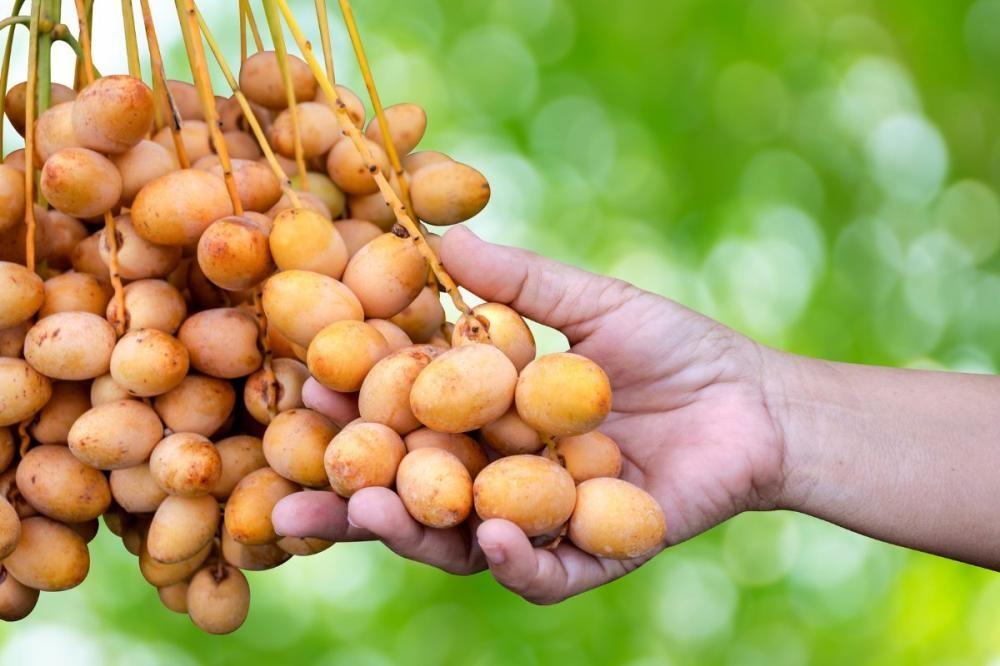

In the heat of summer, while the dates are still small and green, a palm grower notices that some bunches look covered in a layer of dust that the wind will not blow away. Looking closer, he finds a dense, silky gray web between the strands and the fruit, soil stuck to it, and beneath the web, fruit whose skin has turned a rough brown, as if scorched.
This is a dust mite infestation, also called the date palm dust mite, scientific name Oligonychus afrasiaticus, known in North Africa as "boufaroua." The loss here is directly in the product itself: infested fruit develops hard, cracked, shriveled skin, loses its commercial grade, and may become unsellable. The problem is that many people dismiss it as simple "dust" and leave it until the window for treatment has passed.
Pest: The date palm dust mite is a tiny arachnid that spins silky threads over the fruit and feeds on the skin of the dates.
Sign: White dust or silky webbing on the bunch and fruit, with cracked or shriveled fruit turning brown.
Conditions: It thrives in hot, dry weather with little rain and weakens with humidity and rain.
Timing: Infestation starts before the dates ripen and intensifies until harvest, so inspect bunches regularly from fruit set.
Rule: Washing or wetting the bunches, thinning the bunch, and treating early protect the crop better than late treatment.
Is It the Same as the Red Spider Mite? The Difference That Changes Control
The dust mite and the red spider mite belong to the same family, the spider mites (Tetranychidae), so both spin webbing, suck out cell contents, and multiply quickly in the heat. But the practical differences matter:
- Species: The red spider mite that attacks vegetables and ornamentals is usually the two-spotted spider mite (Tetranychus urticae). The date palm dust mite is a different, specialized species, Oligonychus afrasiaticus. In some palm-growing regions of the Americas, a close relative, Oligonychus pratensis, causes similar symptoms.
- Color: The dust mite is very small (under half a millimeter) and pale green to yellowish. It does not show the red color people expect, which is why many never connect it with spider mites at all.
- Where it lives: The red spider mite lives on the underside of leaves and leaves yellow stippling. The dust mite's economic damage is concentrated on green fruit and fruit strands, with only small numbers on the leaflets.
- Webbing: Red spider mite webbing is thin and relatively clean on the leaves. Dust mite webbing is dense and gray, trapping dust and sand to form a cover that protects the colony from natural enemies and from spraying.
- Timing: Dust mite infestation is tied to the kimri stage (green, hard fruit) in summer and declines on its own once the fruit starts to color.
If your problem is on tomatoes, cucumbers, eggplants, or roses, the right article is red spider mite. This article is only about date palm bunches.
When Does It Start and When Does It Stop? The Infestation Calendar on the Palm
The mite spends winter and spring in small numbers on the leaflets and on plants and weeds under the palms. As temperatures rise in late spring and early summer, it moves to the green bunches.
In a study of palm oases in Tunisia, fruit infestation began between the first and third week of July, while references from Iraq place it from mid-May to June. It varies by region and temperature. The infestation passes through three stages on the bunch:
- Kimri stage (green, hard fruit): Numbers multiply rapidly here. This is the real danger stage.
- Khalal stage (fruit turning yellow or red): Infestation drops noticeably because the fruit contains less water and more sugar, making it less suitable for the mite.
- Autumn: The mite leaves the bunches for the leaflets and ground vegetation under the palms as temperatures fall.
This means the control window is short and well defined: from the first appearance of webbing on green fruit until the start of coloring. Spraying after the fruit has colored is usually pointless, because the damage is done and the mite is already declining.
Conditions the Dust Mite Loves
Not all orchards are equally affected. Some conditions make an orchard ideal for dust mite reproduction:
- Intense heat and dryness: Average temperatures around 32 degrees Celsius (about 90 F) in July and August are very favorable for its reproduction.
- Dust: Orchards near dirt roads or open ground get more dust, and dust protects the colonies under the webbing and weakens natural enemies.
- Wind: Researchers noted that the mite reaches the bunches more by air than by crawling up the supports, which is why sticky bands on the supports did not stop it from reaching the fruit.
- Host plants under the palms: Sorghum, eggplant, watermelon, and some weeds under the palms can be an early source of infestation.
How to Inspect Your Bunches
Because the control window is short, regular inspection is what determines the moment to act. Follow these steps:
- Timing: Start inspecting a few weeks after fruit set, then weekly from the beginning of summer until the fruit colors.
- Location: Focus on bunches on the side exposed to dust and wind, and on palms near dirt roads.
- Signs: Look for gray webbing between the fruit and at the base of the strands, then run a white tissue over the fruit: if tiny moving yellowish-green dots or colored streaks appear, the infestation is active. A 10x hand lens makes the diagnosis certain.
- Hot spots: Record the infested palms first. Infestation often starts on a few palms and then spreads, and early action on hot spots saves spraying the whole orchard.
Control: Orchard Hygiene First, Then Spraying at the Right Time
A pesticide alone is not enough against a pest that shelters under a layer of dust and webbing. So we start by improving the orchard environment, then support natural enemies, then spray within the kimri window.
Reducing Dust and Improving the Orchard Environment
- Windbreaks and wetting roads: Windbreaks around the orchard and watering the internal dirt roads in summer reduce the dust that protects the mite.
- Managing ground cover under the palms: Avoid intercrops that host the mite in spring, and remove host weeds before the infestation season.
- Washing infested bunches: On low palms and home palms, washing infested bunches with water at suitable pressure removes much of the webbing and dust and exposes the colonies. It makes the following spray more effective because the pesticide reaches the mite instead of stopping on a layer of dirt.
- Removing dry fronds: Remove dry fronds and old bunches left over from the previous season.
Natural Enemies
In dry, dusty conditions, natural predators on the bunches decline. A trial in southern Tunisia showed that releasing the predatory mite Neoseiulus californicus significantly reduced dust mite numbers, with a recommendation to release early in the season. This is an option for large farms that work with biological control companies.
Sulfur: The Traditional Method and Its Limits
Dusting or spraying bunches with sulfur is one of the oldest methods, but the Tunisian study recorded inconsistent results: numbers dropped after dusting and then returned within a week in some years, with no clear effect in others, and sulfur may harm predators.
For this reason we do not rely on it alone, and we do not use it in extreme heat because it can burn plant tissue.
Acaricides in the Kimri Window
Start spraying at the first appearance of webbing on green fruit, with full coverage of the bunch from all sides, and repeat after 10 to 14 days if new webbing continues. Spraying bunches that are covered in dust without washing them first wastes a large part of the pesticide on the dirt.
The Products We Rely On for Dust Mite
At Orkida Agri, for dust mite we rely on specialized acaricides applied at the kimri stage, together with a sprayer that helps wash the bunches and drive the spray between the strands:
- Vertimec 1.8% EC by Syngenta: abamectin 18 g/L, IRAC Group 6. It works by contact and ingestion and penetrates plant tissue, so it stays active for days and is not easily washed off by moisture. It needs about 3 to 4 days to reach full effect, so do not judge the result the next day. We use it as the first spray when webbing appears on green fruit.
- Agrimec Gold 8.4% by Syngenta: abamectin at a higher concentration, so a small amount is enough for a large tank, which suits growers who spray many palms. It has the same active ingredient as Vertimec, so choose one or the other, and do not count switching between them as rotation.
- Athena 118 EW by FMC: bifenthrin 10% with abamectin 1.8%. Date palm is among its labeled crops, with a pre-harvest interval of 7 to 21 days depending on the crop. We prefer it in orchards where dust mite occurs together with other sucking insects such as dubas bug in late spring, because bifenthrin adds fast contact action on insects while abamectin takes care of the mite.
- Eco Spray 20-Liter Electric Backpack Sprayer, Turbo Model: for washing bunches with water and then spraying low palms, offshoots, and home palms. The electric pump gives steady pressure that drives the spray between the strands, and the agitation system keeps the solution uniform. Tall palms need motorized sprayers that reach the crown.
Mites are among the fastest pests to develop resistance, so do not make more than two sprays with the same active ingredient in a season, and combine spraying with washing and dust reduction instead of relying on the pesticide alone.
Dates are eaten directly without cooking, so follow the dose written on the label and the pre-harvest interval. The advantage here is that spraying is done at the kimri stage, which is usually long before harvest.
Common Mistakes We See
Most control failures with dust mite come from late diagnosis or wrong spraying:
- Treating the webbing as ordinary dust: Ordinary dust blows away with the wind, but dust stuck to webbing between the fruit is a sign of infestation.
- Spraying after the dates color: It is too late, the damage is done, and the mite is declining naturally at this stage.
- Using an ordinary insecticide: Many insecticides do not kill mites, and some kill their natural enemies, which makes the problem worse.
- Spraying one side of the bunch: The colonies are inside the bunch and under the webbing, and incomplete coverage means a quick return.
Frequently Asked Questions
What is the difference between the dust mite and the red spider mite?
Both are spider mites, but the dust mite is a species specialized on date palms (Oligonychus afrasiaticus). It is pale green, attacks green fruit in summer, and spins dense webbing that traps dust. The two-spotted red spider mite attacks the leaves of vegetables and ornamentals and leaves yellow stippling on them.
Is infested fruit safe to eat?
Heavily infested fruit develops hard, cracked skin and lower taste and quality, and is usually sorted out from the good dates. The mite itself does not harm people, but the damage is to quality and market value.
When should I spray palms against the dust mite?
At the first appearance of webbing on green fruit in the kimri stage, usually at the beginning of summer, and repeat after 10 to 14 days if new webbing appears. Do not wait until the fruit colors.
Is dusting with sulfur enough?
Sulfur is a traditional method, but studies show inconsistent results, and numbers may return within a week of dusting. It is better to combine washing the bunches and reducing dust with a specialized acaricide at the right time.
Why does one palm get infested more than others?
Usually because it is closer to a source of dust or wind, because there are plants under it that host the mite, or because its variety is more sensitive. Always start your inspection with these palms, because they warn you that the season is beginning.
Is the dust mite the same as the house dust mite?
No. The house dust mite is a microscopic organism that lives in upholstery, feeds on skin flakes, and causes allergies. It has nothing to do with palms. For anyone looking for it, there is a dedicated article: house dust mites.