
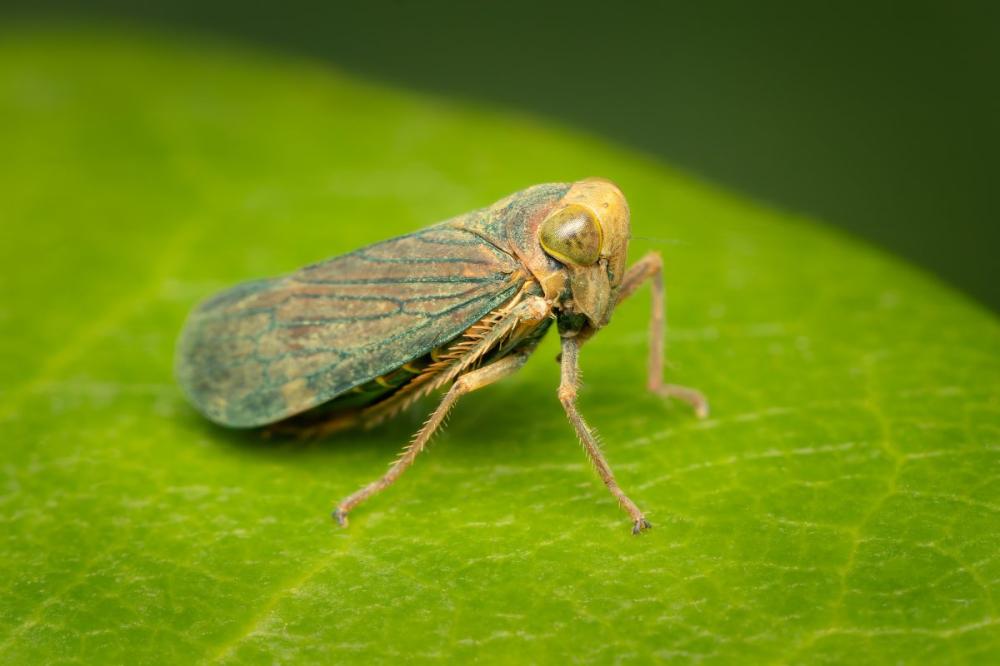

A grower of okra, eggplant, or cotton usually calls with the same complaint: the leaf edges have turned yellow, then red or scorched, and the leaves have curled upward as if thirsty, even though the irrigation is regular and the fertilizer is sufficient. He turns a leaf over and sees small green wedge-shaped insects that scuttle sideways like crabs when touched, or hop and fly away. These are leafhoppers, known in the field as jassids, and the best-known genus on vegetables is Empoasca.
The real problem with jassids is not the amount of sap they suck but their saliva. The insect injects saliva while feeding that disrupts the transport of sugars in the leaf vessels, so symptoms appear far larger than the insect, a condition known as hopperburn. Because the symptoms resemble potassium deficiency, water stress, or even herbicide damage, a lot of time is wasted treating the wrong cause.
Pest: A small green or yellow insect that jumps when touched and sucks leaf sap from the underside.
Symptom: Scorched and yellowing leaf edges, curling, and stippling, which may be followed by disease transmission from plant to plant.
Distinguishing: The symptoms resemble water or nutrient shortage, but the insect itself shows up when you turn the leaf over, and it jumps.
Common mistake: Spraying only the upper side of the leaf, when the insect is on the underside and the spray will not reach it.
Rule: Turn the leaf over to inspect, hang yellow sticky traps for monitoring, and concentrate spraying on the underside.
Who Exactly Is the Jassid?
Leafhoppers are sucking insects of the family Cicadellidae, and the species that matter to vegetable, cotton, and grape growers are very small. The adult is about 2 to 3 millimeters long, light green to yellowish green, with a body pointed at the rear like a wedge. The main species you will meet are:
- Empoasca decipiens and other Empoasca species: Widespread on potato, bean, eggplant, cucurbits, and many vegetables around the Mediterranean and the Middle East. In the Americas a close relative is the potato leafhopper (Empoasca fabae), which has the most studies on leaf burn.
- Jacobiasca lybica: A common leafhopper in Africa, the Mediterranean, and the Middle East, attacking cotton, grapes, and vegetables. On grapes it causes reddening of leaf edges in red varieties and yellowing in white ones, with poor cluster color and lower sugar.
- Amrasca biguttula (the two-spotted cotton jassid): One of the most serious species on cotton, okra, and eggplant in Asia, distinguished by two small black spots on the front of the head and a black spot on each forewing.
For a quick way to tell the jassid apart from pests with similar damage in the field:
- Whitefly: Flies up like a white cloud when the plant is shaken.
- Thrips: Very slender, leaving silvery patches and black specks.
- Red spider mite: Leaves fine stippling with silky webbing.
- Jassid: A green insect that walks sideways and hops, with damage that starts at the leaf tip and edges.
You will find details of the other pests in our articles on the whitefly, thrips, and red spider mite.
How to Read Burn Symptoms on Your Plants
The symptoms develop in stages, and knowing the stage determines whether intervention is still worthwhile:
- Stage one: Yellowing in a V shape starting at the leaf tip, or yellowing on the edges that looks like potassium deficiency, with slight upward curling of the margins.
- Stage two: The yellowing creeps inward, the margins turn red or brown, and the leaf becomes cupped and crinkled.
- Stage three: The tip tissues dry and die, the plant is stunted and the internodes shorten, and leaves may drop in severe infestations.
Oklahoma State University extension guidance on the cotton jassid indicates that by the time reddening reaches the edges, the plant has often passed the stage of rescue, meaning that spraying then protects only the new growth.
So the right decision is made at stage one, not after the leaves are burned.
The picture of damage differs slightly from crop to crop:
- Okra: Damage shows clearly on the middle and upper leaves, with smaller pods.
- Eggplant: Leaves curl, edges yellow, and fruit set slows.
- Potato: Burn starts at the leaflet tips and may be confused with early blight. The difference is that blight gives spots with concentric rings, while jassid burn starts from the tip and has no rings.
- Grapes: Leaf edges change color and drop early, and sugar in the berries is reduced.
Why Do Numbers Explode Suddenly?
The secret of the sudden explosion in numbers lies in the way eggs are laid and the speed of generations, in addition to conditions in the field itself that help the insect.
- Eggs protected inside the tissue: The female does not lay her eggs on the leaf surface where you can see them, but inserts them inside the veins, leaf stalks, and tender stems, so most contact pesticides do not reach them.
- Fast generations: Eggs hatch in about a week, the nymphs pass through five instars on the underside of the leaf, and a generation from egg to adult is completed in about 9 to 18 days depending on temperature.
This means hot weather gives successive, overlapping generations, and that two weeks after a poorly done spray you will find a new generation that has emerged from the eggs protected inside the tissue.
There are also factors that increase infestation which we know from the field:
- Excess nitrogen fertilization: Dense, tender growth is the best food for jassids.
- Weeds around the field: Many are alternative hosts that harbor the insect between seasons.
- Water stress: A thirsty plant shows more severe burn with the same number of insects.
- Indiscriminate broad-spectrum spraying: It kills natural enemies and increases resistance; the cotton jassid, for example, has recorded resistance to most chemical groups in its native range.
- Smooth-leaved varieties: Cotton varieties with hairy leaves are known for higher tolerance to jassids, because the hairs hinder the movement and feeding of the nymphs.
Proper Scouting: Count Nymphs, Not Adults
Adults fly as soon as you approach, so their number does not give a true picture. The more accurate method is turning leaves over and counting nymphs:
- Where to check: Inspect the underside of leaves in the middle and upper part of the plant, and take a sample of no fewer than 25 leaves from scattered places.
- Field edges first: Start from the field edges, because infestation usually enters from the borders and from the side of the weeds.
- Yellow traps: Hang yellow sticky traps at plant-top height to detect the arrival of adults and learn the start of the wave before symptoms appear.
- When to intervene: In cotton, some US extension programs use an economic threshold of one insect per leaf, or the first signs of yellowing with the insect present. In home vegetables we intervene when tip yellowing appears with nymphs on several leaves.
The Control Plan: Three Layers
A pesticide alone is not enough against an insect whose eggs are protected inside tissue and whose generations follow one another. So we build control on three layers that complement each other: cultural prevention, then natural enemies, then calculated spraying when needed.
1. Cultural Prevention
- Weeds: Clean the field and its borders of weeds before planting and during the season.
- Balanced fertilization: Be moderate with nitrogen and give potassium its due. A nutritionally balanced plant tolerates feeding better.
- Regular irrigation: Irrigate regularly, especially in heat waves, since thirst doubles the effect of the insect's saliva.
- Crop residues: Get rid of the previous crop's residues right after harvest, and do not plant okra next to infested cotton or eggplant.
- Nets: In greenhouses and nurseries, fine nets on the openings greatly reduce the entry of adults.
2. Natural Enemies
Jassid eggs inside the tissue are parasitized by tiny wasps of the genus Anagrus and other members of the family Mymaridae, and the nymphs are preyed on by true spiders, lacewings (golden-eyed lacewings), and predatory bugs.
These enemies work for free in your field, and the biggest favor you can do them is not to spray a broad-spectrum pesticide at the first insect you see, and to choose more selective products when spraying is needed.
3. Smart Chemical Control
The jassid lives and feeds on the underside of the leaf and its eggs are inside the tissue, so we rely on systemic pesticides or ones that penetrate the leaf, and we take care to direct the spray to the underside of the leaves. Since generations follow each other, we plan two sprays 10 to 14 days apart when infestation is clear, changing the pesticide group in the second spray.
The Products We Rely On for Jassids
At Orkida Agri we choose jassid pesticides so that they reach the underside of the leaf and the new growth, and so that we can rotate among them without repeating the same group. These are our choices:
- Actara 25 WG by Syngenta: thiamethoxam 25%, IRAC Group 4A, a systemic pesticide that moves inside the plant and reaches nymphs hiding under the leaves and the new growth that forms after spraying. We use it as the first spray at the start of infestation on okra, eggplant, potato, and cotton, and it can be used as a soil treatment with irrigation on small seedlings for early protection. Its advantage is that it works even if the spray is not perfect on every leaf.
- Plesifa Pro 163 SC by Syngenta: combines cyantraniliprole (Group 28) with abamectin (Group 6), and leafhoppers are among its target pests, at the dose written on the label. We prefer it in heavy infestations or when whitefly, thrips, or leaf miners are present with the jassid in the same field, because it covers this mix in one spray and deals with individuals that tolerated conventional pesticides.
- Exirel 10 SE by FMC: cyantraniliprole 10.2% stops the insect feeding quickly through its action on the muscles, so the saliva damage stops even before the insect dies. We use it specifically on grapes against leafhoppers, at the dose written on the label, and on vegetables within the rotation program. Do not follow it immediately with a Plesifa Pro spray because both share Group 28; it is better to separate them with Actara.
- Biobest Yellow Sticky Boards: jassids are attracted to yellow like whiteflies, so we use the boards for early monitoring in greenhouses and gardens, and to reduce adult numbers in small areas. They are not enough alone against an established infestation, but they tell you when the wave begins.
A practical program we suggest for vegetables: Actara at the first appearance of yellowing with nymphs, then after 10 to 14 days Exirel or Plesifa Pro depending on the other pests present, then back to Actara if a third spray is needed.
Do not make more than two consecutive sprays of the same group. And always follow the dose written on the label and the pre-harvest interval, especially for okra and eggplant, which are picked every two or three days.
Common Mistakes That Bring Jassids Back
Many cases of jassids returning do not mean the pesticide is weak, but that there is a flaw in how it was used. These are the most common mistakes we see:
- Spraying only the upper surface of the leaf: The nymphs are under the leaf, and spraying from above leaves most of them unharmed. Aim the nozzle from below upward.
- Treating the symptoms with fertilizer: Spraying potassium and micronutrients will not stop the burn as long as the insect keeps feeding.
- Waiting until the leaves turn red: Burned leaves do not turn green again, and the pesticide protects only what comes after.
- Repeating the same pesticide all season: The fastest route to a resistant generation.
- Spraying at midday: Adults are active and fly, and the solution evaporates. Early morning is better because insects are slower and the leaf absorbs the pesticide better.
Frequently Asked Questions
Is the jassid the same as the big grasshopper that eats leaves?
No. The jassid is a small sucking insect no longer than 3 millimeters that sucks sap and injects harmful saliva, and it does not chew the leaf. The big grasshoppers are chewing insects that eat leaf edges and leave clear holes, and they have their own article in the Pest Library.
Why are the leaves still yellow after I sprayed?
Because burn is permanent damage in the tissue that was affected, and the pesticide stops the insect but does not repair the leaf. The sign of successful control is that new leaves come out green and healthy and the nymphs disappear from the underside of the leaves within days.
Does the jassid transmit viral diseases?
Some leafhopper species transmit viral and phytoplasma diseases to certain crops, but the main damage from Empoasca species and the cotton jassid comes from the saliva that causes burn, not from disease transmission.
What is the best time to spray for jassids?
Early morning when tip yellowing begins and nymphs are present, directing the spray to the underside of the leaves, and repeating after 10 to 14 days with a pesticide from a different group, because the eggs inside the tissue hatch after the first spray.
Does water and soap spray work in a home garden?
Agricultural soap kills only the nymphs it touches, and does not reach eggs inside the tissue or flying adults. It is useful for a light infestation on a few plants with repetition, but it is not enough for a field of okra or cotton with a heavy infestation.
How do I tell jassid burn from potassium deficiency?
Turn the leaf over. If you find small green insects walking sideways, or white shed skins on the underside, the cause is the jassid. Potassium deficiency usually appears first on the lower, older leaves, while jassid burn appears on the active leaves in the middle and top of the plant where the nymphs feed.