
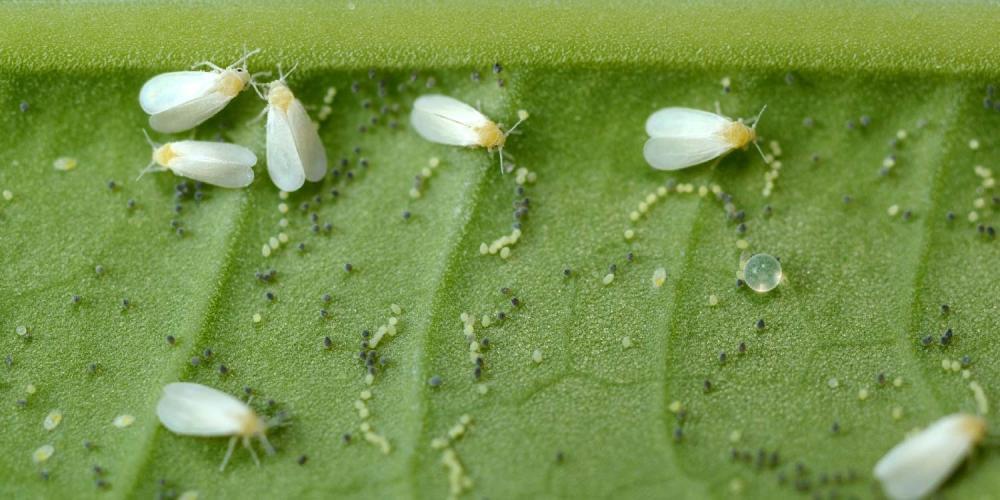

You shake a tomato leaf in the greenhouse and a small white swarm like dust rises then returns to the underside of the leaf. This is the whitefly, an insect no longer than two millimetres yet among the most dangerous vegetable pests, because it sucks sap and excretes honeydew followed by sooty mould, and most importantly transmits viruses such as tomato yellow leaf curl virus (TYLCV), which has no cure after infection. Its generations overlap so one spray is not enough, and wax protects its eggs and nymphs from some insecticides. In this guide we explain how to detect it early, its life cycle, what stops its spread, and how to build an integrated programme combining netting, traps, insecticide and rotation of active ingredients.
The insect feeds by sucking plant sap, which leads to weak growth and yellowing and dropping of leaves. But the greater danger is the honeydew it excretes, rich in sugars, which promotes the growth of sooty mold that covers leaves and fruit and lowers crop quality and marketability. In addition, whiteflies are a major vector of viral diseases such as Tomato yellow leaf curl virus (TYLCV), which causes heavy production losses.
Their ability to reproduce quickly (a female lays large numbers of eggs) and to produce overlapping generations within a single season makes them very hard to control, which calls for an Integrated Pest Management (IPM) program that combines prevention with chemical and biological control.
Appearance: A small white insect with two wings that looks like white dust, gathers on the underside of leaves, and flies off when the plant is shaken.
Damage: It sucks plant sap, causing leaves to yellow and growth to weaken, and transmits serious viruses such as Tomato yellow leaf curl virus.
Sign: Sticky honeydew on the leaves, followed by black sooty mold that covers the surface and reduces photosynthesis.
Spread: It multiplies quickly in greenhouses and warm weather, and its overlapping generations make it hard to control with a single spray.
Rule: Combine yellow sticky traps with suitable insecticides, and rotate active ingredients to avoid resistance.
Symptoms of Infestation
- Gradual yellowing of leaves and weak growth.
- Wilting and dropping of leaves in severe infestations.
- Honeydew on leaves and fruit, followed by the growth of sooty mold.
- Transmission of serious viruses that stunt plant growth and reduce yield.
- Small swarms of white insects flying up when the plant is shaken.
- Most affected crops
- Tomato.
- Pepper.
- Cucumber and zucchini.
- Onion and garlic.
- Strawberry.
- Flowering plants and roses.
Whitefly Life Cycle
- Eggs: Laid on the underside of leaves, and a female may lay large numbers of eggs.
- Nymphs: They begin as a crawler 0.3 mm long, then pass through sessile stages that suck sap.
- Pupa: A sessile stage that precedes the emergence of the adult.
- Adult: 1–2 mm long, and begins reproducing immediately.
- The full cycle takes:
- In summer: 15–25 days.
- In winter: it may extend up to 100 days.
Economic Damage
- Direct losses caused by sucking plant sap.
- Indirect losses caused by virus transmission.
- Fruit deformed by sooty mold and losing its market value.
- Difficult control because of overlapping generations and a high reproduction rate.
Prevention Methods
- Remove weeds, which are a natural host for whiteflies.
- Install tight insect netting on greenhouses.
- Use yellow sticky traps to monitor and track the infestation.
- Plant less susceptible varieties when available.
- Moderate irrigation and nitrogen fertilization.
Active Ingredients for Whitefly Control
- Imidacloprid: Use at the rate stated on the label.
- Thiamethoxam: Use at the rate stated on the label.
- Acetamiprid: Use at the rate stated on the label.
- Buprofezin: Use at the rate stated on the label.
- Pirimiphos-methyl: Use at the rate stated on the label.
Practical Tips for Farmers
- Focus on the underside of the leaves when spraying, because that is where the insect gathers.
- Start control early, before dense colonies form.
- Rotate between active ingredients to avoid resistance.
- Combine cultural methods (netting, weed removal, traps) with insecticides for the best results.
Whitefly Insecticides from Global Brands Available at Orkida
- Actara 25 WG by Syngenta: Systemic insecticide for whiteflies, aphids, and mealybugs, 250 g pack.
- Plesiva Pro by Syngenta: Systemic insecticide for whiteflies, aphids, and thrips, 250 ml pack.
- Brigadier 200 SC by FMC: For aphids, thrips, whiteflies, and mealybugs, 1 liter pack.
- Exirel 10 SE by FMC: For Tuta absoluta, thrips, aphids, and whiteflies, 250 ml pack.
- Biobest Yellow Sticky Board: For monitoring and controlling whiteflies and thrips, 10 boards.
- Koppert Yellow Roller Trap: A long sticky strip for greenhouses, 30 cm × 100 m.
You can find all the options in the Whitefly Insecticides category. Start with yellow traps for early monitoring, and rotate active ingredients to reduce resistance.
Why Prevention Matters More Than Cure with This Pest
A seedling infected with a virus through whitefly cannot be cured, so controlling whitefly in the nursery and the first weeks of planting matters more than any later spray. Bring seedlings from a clean nursery, fit tight netting on greenhouse openings, use a double-door entrance, and remove weeds that shelter the insect around the greenhouse.
How to Monitor and Judge Spray Results
Hang yellow sticky boards at plant-top height and count weekly, and widen inspection to the underside of young leaves. After spraying check for nymphs that were unaffected, and repeat treatment per the label interval while switching chemical group. Do not leave virus-infected plants in the field; remove them far away. Visit one of our branches with a photo of the infestation and we will guide you to the right product for your crop.
Frequently Asked Questions About Whiteflies
How can I tell if a plant has whiteflies?
Gently shake a leaf. If a small white swarm flies up, they are present. You will also see sticky honeydew, yellow spots on the leaves, and black sooty mold on them.
Why are they hard to eliminate?
They reproduce quickly and hide under the leaves, and their eggs and nymphs tolerate some insecticides, so you need consecutive sprays with good coverage of the underside of the leaf.
Do sticky traps work?
Yes. Yellow sticky traps reduce adults and help with monitoring, but they are not enough on their own without treating the other life stages.
How do I prevent them from coming back?
Inspect seedlings before planting, get rid of neighboring weeds, keep good ventilation, and check the underside of leaves weekly.