
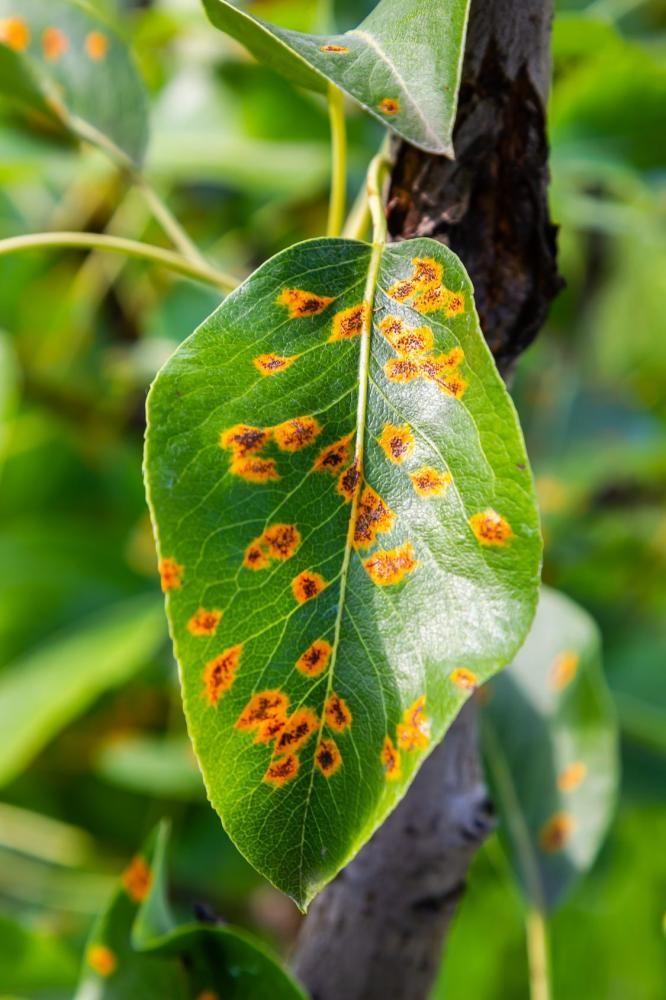

Wipe a spotted plant leaf with a white tissue. If orange, reddish-brown or yellow dust comes off, resembling rusty iron filings, you are looking at rust disease. This simple test separates rust from most other leaf diseases, because that "powder" is nothing but millions of spores ready to fly to neighboring leaves.
Rust is not a single disease. It is a family name for thousands of fungal species that infect wheat, barley and corn, beans, onions and garlic, roses, plumeria and geraniums, figs and pears, and even lawn grass. Each species has its favorite host and its own habits, and that determines how we deal with it.
Disease: Rust is a fungus that produces orange or brown powdery pustules under the leaves, and it infects wheat, roses, beans and many other plants.
Spread: Spores are carried by the wind over long distances, and they thrive with dew, humidity and moderate temperatures.
Difference: Each type of rust infects a specific crop, so identifying the type determines the timing of intervention and the right active ingredient.
Common mistake: Delaying control until the plant is covered with pustules. Early treatment is the one that pays off.
Rule: Resistant varieties, wider plant spacing and early monitoring, with action at the first pustule, protect the crop.
Is it really rust?
Before any spray, make sure what you are seeing is rust and not a similar disease or pest. Rust has distinctive signs that are easy to recognize by eye and with a tissue:
- Colored pustules: Small raised blisters whose skin splits open and releases colored powder, usually on the underside of the leaf.
- Spots on the upper surface: Opposite the pustules, yellow or pale spots appear in the same place on the upper surface.
- Powder that sticks: The powder sticks to fingers and tissue, and it can stain clothes and shoes when you walk through an infected field.
- Dark pustules late in the season: Pustules may turn dark brown or black. These are survival spores, which the fungus uses to get through the unfavorable period.
What it may look like:
- Powdery mildew: A flat, floury white layer on the leaf surface, with no colored pustules.
- Red spider mite: Fine yellow stippling and webbing under the leaf, and with a hand lens you can see the mites moving. No powder comes off on a tissue.
- Ordinary fungal leaf spots: Flat spots within the leaf tissue, with no blistering and no powder.
- Nutrient deficiency: Even yellowing between the veins or along the edges, with no pustules.
How does rust fungus live? Three facts that change how you control it
Understanding how rust fungus lives explains why it does not kill the plant quickly, why you need not worry about it jumping between unrelated plants, and why removing a distant plant that has nothing to do with the crop sometimes helps.
1. It lives only on a living plant
Rust fungi are obligate parasites: they feed on living cells and cannot grow on dead residue the way other fungi do. That is why they rarely kill the plant quickly. Instead they drain it: they steal its nutrients and puncture the leaf skin so it loses water, so the leaves yellow and drop early and yield declines.
2. Each species specializes in its host
Rose rust does not move to wheat, and bean rust does not infect onions. Some species infect only one plant species, and some infect several plants in the same family, such as hollyhock rust, which infects plants of the mallow family and their weeds. This is reassuring: rust on your roses will not move to your vegetables.
3. Some species need two different hosts
Some rust fungi complete their life on two unrelated plants: wheat stem rust spends part of its cycle on the barberry shrub, and pear rust moves between pear and certain junipers. Removing the second host from around the farm or garden breaks the cycle in these cases. Other species complete their whole life on a single host, such as wheat yellow rust and bean rust.
The stage that matters most in practice is the urediniospores (the orange or brown powder): they reinfect the same plant and its neighbors again and again.
Under ideal conditions, infection is complete after six to eight hours of leaf wetness, and the new pustule produces spores within seven to ten days. That is why rust goes from scattered spots to a yellowed field within a few weeks.
Wheat and barley rust: three types with three temperaments
In cereals, rust causes the biggest losses, and telling its three types apart determines the level of risk and the timing of action:
- Yellow (stripe) rust, Puccinia striiformis: Lemon-yellow pustules arranged in straight lines along the veins, which can also infect the heads. It likes cool weather: its best temperature is between 10 and 15°C, and its progress almost stops above 21°C. It is therefore a disease of the start of the winter season and of cool, damp mornings, and it may appear on wheat while the plant is still young.
- Leaf (brown or orange) rust, Puccinia triticina: Small, round, scattered orange-brown pustules on the upper surface of the leaves, usually without any order. Its best temperature is between 15 and 22°C, and it continues up to about 27°C.
- Stem (black) rust, Puccinia graminis: Large, elongated reddish-brown pustules on the stems and leaf sheaths, turning black late in the season, and they can weaken the stem so the plant lodges. It likes warmth: roughly between 18 and 29°C. It includes the famous Ug99 strain, which appeared in Uganda in 1999 and broke the resistance of many varieties.
Why is the flag leaf everything?
The flag leaf (the last leaf below the head) is the largest source of the food that fills the grain. University trials indicate that severe rust on this leaf at flowering can reduce yield substantially, and the loss is even greater in highly susceptible varieties if the flag leaf is infected early. Infection after the hard dough stage, however, has limited effect.
Managing rust in the field
- Resistant variety: The cheapest and strongest tool, but resistance can break down after a few years when new races appear, so follow recommendations for modern varieties in your region.
- Cut the "green bridge": Get rid of volunteer wheat plants between seasons, since they carry rust from one season to the next.
- Do not overdo nitrogen: Dense, soft growth raises humidity inside the canopy and speeds up the disease.
- Spray timing: The best window is between flag leaf emergence and full head emergence, and the goal is to protect the flag leaf. Spraying after flowering is rarely economical. A fungicide protects for roughly two to three weeks, no more.
Rust in the home garden and small farm
In the garden, rust appears on many plants, and each has a sign that helps you recognize it and a way of handling it. These are the most common types you will meet:
Ornamentals and fruit trees
- Rose rust (Phragmidium): Bright orange pustules under the leaves with yellow spots above them. It may infect tender stems and causes heavy leaf drop. Fallen leaves carry survival spores, so collect them and do not leave them under the shrub.
- Plumeria rust, Coleosporium plumeriae: Dense yellow-orange powder under the leaves, followed by brown spots on top and early leaf drop. It is one of the most common rusts on ornamentals in hot, humid climates.
- Fig rust, Cerotelium fici: Many small yellow-brown dots under the leaves, which yellow and drop early in late summer. The tree leafs out again the following season, but repeated defoliation weakens it and affects the fruit.
- Geranium rust: Brown pustules under the leaf, usually arranged in concentric rings, which is a very distinctive sign.
Vegetables, corn and lawns
- Bean and cowpea rust (Uromyces appendiculatus and close species): Small reddish-brown pustules surrounded by a yellow halo on the leaves and pods, with leaf drop in severe infections. It likes mild, humid weather, and many climbing bean varieties are highly susceptible.
- Onion and garlic rust (Puccinia allii): Oval orange pustules on the tubular leaves, and early infection reduces bulb size.
- Common corn rust (Puccinia sorghi): Elongated reddish-brown pustules on both leaf surfaces.
- Mint rust: Orange pustules under the leaves and on the stems, which reduce leaf quality for consumption and marketing.
- Lawn rust: The grass looks yellowed, and orange powder comes off on shoes and the mower. Oddly, lawn rust gets worse with low nitrogen and slow growth, the opposite of cereals. Balanced fertilization and regular mowing let the grass grow faster than the disease and remove infected blades.
Prevention: a dry leaf is half the cure
Rust spores do not germinate without a film of water on the leaf. Every hour you cut from the wetness period reduces the chances of infection:
- Water at the roots: Water at the base of the plant by drip. If you use overhead sprinklers, run them early in the morning so the leaves dry before noon, and do not water in the evening.
- Ventilation: Widen the spacing between plants, thin crowded perennials, and prune inner branches to let air through.
- Inspect purchases: Check plants before buying and turn the leaves over, and reject any plant with pustules.
- Early removal: Remove infected leaves early, at first sight, without taking more than a third of the foliage at one time.
- End-of-season sanitation: Collect fallen leaves and debris and dispose of them outside the garden. Do not put them in home compost unless the compost pile reaches a high temperature (about 64°C).
- Change the variety: If severe rust returns on a particular plant every year, replace it with a resistant variety or a plant from a different family.
When does a fungicide help, and when is it too late?
Fungicides protect healthy leaves; they do not return an infected leaf to its original state. Therefore:
- Start early: Start spraying at the first pustules on the lower leaves, or preventively before the known period of disease appearance on a plant with a history of rust.
- Repeat according to the weather: Existing pustules keep producing spores.
- Know when you are late: If most leaves are covered with pustules, the spray is too late. Remove the affected parts and protect the new growth.
- In home gardens: A few spots on a strong plant do not call for spraying. Reserve fungicide for valuable plants or those that are repeatedly and severely infected.
The strongest groups against rust are the triazoles (FRAC 3), some of which have limited curative action in the first days after infection, and the strobilurins (FRAC 11), which are mainly protective and prevent spore germination. Sulfur is used as a traditional protectant in gardens, but do not spray it in extreme heat.
What we rely on from Orkida's product range
At Orkida, we cover rust with fungicides from the groups that work best against it, plus a protective sulfur for rotation and a spreader for smooth leaves. These are our choices and when we use each one:
- Score 250 EC: From Syngenta, difenoconazole (FRAC 3), a systemic triazole that enters the leaf quickly and blocks ergosterol synthesis in the fungal cell membrane, stopping rust growth inside the tissue. We rely on it against apple and pear rusts, and we use it on fruit trees, vegetables and ornamentals at the first pustules.
- Flint WG: From Bayer, trifloxystrobin 50% (FRAC 11), which binds to the waxy layer of the leaf, spreads within it and prevents spore germination. We prefer it as a protective spray before a humid weather spell, and it suits vegetables, grapes, fruit trees and lawns.
- Ortiva Top 325 SC: From Syngenta, azoxystrobin (11) with difenoconazole (3), which combines protective protection with systemic action in a single spray. We turn to it when rust has already started and the weather is still favorable to it, or in cereals to protect the flag leaf.
- Tilsol 250 EC: From Astrachem, propiconazole 25% (FRAC 3), a triazole absorbed through the leaf within hours and moving upward inside it. It is among the most widely used actives worldwide against the three rusts in wheat and barley. We use it in cereals at the first pustules on the upper leaves to protect the flag leaf, following the dose written on the label.
- Cosavet: From SML, micronized sulfur 80% in water-dispersible granules (FRAC M2), a multi-site contact protectant that prevents rust spores from germinating on the leaf surface, and the fungus does not develop resistance to it. We prefer it for protective spraying on roses, beans and garden plants, and as a break spray between triazoles and strobilurins, following the dose written on the label. We spray it in the morning or before sunset, and not in extreme heat or close to an oil spray.
- Inex: From Cosmocel, a nonionic spreader-sticker. The leaves of wheat, onions and garlic are smooth and waxy, so spray solution rolls off them. Adding Inex to the tank makes the solution spread over the leaf and stay on it.
Do not repeat the same group: Score and Ortiva Top share difenoconazole, Tilsol is from the same group 3, and Flint and Ortiva Top share group 11. The simplest rotation: Score (or Tilsol in cereals), then Flint, then Cosavet.
If you use Ortiva Top, make the next spray Cosavet because it is outside both groups. And follow the label dose and the pre-harvest interval written on the label, especially for vegetables and fruit that are picked in stages.
Frequently asked questions about rust diseases
Does rust spread from roses to other garden plants?
Usually not. Each type of rust specializes in a particular host or plant family. Rose rust infects roses, and bean rust infects legumes. But plants of the same species pass infection to each other easily.
Are rust spores dangerous to people or pets?
They do not infect people or animals, but heavy dust can irritate the nose and eyes of people with allergies, so wear a mask when pruning severely infected plants or harvesting an infected field.
Does rust stay in the soil?
It does not live in the soil in the usual sense, because it needs living tissue. It persists on fallen leaves as survival spores, on perennial living plants, on volunteer plants and the alternate host if there is one, and its spores also arrive on the wind from far away.
Why does rust come back every year on the same shrub?
Because the infected fallen leaves stay beneath it, the variety itself is susceptible, and the watering, shade and crowding conditions have not changed. Collect the fallen leaves, change the way you irrigate, and start protective spraying two weeks before the usual time the disease appears.
Does the plant recover after rust?
Infected leaves do not recover, but a perennial plant will put out new leaves. What matters is protecting the new growth and not stressing the plant with drought or excess fertilizer.
Learn about other crop diseases and pests in the Pest Library.