
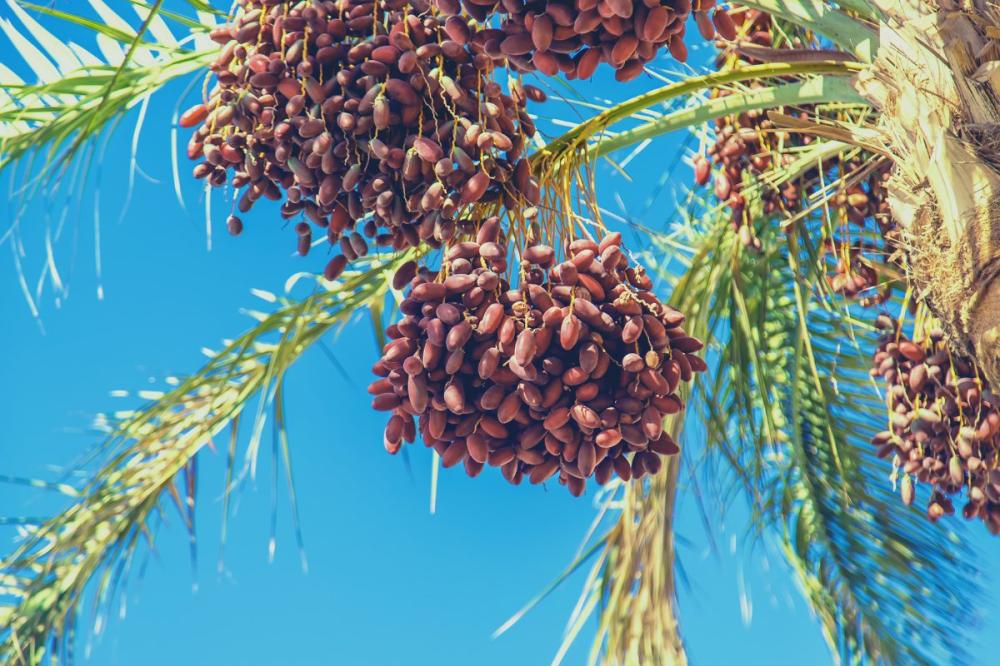

What a palm owner usually notices first is not the insect, but sticky, shiny droplets falling from the fronds onto the car parked under the palm, onto the plants beneath it, or onto the yard floor. A few days later this shine turns into a black layer of fungus that dust sticks to, and the fronds look as if painted with soot. This is the signature of the date palm dubas bug (Ommatissus lybicus), and its popular name comes from "dibs", that is, the honey it excretes in such quantity that it drips from the palm crowns.
Dubas is one of the most important sap-sucking insects on date palms in Iraq, the Gulf states, Iran, and parts of North Africa. Studies have estimated crop losses in severe infestations to be substantial, with smaller fruit, delayed ripening, and dates contaminated with honeydew that are unfit for sale.
Pest: Dubas is an insect that sucks sap from fronds and lays its eggs in their tissues, and excretes sticky honeydew that attracts dust and fungus.
Sign: Honeydew dripping on leaves and dates, yellowing fronds, and black patches from fungus growing on the excretion.
Timing: It is active in certain seasons of the year, and the time to intervene depends on the insect's stage, not the calendar.
Common mistake: Spraying after honeydew and fungus have formed; controlling the insect first, then cleaning off the fungus, is the right order.
Rule: Regular frond inspection and intervention at the young-nymph stage, with a clean palm, protect the fruit from contamination.
How Do You Recognize Dubas?
Dubas is a small, fast-moving insect, but each of its stages has a shape that is easy to tell apart once you know where to look on the fronds:
- Adult: A small insect about 5 to 6 millimeters long for the female, with the male smaller, pale yellowish-green, and transparent wings folded over the body like a roof. It jumps and flies short distances when the frond is shaken.
- Nymphs: Yellowish-green, with short white waxy filaments like feathers at the end of the abdomen, gathering on the underside of the leaflets and on the rachis and the bunch stalk bases.
- Eggs: The female inserts them into the tissue of the leaflets, midrib, and rachis in small slits she makes with a saw-like ovipositor, one egg per slit, and the tip of the egg stays slightly visible. With heavy egg laying, dead yellowish and then brown patches appear on the fronds.
Dubas spends all of its life stages on the palm itself, so it needs no other host, which is why infestation continues in the orchard year after year if its cycle is not broken.
Two Generations a Year: Understand the Calendar Before You Buy the Pesticide
This is the point that separates successful control from wasted spraying. Dubas has two generations a year, and each generation has a clear spray window:
Spring Generation
Overwintering eggs hatch from about February to April depending on the region's temperature. Nymphs go through five instars over about seven weeks, then adults live around ten weeks, and a female lays on average about 140 eggs. This generation coincides with the pollination season and the start of fruit set, so its honeydew falls directly on the small bunches.
Summer Dormancy
In the intense summer heat, the eggs of the spring generation go dormant inside frond tissue, so moving insects decline and some think the problem has ended. The truth is that the next generation is waiting inside the leaflets.
Autumn Generation
Eggs hatch from late August until roughly late October, nymphs complete development in about six weeks, adults live about 12 weeks, and a female lays a larger number, averaging about 180 eggs. These are the eggs that overwinter and produce the next spring's infestation. So neglecting the autumn generation after harvest means a more severe infestation in the following season.
The practical conclusion: the best time to spray is after hatching is complete and young nymphs appear in the early instars, that is, in spring and then in autumn, not when the palm is full of honeydew and soot. Young nymphs are weaker and easier to control, while adults are more mobile and lay new eggs protected inside the tissues.
What Does Dubas Do to the Palm and the Dates?
Dubas damage is not limited to sap sucking; it extends to the fruit and whatever is under the palm. These are its main forms:
- Weakening the palm: Nymphs and adults suck sap continuously, so the palm weakens and fronds yellow in severe infestations, and may dry in extreme cases.
- Honeydew and black mold: The honeydew excretion covers the leaflets and black fungus accumulates on it, blocking light and reducing photosynthesis, so less nourishment reaches the fruit.
- Fruit damage: Dates from infested palms are smaller and ripen more slowly, their reducing sugars rise and sucrose falls, which affects quality and storage. Fruit contaminated with honeydew and dust loses its market value.
- Egg-laying patches: The many slits in the leaflets turn into dead patches that reduce the effective green area.
- Damage beneath the palm: Intercrops such as alfalfa and vegetables get contaminated with honeydew and soot, and cars and floors get dirty, which is a common complaint with home and rest-house palms.
A Crowded Orchard Is an Ideal Home for Dubas
From field experience, infestation is more severe in dense, neglected orchards: palms close together, many offshoots not separated, dry fronds not pruned, and high humidity from flood irrigation and dense intercropping.
This environment protects the insect from sun and wind and gives it shade and humidity. So real control starts with the pruning shears before the sprayer:
- Regular pruning: Remove dry fronds and heavily infested lower fronds after the egg-laying season, because you are removing thousands of eggs embedded in them. Burn the pruned fronds or dispose of them far away; do not leave them piled in the orchard.
- Separate extra offshoots: Many offshoots around the trunk create a small damp forest around the mother palm.
- Ventilation and spacing: In new plantings respect the recommended planting distances, and in old orchards thin out the intercrops pressed up against the palms.
- Controlled irrigation: Excess irrigation raises humidity under the crowns, and drip irrigation is better than flooding in this respect.
- Balanced fertilization: Excess nitrogen produces tender fronds that the insect prefers.
Monitoring: How Do You Know It Is Time?
Researchers in Oman developed a monitoring method based on counting falling honeydew drops as a quick indicator of infestation size, an idea any farmer can apply simply:
- Place a sheet under the palms: A white sheet of paper or light plastic under a number of palms representative of the orchard for one hour in the morning.
- Count the drops: Watch the number of shiny drops. A rise in drops in spring or autumn means nymphs are active and it is time to intervene.
- Confirm with your eyes: Still, check the underside of the leaflets on the middle fronds to see the nymphs yourself and judge their age.
Natural Enemies
Dubas has recorded natural enemies, chiefly tiny wasps that parasitize its eggs inside the leaflets, plus general predators such as lacewings (golden-eyed insects), ladybugs, and spiders.
These enemies are not enough alone in heavily infested orchards, but they help keep numbers low if they are not killed by repeated random spraying. That is why we advise spraying only in the nymph window, not on a calendar schedule all year.
Chemical Control: What Do We Use and When?
For years, control programs in the region relied on aerial and motorized spraying with pesticides from the pyrethroid and organophosphate groups, then research moved toward systemic pesticides of the neonicotinoid group (imidacloprid and thiamethoxam) because they move in the palm's sap and reach the nymphs hiding under the leaflets and in the heart of the crown, and reduce the need for complete coverage of the crown of a tall palm that is hard to reach.
For short palms, offshoots, and recently planted palms at homes and rest houses, spraying with a backpack sprayer is easy. Tall palms need high-pressure motor sprayers or a specialized control service that reaches the crown, and spraying from below with a small sprayer will not reach the nymphs in the heart.
An important spring note: The spring generation coincides with pollination. Do not spray freshly opened spathes or pollen during the pollination process, leave days after pollination before spraying, and avoid spraying while bees are active in the orchard.
Products We Rely On for Dubas
Our choices at Orkida for dubas combine a systemic that reaches hidden nymphs, a contact pesticide that knocks down high numbers quickly, and a sprayer suited to home palms and offshoots:
- Actara 25 WG by Syngenta: Thiamethoxam 25%, a systemic of the neonicotinoid group that has proven efficacy in dubas control research. We rely on it for offshoots and small to medium palms, sprayed on the fronds or applied to the soil around the trunk with irrigation water, so it rises with the sap and reaches nymphs in places spray does not reach. We start with it when young nymphs appear in spring or autumn.
- Brigadier 200 SC by FMC: Combines bifenthrin (a fast contact killer) with imidacloprid (a systemic that protects for longer). We prefer it when infestation is high and honeydew is clearly dripping, because bifenthrin quickly knocks down exposed nymphs and adults, while imidacloprid protects the fronds from individuals that hatch after spraying.
- Talstar 100 EC by FMC: Bifenthrin 10%, a pyrethroid, the same group historically used in ground spraying for dubas, with palms among its crops and a pre-harvest interval written on the label. We use it in rotation with Actara so we do not depend on a single group, and it also has acaricidal activity on spider mites, an advantage in orchards where both pests meet.
- Eco Spray 20 L electric backpack sprayer, Turbo model: 20-liter capacity with an electric pump, a spray-power regulator, and an internal agitation system that prevents the pesticide from settling in the tank. Suitable for spraying offshoots, short palms, garden and home palms, and crops under palms, without the effort of manual pumping.
Suggested program for home palms and small farms: One Actara spray when young nymphs appear in spring after pollination ends, then follow up after two weeks, and if honeydew continues, spray Brigadier or Talstar.
The same program is repeated in autumn right after harvest to reduce overwintering eggs. Follow the dose written on the label and the pre-harvest interval before picking fruit, since dates are eaten directly without cooking.
After Control: Clean What Dubas Left
Black mold does not disappear the moment the insect dies, but it gradually dries and flakes off with time and wind. On home palms, you can wash the lower fronds with water at suitable pressure after controlling the infestation to speed the return of green color. At the same time watch for other pests that exploit a weakened palm, such as scale insects and mealybugs.
Frequently Asked Questions
Does dubas kill the palm?
Rarely directly, but in severe repeated infestations it weakens the palm a lot, so fruiting drops and fruit gets smaller, and fronds may dry in extreme cases. A weakened palm becomes more exposed to more serious pests.
Are dates contaminated with dubas honeydew safe to eat?
The honeydew itself is a sugary excretion, but contaminated fruit gets covered in dust and black mold and its quality falls, so it is considered commercially unacceptable. It is better to stop the infestation before it reaches the bunch stage.
When exactly do I spray dubas?
Twice a year: in spring after egg hatching is complete and young nymphs appear (often March to April depending on region) and after pollination ends, and in autumn with the hatching of the second generation (often September to October). Spraying in mid-summer mostly hits few insects, since most of them are in the dormant egg stage inside the fronds.
Is trunk injection enough?
Trunk injection with systemic pesticides is a method studied in palm research and is usually carried out with the tools and expertise of specialized control bodies. For an owner of a few palms at home, treating the soil around the trunk with a systemic or spraying offshoots and short palms well is easier and safer.
Does dubas spread from a neighbor's palm?
Yes, adults fly short distances and move between neighboring palms. So control succeeds more when neighboring orchard owners agree on the same timing, instead of each spraying alone and the insect returning from the untreated orchard.
What is the difference between dubas and dust mite on palms?
Dubas is an insect that jumps and flies and leaves shiny, sticky honeydew on the fronds in spring and autumn. The dust mite (date palm dust mite) is a tiny organism that is almost invisible, spinning a web that dust sticks to around green fruit in summer, and it excretes no honeydew. Each requires different control.