
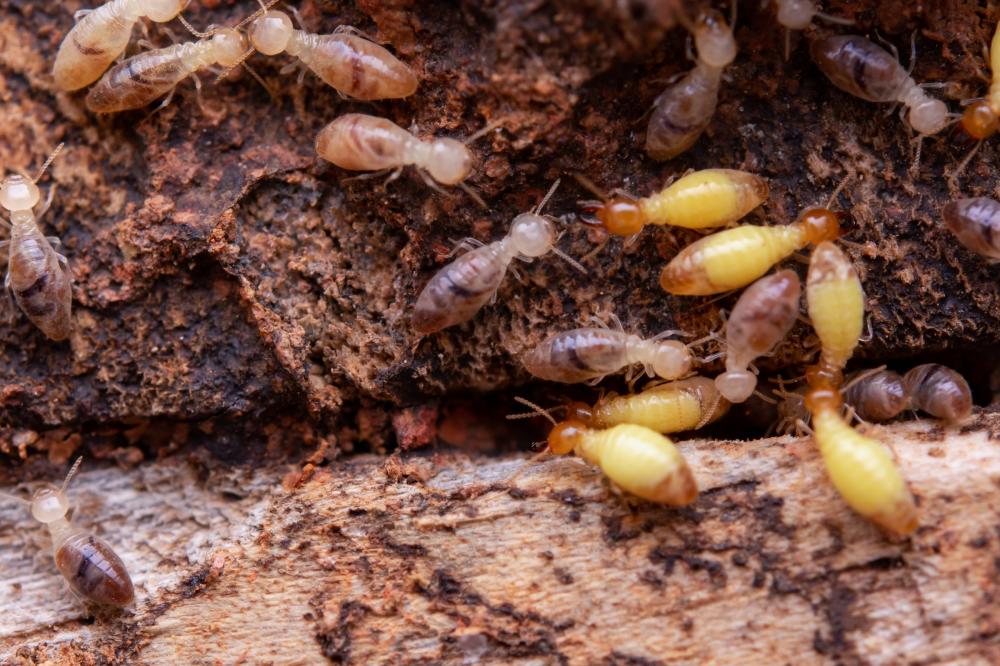

White ants are not true ants. They are insects that feed on cellulose in wood, paper and cardboard, and they work in secret until damage shows. In Saudi Arabia they are called al-ardah and also al-utta, a different name from al-thitha, the moth that attacks clothes. This guide explains how to spot an infestation early, where they enter from, and how to protect a building before and after construction.
What Are White Ants?
Social insects that live in large colonies underground or inside wood. The workers are pale and soft-bodied and avoid light and dry air, so they build mud tubes to travel between the soil and their food. From time to time winged members leave to found new colonies.
White Ants vs Ordinary Ants
- Waist: ordinary ants have a thin, clear waist, while white ants have a broad body with no visible waist.
- Color: white ants are pale or creamy, ordinary ants are usually brown or black.
- Wings: white ant wings are equal in length, ordinary ant wings are unequal.
- Food: white ants eat wood and cellulose, ordinary ants eat food.
Signs of Infestation
- Mud tubes on walls, foundations or around timber.
- Hollow wood that sounds empty when tapped.
- Discarded wings near windows and doors after swarming.
- Fine powdery droppings near infested timber.
- Blistering or peeling paint and uneven patches on walls.
- Doors and windows that no longer close well because wooden frames are damaged.
Where Do White Ants Enter From?
Most infestations start from the soil under or around the building, then reach the inside through small cracks in the foundation, pipe joints or timber touching the ground. Older buildings and those with moisture or water leaks are more exposed, because moisture attracts white ants and helps them survive.
What Attracts Them?
- Moisture, leaks and pipes.
- Wood, cardboard or paper stacked near the ground or walls.
- Tree stumps and debris close to the building.
- False ceilings and untreated wooden doors.
Damage White Ants Cause
White ants weaken wood from the inside while leaving the outer skin intact, so damage only shows after some time. They ruin doors, furniture, ceilings, bookcases and papers, and can affect the safety of timber structures. The later it is found, the higher the cost of repair.
How to Control White Ants
Before Construction: Soil Treatment
This is the best stage for protection. The soil under the foundations and around the building is treated with a termite-specific product to form a chemical barrier that stops the colony reaching the inside. Treatment is carried out as the product label directs.
After Construction: Injection and Spraying
In existing buildings the perimeter is treated by injecting the product into the soil along walls and foundations, together with spraying visible areas and cracks. What matters is that treatment covers the path the colony uses, not a single spot.
Treating Timber and Visible Areas
Infested timber, cracks and mud-tube locations are treated with a suitable product, and tubes and debris are cleared to confirm that activity has stopped.
Ongoing Prevention
- Fix water leaks immediately and remove moisture.
- Do not stack wood or cardboard on the ground or against walls.
- Keep stumps and tree debris away from the building.
- Inspect doors, timber and foundations regularly.
Treating Termites in Walls and Wood
Termites in walls
- Look for mud tubes on the wall or where it meets the floor, and cracks leaking fine soil.
- Effective treatment means injecting termiticide into the soil around the foundations and through small holes at the base of the wall, creating a barrier they cannot cross.
- Do not just break the tubes and spray over them; termites build new tubes and carry on elsewhere.
- Fix any water leaks or damp in the wall, because moisture attracts termites more than anything.
Termites in wood and furniture
- Tap the wood: if it sounds hollow or breaks easily, the damage is internal.
- Treat infested wood by spot injection into holes and galleries with a termite-specific insecticide, then coat the surface with a wood preservative.
- Badly damaged wood is best replaced, and wood should not touch the soil directly.
- Keep stacked boxes and timber away from walls and the ground.
Important: if the infestation spans several rooms or the building's foundations, it needs a full soil treatment around the whole building, not spot treatment alone.
Common Mistakes
- Spraying only the visible surface without reaching the colony source in the soil.
- Treating one spot and ignoring the rest of the perimeter.
- Ignoring the leaks and moisture that attract them again.
- Mixing products or changing rates from the product label.
Products from Orkida
- Premise 200 SC (Envu) — A white ant insecticide with imidacloprid from a global brand
- Bayflex TC (FMC) — A white ant insecticide with bifenthrin, for before and after construction
- Professional Home White Ant Package — An Orkida package for small homes and recent infestations
Common Questions About White Ants
What is the difference between al-utta and al-thitha?
Al-utta is the common local name for white ants (termites), which eat wood. Al-thitha is a moth, an insect from the butterfly family that attacks clothes, grains and stored goods.
Do white ants fly?
Winged members (swarmers) fly in certain seasons to found new colonies, while workers neither fly nor come out into the light.
Do they bite people?
They do not target people or feed on blood. Their damage is to wood and property.
Are wings inside the house a danger sign?
Yes, they usually mean a colony is nearby. Inspect timber and foundations and treat the source instead of only sweeping up the wings.
Can the infestation return after treatment?
It can if moisture remains or part of the path was left untreated, so treated areas are followed up and the cause of moisture is fixed.