
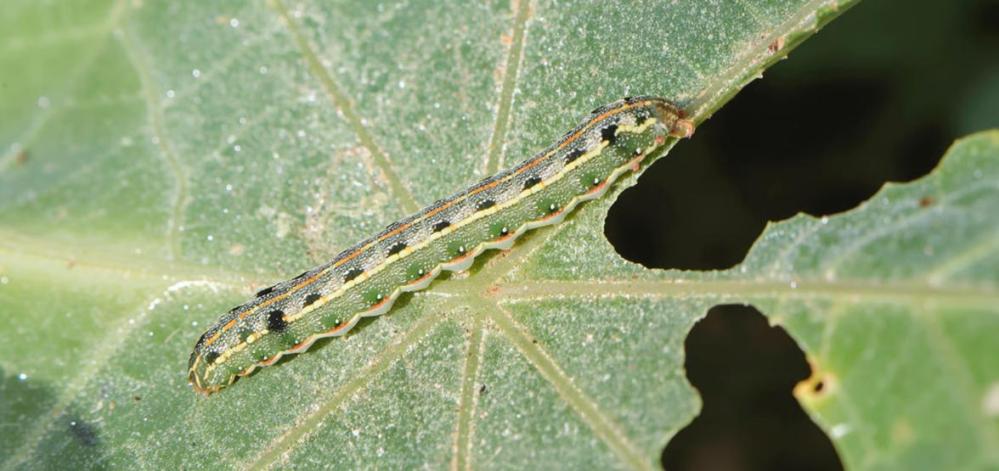

In agriculture, emamectin benzoate is a powerful larvicide at a very small dose: Tuta absoluta, leafminers, cotton leafworm, fall armyworm and fruitworms. The larva stops feeding within hours of taking the dose, and the active enters the leaf, reaching pests that hide inside it.
This article explains how emamectin works in agriculture, which pests it controls, when to spray it so it keeps its strength, and how to rotate it properly.
- Group: avermectins, IRAC group 6.
- Type: translaminar insecticide (moves into the leaf), killing mainly by ingestion and also by contact.
- Works on: caterpillars, leafminers, thrips and some mites.
- Common forms: emulsifiable concentrate (EC) at 5%, water-dispersible granules (WDG) and formulations for palm trunk injection.
How does emamectin work?
It opens chloride channels in the larva's nerves and muscles, so it becomes paralysed, stops feeding quickly and dies within two to four days.
- It enters the leaf quickly and builds a reservoir inside it, reaching larvae that mine tunnels such as Tuta and leafminers.
- Sunlight breaks it down on the leaf surface, but the part inside the leaf is protected and lasts longer.
- Its dose is very small compared with most insecticides.
Which pests does it control?
- Tuta absoluta: larvae inside mines in tomato leaves.
- Leafminers: in tomato, cucumber, squash and ornamentals.
- Cotton leafworm and fall armyworm: in vegetables and corn.
- Bollworm (tomato fruitworm): while small, before it enters the fruit.
- Red palm weevil: some formulations are injected into the palm trunk as the label directs.
When to spray it
1. On young larvae
The best result comes at egg hatch and the first mines and holes. A large larva that has entered the fruit is harder.
2. Late afternoon or early morning
Strong sunlight breaks down the part on the leaf surface. Spraying in soft light gives it a chance to enter the leaf.
3. Cover the tops and new leaves
Moths usually lay eggs on new growth, so focus there and on the leaf undersides.
4. Do not judge too fast
The larva stops feeding quickly but stays on the leaf for a day or more before dying. What matters is that new damage stops.
How to protect it from resistance
- Abamectin is in the same group (6), so switching between them is not a real rotation.
- Rotate with other groups such as chlorantraniliprole (28), indoxacarb (22) and spinosad (5).
- Use a window approach: one group for roughly one pest generation, then switch.
- Combine control methods with pheromone traps and removal of infested leaves.
Safety
- Wear gloves, goggles and a mask.
- It is toxic to bees at spraying time, so do not spray while bees are working the flowers.
- Respect the pre-harvest interval stated on the label.
Products from Orkida
- Aritor 9.7% ME, 1 litre: emamectin benzoate for red palm weevil control.
- Sniper 75 EC, 1 litre: emamectin benzoate for Tuta absoluta, caterpillars and leafminers.
- Robust 50 EC, 1 litre: emamectin benzoate 5% for cutworms and leaf caterpillars.
- Emar 5% EC, 500 ml: emamectin benzoate for leaf and fruit worms and borers.
- Emactin 50 WDG, 500 g: emamectin benzoate 5% granules for caterpillars and leafminers.
- Pasha 5% WDG: emamectin benzoate granules for leaf and fruit worms.
Frequently asked questions
What is the difference between it and abamectin?
Both are from the same family. Emamectin is much stronger on caterpillars, while abamectin is stronger on mites and leafminers. Because they share a group, switching between them is not a real rotation.
I sprayed and the larvae are still on the leaves. Why?
The larva stops feeding within hours and dies after two to four days. Check whether there are new mines or holes.
Can I spray it at midday?
Better not. Strong sun breaks part of it down before it enters the leaf. Spray late afternoon or early morning.
Does it work on whitefly and aphids?
It is not the right choice for them. Use insecticides made for aphids and whitefly.