
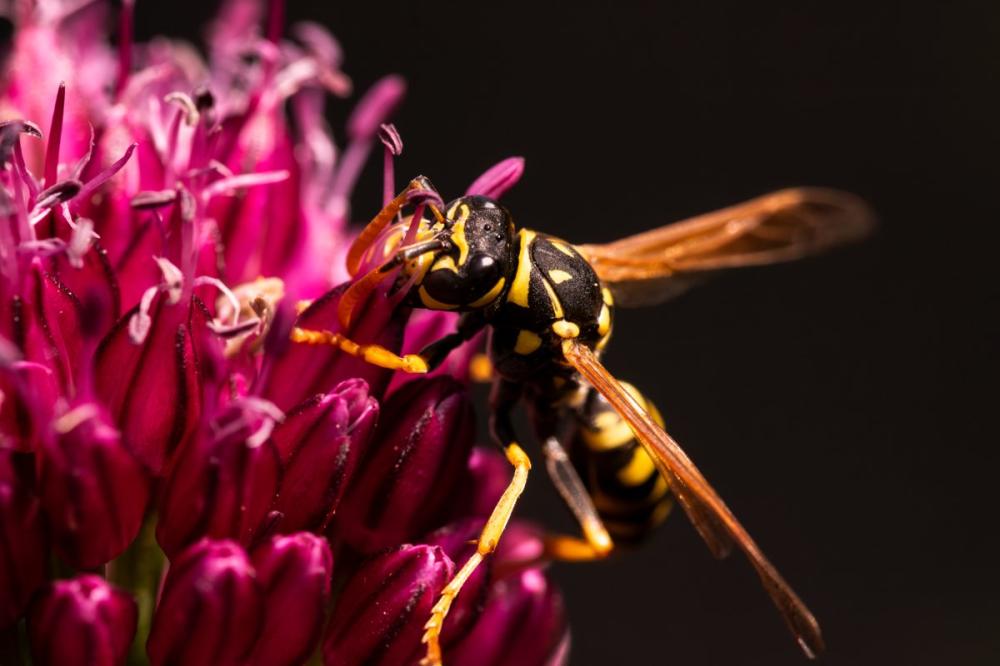

One wasp circling a glass of juice is a nuisance. Dozens of wasps going in and out of a gap in the pergola roof or a crack in the wall is a different story: there is a nest nearby, and anyone who gets close risks several stings.
This article does more than describe wasps and hornets. It helps you make a practical decision: is this a nest you can safely deal with yourself, or one that needs a night-time treatment with full protective gear from a safe distance? What do you do if someone is stung, and when is it an emergency?
- The risk: wasps defend their nest and sting repeatedly, and the greatest danger is to anyone allergic to stings.
- First aid: remove the sting if there is one, clean the spot with soap and water, apply a cold compress to reduce swelling, and watch for any breathing symptoms.
- Emergency: shortness of breath, swelling of the face or throat, or dizziness call for an ambulance, not home care.
- The common mistake: trying to remove the nest with fire or random spraying in daytime, which only increases the number of stings.
- The rule: do not approach a large nest in daytime; treat it after sunset with a nest insecticide and full protective clothing, and stay away completely if you are allergic to stings.
Wasp, hornet or bee? The difference changes how you deal with it
In everyday speech "wasp" covers more than one insect, but there are important differences in shape, nest and aggression, and all of them affect how you handle it:
- Paper wasp (genus Polistes): a slim body with a very narrow waist, and hind legs that dangle in flight. It builds a small open nest like an upturned umbrella hanging from a thin stalk, with the hexagonal cells visible from below. A nest usually holds only 15 to 200 wasps, and it is less aggressive than the others.
- Yellowjackets: smaller and stockier, striped yellow and black. They nest in burrows underground, inside wall and ceiling voids, or in closed paper nests with a single opening. A nest may reach thousands, and they are more aggressive, especially near the nest, and strongly attracted to food and juice.
- Hornets (genus Vespa): the largest of this group.
- Oriental hornet (Vespa orientalis): the best-known hornet in hot dry regions, 2.5 to 3.5 cm long, reddish brown with a wide yellow band on the abdomen and a yellow patch on the face. It is the only hornet that lives in desert environments. It usually nests underground or in sheltered cavities, its activity peaks at midday unlike most wasps, and it is a fierce enemy of beehives.
- Bees: a stout, hairy body. They attack only to defend the hive and usually die after stinging because the barbed sting stays in the skin. Bees are very beneficial, and if you find a hive in your house, call a beekeeper to move it instead of killing it.
The key safety difference: the sting of a wasp or hornet is smooth, not barbed, so it can sting several times in a row, especially if it gets under clothing.
If someone is stung: what do you do?
Most stings pass with brief pain and mild swelling. What matters is to move away first, give first aid correctly, and know the signs that turn a sting into an emergency. The steps in order:
- Leave the area first: if wasps start stinging you, do not stand and swat them. Move away quickly to a building or a closed car and cover your face as much as you can. Swatting and sudden movement near the nest provoke more of them.
- Wash the spot: wash the sting site with soap and water.
- Remove the sting if present: if it was a bee and the sting is still in the skin, scrape it off quickly with the edge of a card or a fingernail. A wasp does not usually leave its sting.
- Cold compress: apply a cold compress wrapped in cloth to ease pain and swelling.
- Raise the limb: if the sting is on a hand or foot, and remove rings and bracelets before the swelling increases.
- Painkiller and antihistamine: an ordinary painkiller and an antihistamine may ease the pain and itching.
What is normal and what is worrying?
Normal: a burning pain straight away, then swelling and redness at the site that ease within hours. In some people the swelling spreads over a day or two and lasts several days. That is a large local reaction and not necessarily a dangerous allergy.
Worrying and urgent: anaphylaxis, which usually starts within fifteen minutes to an hour of the sting. Its signs:
- Skin: a rash or hives spreading over the body away from the sting site.
- Breathing: difficulty breathing, wheezing or tightness in the chest.
- Face and throat: swelling of the tongue, lips or throat, or difficulty swallowing.
- Circulation: dizziness, collapse or loss of consciousness.
At any of these signs, even one or two, call an ambulance immediately. Anyone with a doctor-prescribed epinephrine (adrenaline) pen should use it at once and then call an ambulance.
Multiple stings are dangerous even without allergy
Many people overlook this: someone who receives more than about ten stings may suffer general poisoning from the venom itself, even with no allergy at all, with nausea, vomiting, dizziness and fever. In very severe cases the blood and kidneys may be affected.
So multiple stings, especially in children, the elderly and people with heart or lung disease, mean going to the emergency department.
Anyone who has had a severe allergic reaction to a sting before is likely to have one again with the next sting, and should see an allergy doctor to discuss an epinephrine pen and desensitisation treatment.
Why do wasps come near your house?
Adult wasps feed on sugars, and hunt insects and meat to feed their larvae. That is why they are drawn to:
- Exposed sugars: uncovered juice and soft drinks, and fruit fallen under trees.
- Protein: open rubbish, meat and fish scraps, and pet food left outside.
- Water: water sources in the heat, such as fountains, leaks and basins.
- Beehives: nearby hives, which the oriental hornet attacks fiercely.
A simple tip that prevents many stings to the mouth and throat: when sitting outdoors, do not drink from an open soft-drink can without looking inside it. Use an open cup or a lid, because a wasp can enter the can without you seeing it.
The nest: when to handle it yourself and when not to
Not every nest is treated the same way, and not every nest is safe to handle at any time. You can deal with a nest yourself only if all of these apply:
- Size and place: a small, open paper wasp nest (the size of a golf ball or a little smaller) in a visible spot that is easy to reach from the ground.
- Stage: the nest is just starting and has few wasps on it.
- Household: nobody in the house is allergic to stings.
Cases where you should not approach the nest in daytime
- A nest inside a wall, ceiling or closed void: do not seal the opening before the nest is dead, because trapped wasps may chew their way into the house. Sometimes a damp or soft patch appears on the wall or ceiling over the nest.
- A nest underground: it may extend far from the visible opening, so the insecticide does not reach all the wasps and you may find them agitated the next day.
- Large hornet nests: or any large closed nest with big numbers.
- A nest high up: it needs a ladder. Falling off a ladder while fleeing wasps is more dangerous than the sting itself.
- Allergy in the house: if anyone at home has had an allergic reaction to stings before.
If you decide to handle a small nest yourself
- Pick the right time: an hour after sunset or before dawn, when most wasps are inside the nest and less active. With the oriental hornet, avoid midday in particular.
- Lighting: do not point a strong white torch at the nest, because light draws the wasps toward you. Use a red light or put the torch on the ground away from you.
- Clothing: long sleeves, trousers, gloves and eye and face protection, with trouser legs tucked into socks.
- Spraying: use an insecticide registered for wasps, spray it directly on the nest and its opening, then move away at once and do not stand to check.
- Waiting: leave the nest for at least a full day, then make sure there is no movement before removing it with a long tool and putting it in a sealed bag. Wasps returning from outside will touch the treated surface.
And there are things you never do, however small the nest:
- Burning: do not burn the nest or pour petrol on it. The risk of fire and injury is far greater than the risk from the wasps.
- Hitting and water: do not hit the nest with a stick or spray it with a hose.
- Daytime removal: do not try to remove it in daytime while the wasps are active around it.
Prevention: how to reduce the chance of a new nest
A small nest started by a single queen is far easier than a finished one, so prevention begins at the start of the warm season:
- Early inspection: check under roof edges, pergolas, outdoor play equipment and meter boxes at the start of the warm season, before any nest started there grows.
- Seal openings: close cracks and gaps in outside walls and cover vents with mesh.
- Remove attractants: collect fallen fruit, cover rubbish and do not leave pet food outside.
- Care while working: take care when mowing, trimming trees and moving stacked items, because many stings happen when a hidden nest is disturbed.
Do not forget that wasps have a useful side: they hunt caterpillars and harmful insects in gardens and farms. A nest far from daily activity at the edge of the farm may not need removing at all.
Products from Orkida
For small outdoor nests we rely on two contact insecticides: one that leaves a residual effect on the nest and one with fast knockdown:
- Demand CS from Syngenta: its active ingredient, lambda-cyhalothrin, kills wasps by contact, and the microencapsulated formulation leaves a residue on the nest and around its opening that affects wasps returning later. For outdoor use on nests, under pergolas and along roof edges, not inside bedrooms. It is applied with a hand sprayer, and we prefer spraying after sunset when the wasps are inside the nest, at the dilution rate written on the pack.
- Demon Max EC from Syngenta: a cypermethrin concentrate with fast contact knockdown, suitable for treating small outdoor nests and places where wasps gather, with protective clothing worn while spraying.
Large nests and nests inside walls or underground are treated after sunset, when the wasps are inside, with a nest insecticide sprayed or puffed into the entrance from a safe distance while wearing full protective clothing; never approach them if you are allergic to stings. For more articles, browse the pest library.
Frequently asked questions
Is a wasp sting more dangerous than a bee sting?
A single sting is similar in pain and allergy risk, but a wasp can sting several times, and yellowjackets and hornets attack in larger numbers near the nest, which raises the risk of multiple stings.
How long do wasp sting symptoms last?
The sharp pain eases within hours. Swelling may increase on the first and second day and last up to a week in some people. If symptoms continue for more than three days or signs of infection appear, see a doctor.
Does garlic or toothpaste help a wasp sting?
There is no evidence that they neutralise the venom, and some irritate the skin. Soap and water, a cold compress and an antihistamine are more useful.
Do wasps return to an old nest?
They usually do not reuse an old nest after it dies, but the same spot may attract a new queen next season if it stays sheltered and suitable. Remove the remains of the nest and close the void once you are sure it is empty.
Do wasp traps solve the problem?
Baited traps reduce the wasps foraging around a seating area, especially yellowjackets, but they do not eliminate a large nest. Place them at the edges of the area away from where people sit, not in the middle.
I saw wasps going in and out of a hole in the wall. What do I do?
That usually means a nest in the wall void. Do not seal the hole now and do not spray heavily into it while you are close. Treat it after sunset by puffing an insecticide dust into the hole from a distance, then seal it once activity has stopped completely, because the nest may be large and the wasps may come out somewhere else inside the house.