
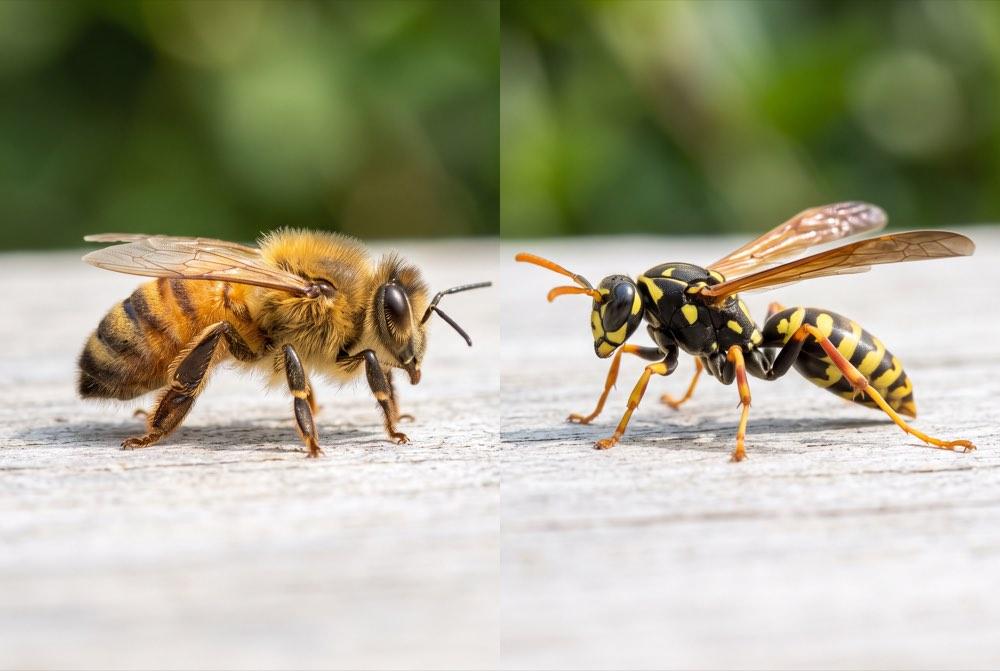

The difference between a wasp and a bee shows in the body: a bee is plump and hairy, while a wasp is smooth, shiny and narrow-waisted. In the sting, a honey bee stings once and leaves its stinger in the skin, while a wasp stings more than once and leaves no stinger.
Wasp vs bee comparison table
Body
- Bee: Plump and hairy
- Wasp: Smooth with a narrow waist
Colour
- Bee: Dull golden brown
- Wasp: Bright yellow and black, or reddish brown
Legs
- Bee: Thick, carrying pollen
- Wasp: Thin, hanging in flight
Food
- Bee: Nectar and pollen
- Wasp: Insects, meat, sugars
Sting
- Bee: Once, leaves the stinger
- Wasp: Repeated, no stinger
Nest
- Bee: Hexagonal wax combs
- Wasp: Grey paper nest or mud
Temper
- Bee: Calm unless the hive is threatened
- Wasp: More aggressive, especially near the nest
Telling a wasp from a bee by shape
- Look at the waist: a clear narrow waist between chest and abdomen means a wasp.
- Look at the hair: a fuzzy, soft body means a bee.
- Look at the food: what hovers around meat, juice and rubbish is a wasp. Bees go to flowers.
Wasp sting vs bee sting
- Bee sting: sharp pain, and the stinger stays in the skin with its venom sac.
- Wasp sting: sharp pain and burning, no stinger, and it may sting two or three times.
- Swelling: both cause swelling and redness that ease within a day or two.
What to do with the sting
- If there is a stinger, scrape it off with the edge of a card. Do not squeeze it with your fingers.
- Wash the area with soap and water.
- Apply a cold compress.
- Go to emergency care at once if there is facial swelling, difficulty breathing or dizziness. These are signs of allergy.
Wasp nest vs bee hive
- Bee hive: neat wax combs, usually inside a cavity: a wall, a tree, a box.
- Wasp nest: looks like grey paper, exposed under roofs and canopies, or mud tubes on a wall.
Details in Wasp Nests.
How to deal with each
- Bees: do not spray them. Bees are useful; if they settle at your home, call a beekeeper to move the hive.
- Wasps: remove what attracts them: cover food and juice, close the bin, and seal gaps under the roof.
- A small early nest: is sprayed after sunset when the wasps are inside, while you wear covering clothes.
- A large nest: do not approach it yourself.
Products from Orkida
Wasp and bee FAQs
Which is more dangerous, a wasp or a bee sting?
The real danger is allergy, which can happen with both. A wasp stings more than once, so its stings are usually more numerous.
Do wasps make honey?
No. The wasps found here do not make honey; they feed on insects and sugars.
Does a bee die after stinging?
A honey bee does, as its stinger lodges in the skin. A wasp does not.