

You walk past your tomatoes or eggplants in the afternoon and find the leaves drooping, then in the morning they are perky again as if nothing happened. You irrigate more and nothing changes, and after a few weeks the lower leaves turn yellow in sharp arc-shaped patches, then dry out and fall, while the fruit stays small. You are not dealing with thirst or a fertilizer shortage, but with a fungus that has settled in the plant's vessels and blocks them from the inside: Verticillium wilt.
This disease is not settled by a spray or extra fertilizer, because the fungus lives inside vessels that most pesticides do not reach, and in the soil it survives for many years with no host. So the situation is won through early diagnosis, keeping the fungus out of clean land, and arranging the crop rotation. In this article we explain the signs, the difference between it and Fusarium and bacterial wilt, and what really works in infested soil.
Symptom: Wilting and yellowing that starts on the lower leaves, often on one side of the plant, even though the soil is wet.
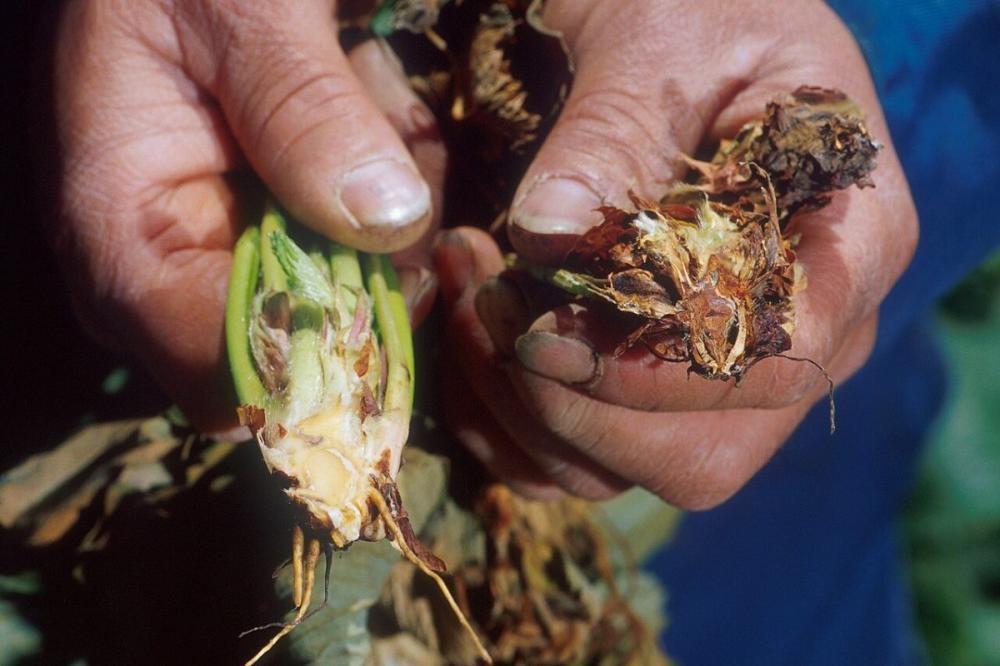
Detection: Cutting the plant's stem lengthwise shows brown discoloration in the water-carrying vessels inside the stem.
The fungus: It lives in the soil for many years and enters through the roots, so it does not go away just by removing the infected plant.
The difference: It looks like Fusarium but prefers mild weather, and identifying the type changes the prevention plan.
The rule: Prevention through disinfection, crop rotation and resistant varieties works better than trying to cure a plant that already shows wilting.
How Do You Know It Is Verticillium?
The symptoms of this wilt are slow and gradual, which is why it is easily confused with irrigation and nutrition problems. The best way to tell is to combine the look of the leaf with what you see inside the stem, rather than relying on a single sign.
- V-shaped yellowing: It starts at the edge of the lower leaf and narrows toward the midrib, then turns brown and dead. This sign is what best distinguishes Verticillium from other diseases.
- Wilting that comes and goes: The plant wilts in the heat of the day and recovers at night, then wilts again and gets worse until it no longer recovers.
- Lower leaves first: They die and fall off gradually upward, and the plant stays short with weak growth and poor fruit set.
- Streaks inside the stem: Split the stem lengthwise at the base and you find light brown to cream streaks just under the bark.
- Late appearance: The symptoms look worse when fruit begins to form, because the plant needs more water at that stage.
In trees such as olive, the disease appears as whole branches wilting with their leaves curled and left hanging, while the rest of the tree looks healthy, then death spreads from one branch to another season after season.
The Difference Between It, Fusarium and Bacterial Wilt
Three diseases cause wilting and discoloration in the vessels, and each needs a different action. A wrong diagnosis means you spend your effort on a treatment that does not suit the disease.
- Verticillium: V-shaped patches on the lower leaves, slow development, and a preference for mild weather. The plant often does not die quickly, but its productivity declines.
- Fusarium wilt: Yellowing that starts on one side of the plant or leaf, becomes worse in high heat, and the wood turns dark brown.
- Bacterial wilt: Sudden collapse of a plant with green leaves. If you put a cut stem in a glass of clear water and sticky white threads come out of it, it is bacterial and not fungal.
- Water shortage or root damage: The plant recovers with irrigation and no brown streaks appear inside the stem.
And because the difference between Verticillium and Fusarium is not always visible to the eye, it is advised to send a stem sample to a plant protection laboratory before you decide to change the crop or treat the soil.
A Fungus That Lives in the Soil for Many Years
The cause is two fungi of the genus Verticillium: the best known is Verticillium dahliae, which infects vegetable crops, cotton, olive and strawberry, and Verticillium albo-atrum. The first forms small black bodies called microsclerotia, which tolerate drought and cold.
Extension references confirm that these bodies can stay alive in the soil for up to ten years without a host. When the grower plants a susceptible crop, the secretions from its roots stimulate the dormant bodies to germinate, and the fungus enters through the roots and then through small wounds, spreads in the water-carrying vessels and blocks them.
What encourages the disease? Mild weather around 24 to 29 degrees, neutral to alkaline soil, and wounds caused by the hoe or cultivation or by nematodes feeding on the roots. This is why the damage grows when nematodes and the fungus occur together, as happens in what is called potato early dying.
The Crops It Infects
Verticillium does not choose one particular crop; its host range reaches hundreds of plant species, including weeds. The crops where growers lose the most to it are vegetables and trees:
- Tomato, eggplant and pepper: These are the most severely affected, and infection often appears in greenhouses where the nightshade family is grown repeatedly.
- Potato: It causes early yellowing and smaller tubers, and gets worse in the presence of nematodes.
- Strawberry, cucurbits and watermelon: Growth vigor declines and plants wilt at the start of fruiting.
- Olive, cotton and stone fruit trees: It affects branches and young trees more, and may continue for years.
- Weeds: Some carry the fungus without symptoms, so the land stays a source of infection while you think it is clean.
Potato and Nematodes: Early Dying
In potato, Verticillium appears in a form called early dying, where the vines yellow and dry weeks ahead of schedule and the tubers decline in size and yield. The root lesion nematode is an important partner of it, because it wounds the root and weakens its defense, so a small amount of fungus is enough to cause great damage.
That is why we do not look at the disease as a fungus alone; we assess the whole field: the nematode level, the residues of the previous crop, and what was planted before it. A field that was preceded by tomato, potato or cotton carries a larger inoculum reserve than a field that was wheat.
How Does the Disease Enter Your Farm?
The fungus does not fly and rarely spreads by air. It travels with soil, and anything that carries soil from an infected field to a healthy one is a means of transport.
- Machinery, shoes and tools: A lump of mud stuck to a spade or a tractor tire is enough to carry the fungus.
- Infected seedlings and seeds: They may carry the fungus with no visible symptoms and bring it into clean land.
- Reused pots and trays: They bring infection back to the nursery if not sterilized.
- Runoff water and wind carrying soil: They move parts of the infected soil over short distances.
No Cure for an Infected Plant: What Do We Do?
After symptoms appear, the fungus has already spread inside the vessels, and no spray brings the plant back to health. The right action is to manage the field so that infection falls in the next cycle and the healthy parts are protected.
- Confirm the diagnosis: Split the stem and try the water test to rule out bacteria, and send a sample to the laboratory if the field is large.
- Pull up the plant with its roots: Put it in a bag and take it out of the field, and do not leave it to decompose in the soil.
- Sterilize tools: Pruners, knives, crates and pots with a disinfectant solution before moving on to the next plant.
- Rearrange the rotation: Rest the land from the nightshade family, cucurbits and strawberry for a period of three to five years, and plant wheat, barley or corn in their place.
- Choose resistant varieties: Look for the letter V in the variety name or the resistance code on the seed packet, and remember that the resistance covers race 1 only, and there is a second race with no commercial resistance.
- Consider grafted seedlings: Tomato and eggplant are grafted onto strong-rooted rootstocks, which is one of the most successful solutions in infested land.
- Adjust irrigation and fertilization: Avoid excess ammonium nitrogen, and support the roots with regular irrigation without flooding.
Soil Disinfection and Reducing the Fungus Reserve
The least costly option in hot, sunny regions is solar disinfection in summer: the land is irrigated well and then covered with clear plastic for many weeks, so the temperature of the top layer rises and the microsclerotia weaken. In large fields with severe infections, fumigation with approved materials is used according to the instructions of agricultural authorities before planting.
Controlling nematodes also helps, because they open the wounds the fungus enters through, as does removing host weeds and avoiding moving soil from suspect fields. For details on nematodes, see the nematodes article, and to understand the accompanying root rots, see root rot.
Which Products Do We Recommend?
We do not present any product as a cure for an infected plant. We choose what protects the new roots, reduces the entry points the fungus exploits, and prevents the spread of infection through tools. Follow the label dose and the pre-harvest interval for every product you use.
- Uniform 446 SE: Mefenoxam with azoxystrobin, applied as a drench around seedlings after transplanting, it protects the root system from soil fungi, including Verticillium. We start with it preventively in fields known to be infected, not after the vessels are blocked.
- Velum Prime 400 SC: Its active ingredient fluopyram suppresses root nematodes that wound the root and open the door for the fungus. We use it in fields where nematodes and wilt occur together.
- Virkon S: An oxidizing disinfectant in which we dip pruners, knives, crates and pots between fields, cutting the path of infection on the tools that carry soil and fungus.
Keep Farming or Change the Crop?
It is a hard decision for the landowner, but it is settled by three simple questions before you buy seed or seedlings for the new season.
- What share of the plants is infected? If it is scattered patches, isolate them and treat the tools, but if it passes a third of the field, it is better to change the crop for at least two seasons.
- Do you have a resistant variety or a grafted rootstock? If so, continuing is possible; otherwise the risk is great.
- Can you raise the temperature by solar disinfection in a suitable season? If you can, it gives cleaner soil in the layer where most roots spread.
And remember that this fungus does not forgive haste; the season in which these questions are skipped often ends with fewer plants, smaller fruit and a higher cost than the cost of the alternative rotation.
Frequently Asked Questions
Can Verticillium wilt be treated with a fungicide?
A plant that has shown symptoms does not return to health, because the fungus is inside the vessels. Root-applied fungicides may protect new plants or slow the infection, but the basis of success is crop rotation, resistant varieties and disinfection.
How do I tell Verticillium from Fusarium?
Look for V-shaped patches on the lower leaves and slower development for Verticillium, and for yellowing on one side and higher temperatures for Fusarium. When in doubt, the laboratory settles it, because the treatment may differ.
Should I plant tomatoes in the same soil next season?
Preferably not. The fungus stays for years, so plant a cereal crop such as wheat or corn, or use grafted seedlings on a resistant rootstock if you must plant there.
Can the disease spread through seeds?
Yes, in some crops it may spread through infected seeds and seedlings, so buy seeds and seedlings from a trusted source, and do not move seedlings from an infected field.
Is solar disinfection enough?
It greatly lowers the fungus reserve in the top layer if done well in summer, but it does not reach the depths. So it is combined with crop rotation and resistant varieties and not relied on alone.
What about infected olive trees?
Cut the infected branches and burn them, avoid planting new trees after nightshade family and cotton crops, and irrigate moderately because flooding increases the damage. Young trees are the most vulnerable, and some trees may recover if the conditions that help the disease ease.
Image source: Wikimedia Commons (public domain)