
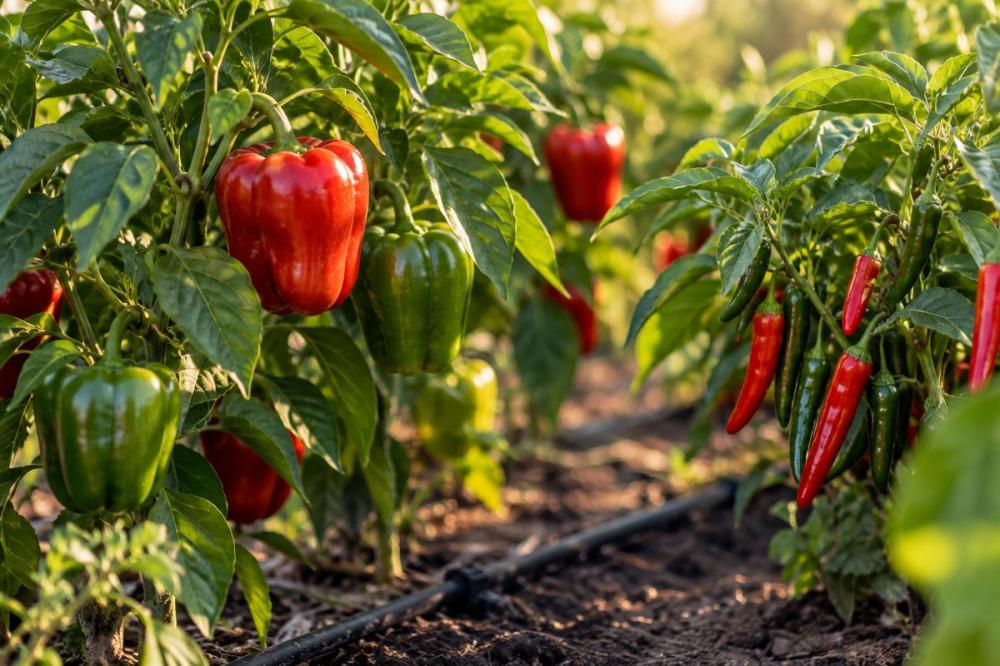

Peppers of every kind, sweet, hot and bell, give a long harvest when grown correctly. They need patience at the start because they germinate more slowly than most vegetables, but then they keep fruiting for many weeks with regular picking.
In this article we explain how to grow peppers from seed step by step: the best time, starting and transplanting seedlings, spacing, watering, feeding with rates, when to harvest, and why flowers drop.
Types of peppers
- Sweet peppers (bell or capsicum): large fruit, picked green or left to turn red.
- Hot peppers: smaller fruit whose heat depends on the variety, and they need strong sun.
- Long red peppers: such as the Largo de Reus variety, good for cooking and drying.
Best time to grow peppers
- Peppers like mild to warm weather and struggle in severe cold and very high heat.
- Mild areas: sow seeds from September to March.
- Warm areas: from August to April, focusing on the winter crop.
- Spring crop: sow in trays from January to March and transplant from March to April.
- Avoid flowering in the peak of the heat, as fruit set drops.
Step 1: Starting seedlings
- Sow seeds in seedling trays 0.5 to 1 cm deep.
- Medium: a light, well-drained mix rich in organic matter, such as peat moss with perlite.
- Warmth: peppers need warmth to germinate, so keep the tray in a warm place.
- Germination: within 7 to 14 days depending on temperature, slower than tomatoes, so be patient.
- After germination: strong light and moderate moisture without waterlogging.
Step 2: Transplanting
- When: when seedlings are 10 to 15 cm tall or have 4 to 6 true leaves.
- Harden off the seedlings for a week before transplanting by gradually exposing them to outdoor conditions.
- Transplant in the late afternoon and water straight away.
Spacing
- Most varieties: 50 cm between plants and 70 cm between rows.
- Large varieties such as Largo de Reus: 50 cm between plants and 80 cm between rows.
- In pots: one plant per pot 25 to 30 cm deep.
Watering peppers
- Regular watering without waterlogging: peppers are sensitive to both drought and standing water.
- The critical period: flowering and fruit set. Irregular watering at this stage makes flowers drop and keeps fruit small.
- Drip irrigation is best, and water early in the morning.
- Mulching with straw or plastic around the plant keeps the soil moist.
Feeding peppers with rates
During vegetative growth
- Balanced 20-20-20 fertilizer: 1 to 2 g per litre as a spray or through irrigation, every 10 to 14 days.
From the start of flowering
- Calcium and boron: improve fruit set and reduce fruit cracking and blossom end rot. For example, Calborn Plus: spray 2 ml per litre.
- Potassium: increases fruit size and improves colour. For example, soluble potassium sulphate 0-0-50: spray 2 to 3 g per litre.
- Reduce nitrogen at this stage, as it boosts leaves at the expense of fruit.
When to harvest peppers
- 70 to 90 days after transplanting for most varieties.
- Sweet peppers: pick them green once they reach full size, or leave them to turn red and sweeter.
- Regular picking keeps the plant flowering and producing, so do not leave ripe fruit on the plant too long.
- Use scissors rather than pulling, so the branches do not break.
Common problems and their causes
Flower drop
- Causes: intense heat, drought or too much nitrogen.
- Fix: regular watering, light midday shade in hot weather, and calcium-boron from the start of flowering.
Small or cracked fruit
- Causes: irregular watering and a lack of potassium and calcium.
Curled leaves
- Usually aphids, spider mites or thrips. Check the undersides of leaves and hang yellow and blue sticky traps.
A sunken patch at the tip of the fruit
- Blossom end rot, caused by calcium deficiency in the fruit together with irregular watering.
Tips for hot peppers
- Wash your hands after picking hot peppers and do not touch your eyes.
- Strong sun and moderate watering increase the heat of the fruit.
Products from Orkida
- Red Pepper Seeds, 2 g: 0.5 to 1 cm deep; germinates in 7 to 14 days; 70 × 50 cm spacing; harvest 70 to 90 days after transplanting.
- Sweet Red Pepper Seeds, 2 g: transplant at 4 to 6 leaves; harvest 70 to 90 days after transplanting.
- Bell Pepper Seeds, 2 g: 50 × 70 cm spacing; pick green or red.
- Largo de Reus Pepper Seeds, 10 g: 0.5 cm deep; 80 × 50 cm spacing.
- Hot Pepper Seeds, 1.5 g: start in trays, then transplant to a sunny spot.
- Bavaria 20-20-20 Balanced Fertilizer, 2 kg: 1 to 2 g per litre as a spray or through irrigation.
- Calborn Plus Calcium and Boron, 1 L: spray 2 ml per litre from the start of flowering.
- SAF 0-0-50 Soluble Potassium Sulphate, 1 kg: spray 2 to 3 g per litre while fruit is forming.
Frequently Asked Questions
How long do pepper seeds take to germinate?
7 to 14 days depending on temperature. They need warmth, and take longer in the cold.
How long do peppers take from planting to harvest?
Most varieties start producing 70 to 90 days after transplanting.
Why do my peppers flower and then drop their flowers?
Usually intense heat, drought or too much nitrogen. Water regularly and add calcium and boron from the start of flowering.
Can I grow peppers in a pot?
Yes, one plant per pot 25 to 30 cm deep, in a sunny spot.
Are green and red peppers the same plant?
For sweet peppers, yes. A green pepper is the same fruit before it fully ripens and turns red.