
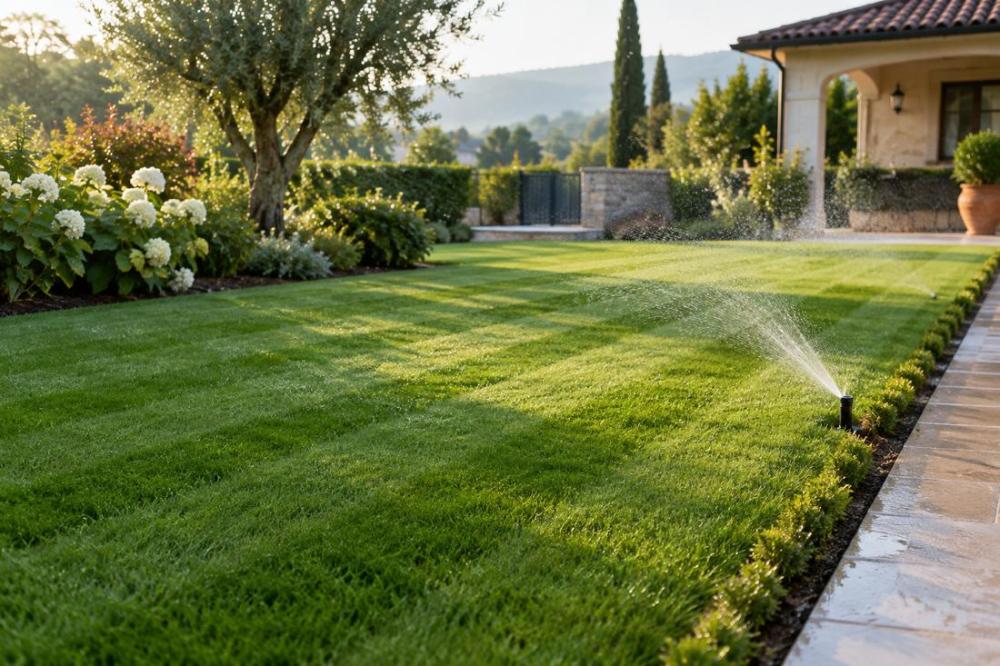

The lawn is what gives a garden its look, and when it yellows or develops dry patches the whole house looks different. Most lawn problems come from one of four things: watering, mowing, fertilizer, or an insect under the soil.
In this article we explain how to care for a lawn, from watering, mowing and feeding to the causes of yellowing and dry patches and how to fix them, with rates.
Watering the lawn correctly
- Deep, spaced-out watering is better than light daily watering, because it drives the roots down so they tolerate heat.
- The best time to water: early morning or late afternoon, avoiding midday.
- In summer it needs more water, and in winter cut back clearly.
- Standing water in certain spots rots the roots and causes yellow patches.
Mowing correctly
- Do not cut more than a third of the blade length at once.
- Mowing very short burns the lawn in summer and weakens it.
- Keep the mower blades sharp, because blunt blades tear the tips and turn them yellow.
- Mow regularly during growth instead of letting it grow tall and cutting it all at once.
Fertilizing the lawn
- Balanced 20-20-20 fertilizer: Pioneers at 3 to 5 g per square metre once a month during growth, dissolved in irrigation water or spread and watered in.
- Yellowing with green veins: iron deficiency, treated with a 12% chelated iron spray at 1 to 1.5 g per litre of water.
- Do not fertilize in extreme heat on a thirsty lawn.
Why is my lawn turning yellow?
- Drought or irregular watering, especially at the edges and next to walls.
- Overwatering and waterlogged soil in low spots.
- A lack of iron and nitrogen in alkaline soil.
- Salty water or soil: burnt tips and pale patches.
- Insects under the soil eating the roots.
Treating salinity
- Agricultural gypsum at 0.8 to 2 kg per square metre depending on salinity, spread and watered in straight away.
- A heavy watering from time to time washes the salts away from the roots.
Dry patches and pests
White grubs
- The sign: dry patches that lift easily like a carpet, with curved white grubs underneath.
- The fix: see the white grubs article below for the full control plan.
Mole crickets
- The sign: raised tunnels on the soil surface and wilted patches.
- The fix: see the mole cricket article below.
Lawn caterpillars
- The sign: chewed blades and brown patches that spread fast in summer, with activity at night.
- Treatment: Deltathrin 25 EC at 0.35 to 0.5 ml per litre of water, sprayed at dusk.
Patching bare spots
- Lightly rake the soil in the bare spot.
- Sow lawn seed at 3.5 to 4 kg per 100 square metres, so a 1 kg pack covers 25 to 30 square metres.
- Water lightly and often until the seeds germinate.
Products from Orkida
- Pioneers 20-20-20 balanced fertilizer, 1 kg: 3 to 5 g per square metre once a month.
- Dolphin chelated iron 12%, 1 kg: for yellowing, 1 to 1.5 g per litre.
- Agricultural gypsum, 25 kg: for salinity, 0.8 to 2 kg per square metre.
- Deltathrin 25 EC: for lawn caterpillars, 0.35 to 0.5 ml per litre.
- Dutch seven-blend lawn seed, 1 kg: 3.5 to 4 kg per 100 square metres.
Frequently Asked Questions
Why does my lawn turn yellow in summer?
Usually drought, mowing too short or salinity. Water deeply and raise the mowing height.
How often should I water the lawn?
Deep, spaced-out watering instead of light daily watering, more in summer and less in winter.
How often should I fertilize the lawn?
Once a month during growth with a balanced fertilizer, at 3 to 5 g per square metre.
Why does my lawn lift like a carpet?
That is a sign of white grubs eating the roots under the soil.