
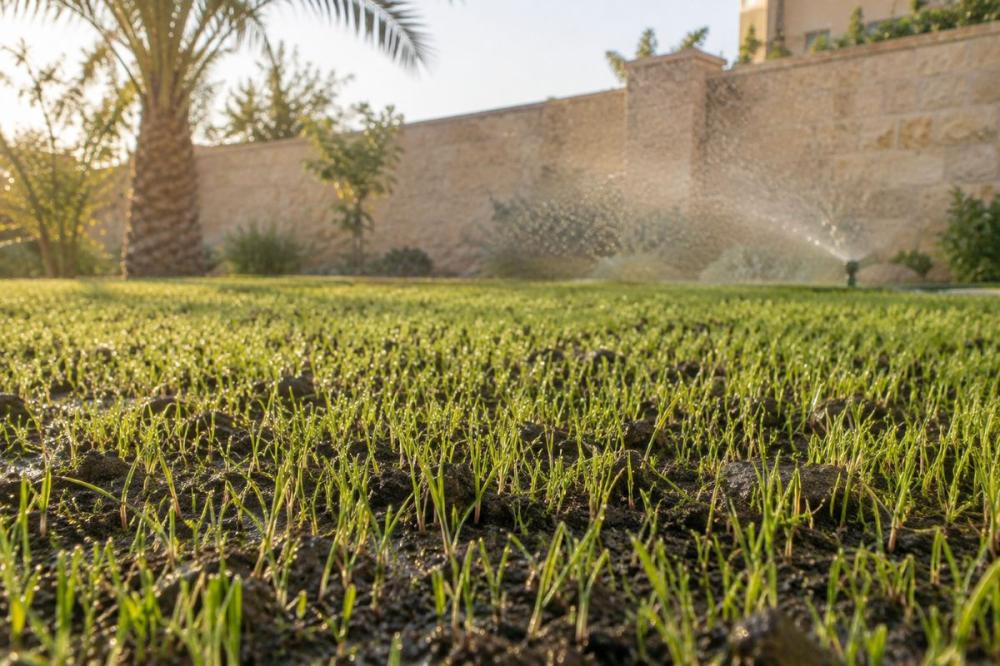

Want a green yard or a garden with thick lawn grass instead of bare soil? Growing a lawn from seed costs far less than ready-made turf rolls, and the result is excellent if you prepare the soil properly, sow the right amount and keep up with watering in the first weeks.
In this article we explain how to grow lawn grass from seed step by step, how many kilos of seed you need for your area, the best time to sow, watering, mowing and feeding, and why lawns turn yellow and how to fix it.
Seed or ready-made turf?
- Lawn seed: much cheaper, and you can choose a mix that suits sun, shade or low water, but you need 6 to 10 weeks for a full lawn to form.
- Ready-made turf (rolls): green from day one, but far more expensive and needs heavy watering in the first weeks until the roots take hold.
- To renew an existing lawn or fill gaps and bare patches, seed is the easiest and cheapest option.
Lawn seed types for hot climates
Good mixes usually contain more than one grass type, each with its own strength:
- Tall fescue: deep roots, tolerates heat, drought and foot traffic, and is the main component of most garden mixes.
- Kentucky bluegrass (Poa pratensis): adds density and a fine look and fills gaps, but germinates more slowly.
- Perennial ryegrass: germinates fast and gives early green colour, covering the ground while the other types establish.
- Bermuda grass: tolerates strong sun and high heat.
Best time to sow lawn seed
- The best time is mild weather: autumn and early winter or spring.
- Avoid establishing a new lawn in peak summer, because the soil surface dries quickly and seeds die before they establish.
- If you must sow in the heat, choose a partly shaded spot and mist several times a day.
How much lawn seed do you need?
- Normal rate: 25 to 40 g per square metre.
- In other words: 1 kg of seed covers roughly 25 to 40 m² depending on the density you want.
- Example: a 100 m² yard needs roughly 2.5 to 4 kg of seed.
- For renewing and filling gaps you need less, about half the rate on the weak areas only.
- Do not go far above the rate: crowded seedlings compete and the lawn ends up thin.
How to grow lawn grass from seed, step by step
1. Prepare the soil
- Remove weeds, stones and plant debris.
- Dig the soil to about 10 to 15 cm and break up large clods.
- If the soil is poor and sandy, mix in a 3 to 5 cm layer of planting soil or well-rotted organic matter.
- Level the surface well so water does not collect in low spots.
2. Water before sowing
- Moisten the soil a day before sowing so it is damp, not muddy, at sowing time.
3. Sow in two passes
- Split the seed into two halves.
- Spread the first half lengthwise and the second half crosswise for even coverage without gaps.
4. Cover the seed lightly
- Run a rake lightly over the surface to work the seed into the soil.
- Do not bury the seed deeply: no more than about 5 mm.
- Press the surface gently with a board or your feet so the seed makes good contact with the soil.
5. Water straight after sowing
- Water with a fine, gentle mist so the seed does not wash away and collect in one spot.
- Keep the soil surface constantly moist until the grass comes up, and never let it dry out once you have started watering.
How long does lawn seed take to come up?
- It starts to emerge within 1 to 3 weeks depending on the grass type and temperature.
- Ryegrass comes first, then fescue, and Kentucky bluegrass last, so it is normal for it not to all appear at once.
- A full, dense lawn forms after roughly 6 to 10 weeks.
Watering the lawn
During germination (first 3 weeks)
- Light watering 2 to 3 times a day depending on the heat; the key is that the surface never dries.
- Water early morning and late afternoon, and avoid midday in the heat.
Once the lawn is established
- Water less often but more deeply: a deep soak every 1 to 2 days in summer and every 3 to 4 days in winter.
- Deep watering pushes the roots down and makes the lawn more heat-tolerant.
- Sign of thirst: the grass turns a blue-grey colour and footprints stay on it instead of springing back.
Mowing
- First mow when the grass reaches about 6 to 7 cm.
- Never remove more than a third of the height in one mow.
- Mow a little higher in summer: taller grass shades the soil and needs less water.
- Keep mower blades sharp; a blunt blade tears the leaf tips and turns them brown.
Feeding the lawn
- Do not feed seed during germination with strong fertilizer, as it can burn the tiny roots.
- After the first one or two mows, start with a light balanced fertilizer.
- Practical example: water-soluble 20-20-20 at 3 to 5 g per square metre, once a month, dissolved in water and applied with a sprayer or through irrigation.
- Water straight after feeding so it does not scorch the leaves.
Why lawns turn yellow and how to fix it
Thirst or heat
- The grass yellows and dries from the edges in patches the sprinklers do not reach.
- Fix: make sure sprinklers cover the whole area and increase deep watering in summer.
Overwatering and poor drainage
- The grass yellows, the soil stays muddy and smells bad, and sometimes fungus appears.
- Fix: water less and aerate compacted areas with a garden fork.
Lack of nutrients
- General yellowing across the whole lawn, especially if it has not been fed for a long time.
- Fix: feed with a balanced fertilizer at the rate above.
Mowing too short
- If you cut the grass very short it looks yellow because the green part has gone.
- Fix: raise the mowing height and let it recover.
Common mistakes when growing lawn grass
- Burying the seed too deep, so it never comes up.
- Letting the surface dry out in the first two weeks after germination starts.
- Watering with a strong hose jet, washing seed into clumps and leaving gaps.
- Walking on new grass before it is established.
- Sowing in peak summer without shade or enough water.
Products from Orkida
- Green Field Mix 2 Lawn Seed, 1 kg: German mix of 6 varieties, 70% tall fescue, for sun and partial shade, covers 30 to 40 m².
- Green Field Mix 2 Lawn Seed, 10 kg: the same mix for large areas, covers up to 400 m².
- Barenbrug Water Saver Dutch Lawn Seed, 1 kg: drought-tolerant mix, 80% tall fescue, sown at 3.5 to 4 kg per 100 m².
- Pioneers 20-20-20 Soluble Fertilizer, 1 kg: for lawns at 3 to 5 g per m² once a month.
Frequently Asked Questions
How long does lawn grass take to grow from seed?
It starts to emerge within 1 to 3 weeks depending on the type and temperature, and the lawn fills in after about 6 to 10 weeks.
How many kilos of lawn seed do I need for 100 m²?
About 2.5 to 4 kg, at a rate of 25 to 40 g per square metre.
When should I water my lawn?
Early morning or late afternoon. For the first 3 weeks, light watering 2 to 3 times a day; once established, deeper watering less often.
When should I mow new grass for the first time?
When it reaches about 6 to 7 cm, without removing more than a third of the height.
When should I fertilize the lawn?
After the first one or two mows, with a light balanced fertilizer once a month, watering straight afterwards.
Can lawn grass grow in shade?
Mixes with tall fescue tolerate partial shade, but full shade all day leaves the lawn thin and weak.
Read next
- 20-20-20 Fertilizer: When to Use It and How to Apply It by Foliar Spray or Irrigation
- NPK Fertilizer: What the Numbers Mean and How to Choose the Right Formula
- Growing Mint at Home from Seed: Method, Watering and Feeding
- Lawn Mowers: How to Choose Between Push and Self-Propelled and the Right Cutting Width
- Ride-On Lawn Tractors: When You Need One and How to Choose the Right Model
- Lawn Care: Watering, Mowing, Feeding and Fixing Yellow Grass