
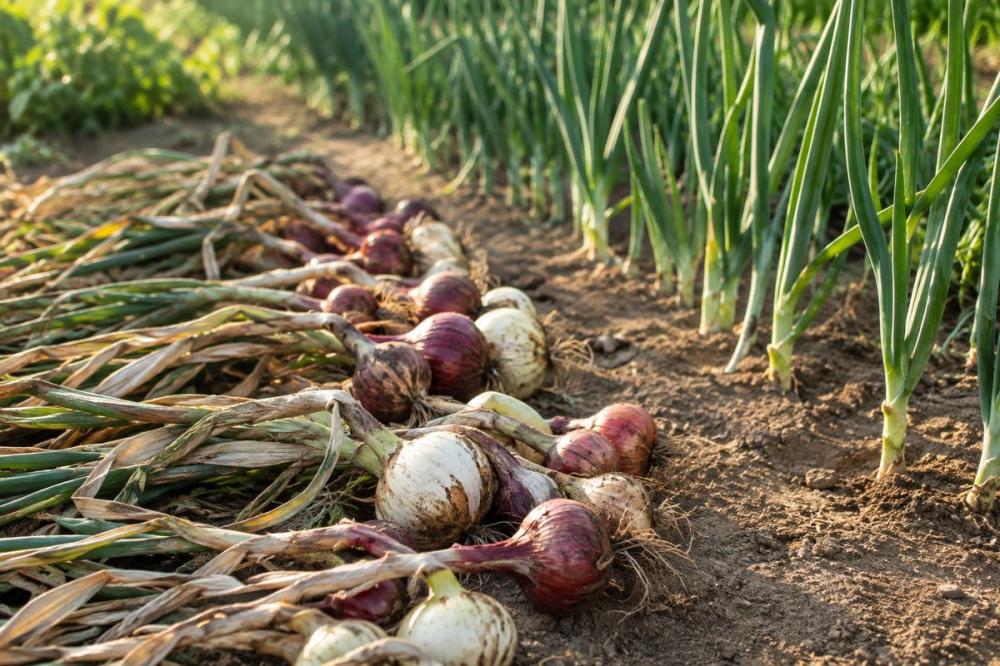

Onions are a staple crop in every home and farm, grown either for their bulbs (red and white onions) or for their green leaves (spring onions or leeks). They are easy to grow, but bulb size and storage quality depend on the right timing and balanced watering.
In this article we explain how to grow onions from seed step by step: the best time, raising seedlings and spacing, watering and feeding, and when to harvest and how to cure onions for storage.
Types of onion
- Red onion: such as the Morada de Amposta variety, slightly sharp and colourful in salads.
- White onion: such as Blanca Grande, with large bulbs and a milder flavour.
- Spring onion (green onion): grown for its leaves, which you can cut several times.
Best time to grow onions
- Bulb onions: sown in autumn and winter, avoiding high heat early in growth.
- Spring onions: in spring in mild areas, and in warm areas most of the year, avoiding severe cold.
How to grow onions step by step
1. Sowing
- In a nursery bed or directly in the ground, 0.5 to 1 cm deep.
- Soil: light and well-drained.
- Moisture: keep the surface moist until the seeds germinate.
2. Transplanting (bulb onions)
- Transplant the seedlings once they have a good root system, usually when they are about as thick as a pencil.
- Trimming the leaf tips and roots slightly at transplanting helps the seedling establish.
3. Spacing
- 40 cm between rows.
- 15 cm between plants in the row.
- Do not crowd the plants: crowding produces small bulbs.
4. Spring onions
- Sown in rows and thinned after germination; they do not need wide spacing.
Watering onions
- Regular watering without waterlogging, especially at the start and during bulb formation.
- Irregular watering produces split or double bulbs.
- Reduce watering two to three weeks before harvest so the bulbs mature and store without rotting.
Feeding onions with rates
- Vegetative growth: balanced 20-20-20 fertilizer at 1 to 2 g per litre as a spray or through irrigation, every 10 to 14 days.
- Bulb formation: soluble potassium sulphate 0-0-50 sprayed at 2 to 3 g per litre, or through irrigation for vegetables 3 to 5 kg per hectare. Potassium increases bulb size and improves storage.
- Reduce nitrogen in the later stages, as it delays maturity and weakens storage.
Weed control
- Onions cannot compete with weeds because their thin leaves do not shade the ground.
- Keep between the rows clean regularly, and carefully so you do not damage the bulbs.
When to harvest onions
Bulb onions
- The sign: the leaves turn yellow, bend and fall over.
- Lifting: pull the bulbs and leave them on the soil surface or in a shaded, well-ventilated place for a few days to two weeks until the neck and outer skin dry.
- After curing: cut the leaves leaving 2 to 3 cm of neck, and store in a cool, dry place.
Spring onions
- Cut them when the leaves reach a good length, and cut in batches so they regrow.
Common problems
Small bulbs
- Causes: crowding, weeds, late sowing or potassium deficiency.
Onions sending up a flower stalk (bolting)
- Cause: large seedlings exposed to cold, or sowing at the wrong time. A bolted onion does not store well.
Bulbs rotting in storage
- Causes: watering close to harvest, insufficient curing, or late nitrogen.
Silver streaks on the leaves
- Usually thrips. Hang blue sticky traps and check the heart of the plant.
Products from Orkida
- Morada de Amposta Red Onion Seeds, 7 g: 0.5 to 1 cm deep; 40 × 15 cm spacing; sow from autumn to winter.
- Blanca Grande White Onion Seeds, 7 g: large bulbs; 40 × 15 cm spacing.
- Spring Onion (Green Onion) Seeds, 2 g: 0.5 to 1 cm deep; cut the leaves in batches.
- Bavaria 20-20-20 Balanced Fertilizer, 2 kg: 1 to 2 g per litre during vegetative growth.
- SAF 0-0-50 Soluble Potassium Sulphate, 1 kg: spray 2 to 3 g per litre during bulb formation.
Frequently Asked Questions
When should I plant onions?
Bulb onions in autumn and winter, and spring onions most of the year in warm areas.
How far apart should onion plants be?
15 cm between plants and 40 cm between rows.
How do I know onions are ready to harvest?
When the leaves turn yellow, bend and fall over.
Why are my onions small?
Usually crowding, weeds, late sowing or potassium deficiency.
Can I grow spring onions in a pot?
Yes, in a pot 15 to 20 cm deep, and cut them in batches.
Read next
- Starting Seeds in Seedling Trays: A Step-by-Step Guide to Strong Seedlings
- Potassium Sulphate and Calcium Nitrate: Benefits, Timing and Why Not to Mix Them
- The Easiest Vegetable Seeds to Grow at Home for Beginners
- Growing Kurrat and Leeks from Seed: The Difference, Cutting and Harvest
- Onion and Garlic Diseases: Purple Blotch, Downy Mildew, Thrips and Treatment