
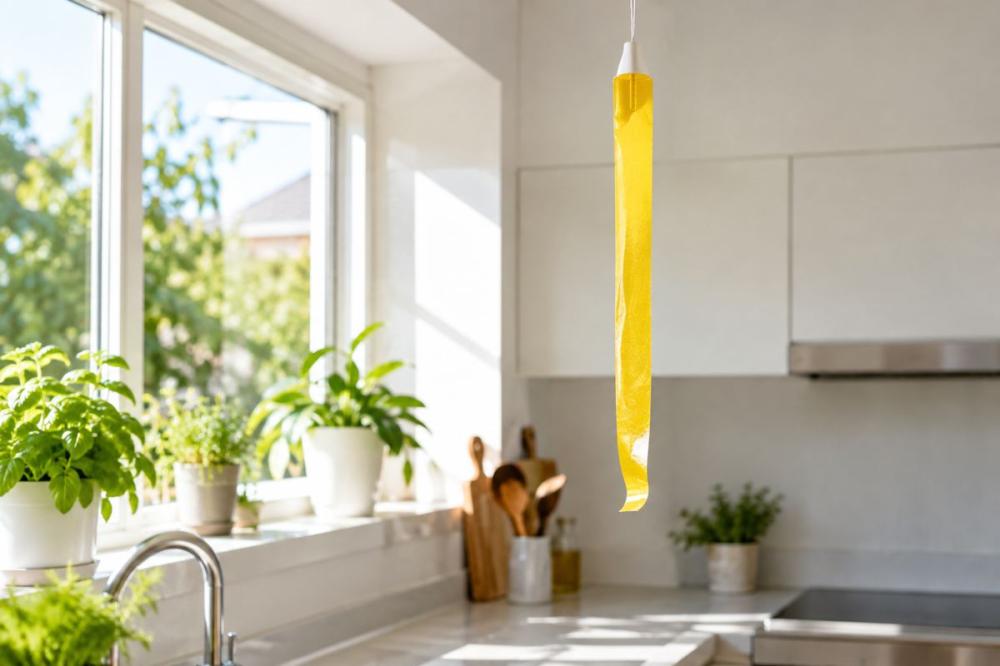

If flies have taken over your kitchen, yard or restaurant and you do not want to spray insecticide near food, sticky fly traps are one of the simplest and cleanest solutions: a tape, stick, board or roll that holds the fly the moment it lands, with no electricity and no chemicals.
But not every sticky product suits every place. In this article we explain the difference between fly tape, sticky sticks, rolls and boards, where to hang each one, how many you need and when to replace them.
Types of sticky fly traps
Hanging fly tape
- What it is: a tape rolled inside a small tube; you pull it out and hang it from the ceiling or window.
- Best place: kitchens, storerooms, next to doors and windows, small animal sheds.
- Example: American Catch Master fly tape, 60 cm long with 4 tapes per pack, and Force Catch model 931 tape, which works the same way.
Sticky stick
- What it is: a yellow tube coated with strong glue, 30×7×7 cm.
- Best place: spots where a hanging tape is not practical, such as next to bins or on outdoor tables.
- Advantage: its yellow colour attracts flies more than a clear tape.
Long sticky roll
- What it is: a 7 m by 30 cm roll on a metal holder; you pull out the length you need.
- Best place: barns, farms, warehouses and large restaurants with many flies over a wide area.
- Advantage: you cut off the full section and pull out a fresh one instead of replacing the whole piece.
Glue boards
- Yellow board for direct hanging: such as the Force Catch 27×60 cm board. Hang it flat or roll it into a cylinder; it catches flies and small flying insects.
- Light trap boards: such as the Y3020 board (20×30 cm) and the black Force Catch model 932 board (28×47 cm). These go inside a light trap, and the black colour hides the caught insects so the area looks cleaner in front of customers.
Where to hang it so it catches flies
- At fly entry points: next to doors, windows and vents, because that is where flies come in.
- Near what attracts them: next to the bin or meat preparation area, but never directly above food.
- In bright spots: house flies like light and warmth, so they gather at windows and sunny corners.
- At the right height: a hanging tape should be at about head height or a little higher, away from walkways so it does not catch in people's hair.
- Away from strong air-conditioning flow: moving air swings the tape into the wall and reduces how many flies reach it.
How many do you need?
- A normal home kitchen: two or three tapes, one by the window and one by the door.
- A restaurant or bakery: a tape or stick at each entrance, plus a light trap in the preparation area.
- A barn or poultry farm: a 7 m roll or more, hung along the aisles where flies gather.
When to replace it
- When it is full: once flies cover most of the surface, it cannot hold more.
- When it gets dusty: dust covers the glue and weakens it, especially in yards and barns.
- Light trap boards: replace them every 2 to 3 weeks for light infestations and every 7 to 14 days for heavy ones, or sooner if full, because a full board stops the trap working properly.
Tips to make it work
- If the tube is cold, leave it at room temperature for a while before opening, so the tape pulls out easily without tearing.
- Pull the tape out slowly and fix it with the clip provided.
- Do not touch the sticky surface with your hands, and wear gloves when changing a large roll.
- Sticky traps alone are not enough for a heavy infestation. Remove breeding sources (rubbish, organic waste, animal manure), and in barns you can add fly bait or treat resting surfaces.
Sticky trap or light trap?
Sticky traps are better when:
- You want a cheap, quick solution with no electricity.
- The area is small, or it is outdoors or a barn.
- You want to keep insecticides away from food.
Light traps are better when:
- Flies come at night or the area is closed and dark.
- You want a clean, professional look in restaurants and hotels.
- You want to track fly numbers from the board every week.
Products from Orkida
- Catch Master Fly Tape Roll (4 tapes): American tape, 60 cm long, for flies and flying insects; hang at windows and doors.
- Force Catch Fly Tape Roll (4 tapes): model 931 fly tape for indoor use.
- Force Catch Sticky Stick 30×7×7 cm: yellow stick for indoor and outdoor use.
- Force Catch Sticky Roll 7 m × 30 cm: for barns, farms and warehouses, hung on a metal holder.
- Force Catch Yellow Glue Board 27×60 cm: for direct hanging or rolling into a cylinder.
- Light Trap Glue Board Y3020, 20×30 cm: replacement board for small light traps.
- Force Catch Black Glue Board Model 932, 28×47 cm: for light traps in restaurants and food factories.
Frequently Asked Questions
Is fly tape safe in the kitchen?
Yes, sticky traps contain no insecticide. Just hang them away from food and preparation areas, and out of children's reach.
Why is the tape not catching flies?
Usually it is in the wrong place: far from fly entry points, in a draught, or dusty. Move it next to a window or door and replace it if it is full.
How long does a fly tape last?
Until it is full or dusty. In a kitchen it can last weeks; in a barn it can fill up in days.
What is the difference between yellow and black boards?
Yellow boards attract insects with their colour and hang directly. Black boards are used inside light traps and hide the caught insects for a cleaner look.
Does it work on mosquitoes?
It catches some mosquitoes, but it is mainly designed for flies. For mosquitoes, a light trap or spraying works better.