
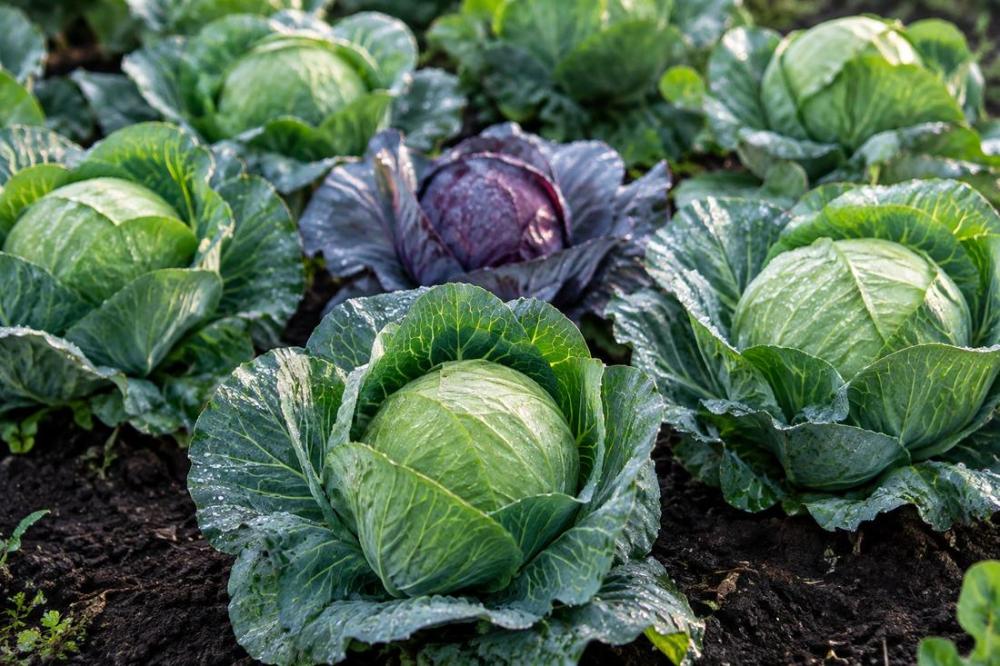

Cabbage is a cool and mild-season vegetable that gives you large, firm heads that keep for days after picking. Success comes down to three things: planting in the right season, giving it enough space, and never letting it go thirsty while the head is forming.
In this article we explain how to grow cabbage from seed step by step: the best time, raising seedlings and spacing, watering and feeding with rates, when to harvest, and the most common problems and their fixes.
Best time to plant cabbage
- Mild regions: from August to November.
- Cooler regions: from March to May.
- Avoid having the head form in intense heat, because heads come out small and loose.
Step one: raising seedlings
- Sow seeds in seedling trays at a depth of 0.5 to 1 cm.
- Keep the mix moist but not waterlogged until germination.
- Seedling mix: light and well drained, such as peat moss with a little perlite.
Step two: transplanting
- Transplant seedlings at 30 to 40 days old.
- Suitable soil: well-drained loam rich in organic matter.
- Water straight after transplanting so the roots settle.
Correct spacing
- Brunswick (green) cabbage: 40 to 50 cm between plants.
- Azzurro (red) cabbage: 50 to 60 cm between plants.
- Between rows: leave enough room to walk and tend the plants easily.
- In a pot: one plant in a pot of at least 20 litres.
Watering
- Regular watering that keeps the soil moist, without water pooling around the roots.
- Most important stage: head formation, because drought then gives small heads.
- Do not let the plant dry out then flood it: this is the most common cause of split heads.
Feeding with rates
- Before planting: organic cow manure such as Black Cow at 20 to 30 kg per 100 m², mixed into the soil.
- During vegetative growth: balanced 20-20-20 fertilizer at 1 to 2 g per litre as a spray or through irrigation, every 10 to 14 days.
- Before head formation: a calcium and boron spray such as Calborn Plus at 2 ml per litre, because boron deficiency causes hollow stems and discoloured inner leaves.
When to harvest cabbage
- Usually 90 to 120 days depending on variety and temperature.
- Sign of maturity: the head is full-sized and firm when you press it with your hand.
- Cut the head at the base, leaving a few outer leaves to protect it.
- Do not harvest late: a mature head left too long can split.
Common problems and fixes
The head splits
- Cause: irregular watering, or harvesting late after the head has matured.
- Fix: water regularly and harvest as soon as the head is firm.
The head does not form or is loose
- Causes: heat during head formation, drought, under-feeding, or tight spacing.
Holes in the leaves
- Usually caterpillars of the diamondback moth and cabbage worm.
- Check leaf undersides and remove eggs and caterpillars early, before they reach the head.
Grey insects clustered on the leaves
- Aphids. Spray a potassium soap such as Plant Care at 10 ml per litre on the colonies, covering leaf undersides.
Products from Orkida
- Brunswick Cabbage Seeds, 12 g: large firm heads, depth 0.5 to 1 cm, spacing 40 to 50 cm, harvest after 90 to 120 days.
- Azzurro Red Cabbage Seeds, 10 g: purple heads, transplant at 30 to 40 days, spacing 50 to 60 cm.
- Black Cow Organic Cow Manure, 25 kg: 20 to 30 kg per 100 m² before planting.
- Bavaria 20-20-20 Balanced Fertilizer, 2 kg: 1 to 2 g per litre during vegetative growth.
- Calborn Plus Calcium and Boron, 1 litre: spray at 2 ml per litre before head formation.
- Plant Care Potassium Soap, 1 litre: for aphids, 10 ml per litre.
Frequently Asked Questions
When should I plant cabbage?
In mild regions from August to November, and in cooler regions from March to May.
How long does cabbage take from planting to harvest?
Usually 90 to 120 days depending on variety and temperature.
Why do cabbage heads split?
Because of irregular watering or harvesting late after the head has matured.
How far apart should cabbage plants be?
40 to 60 cm depending on variety; red cabbage needs a little more space.
Can I grow cabbage in a pot?
Yes, one plant in a pot of at least 20 litres, with regular watering.