
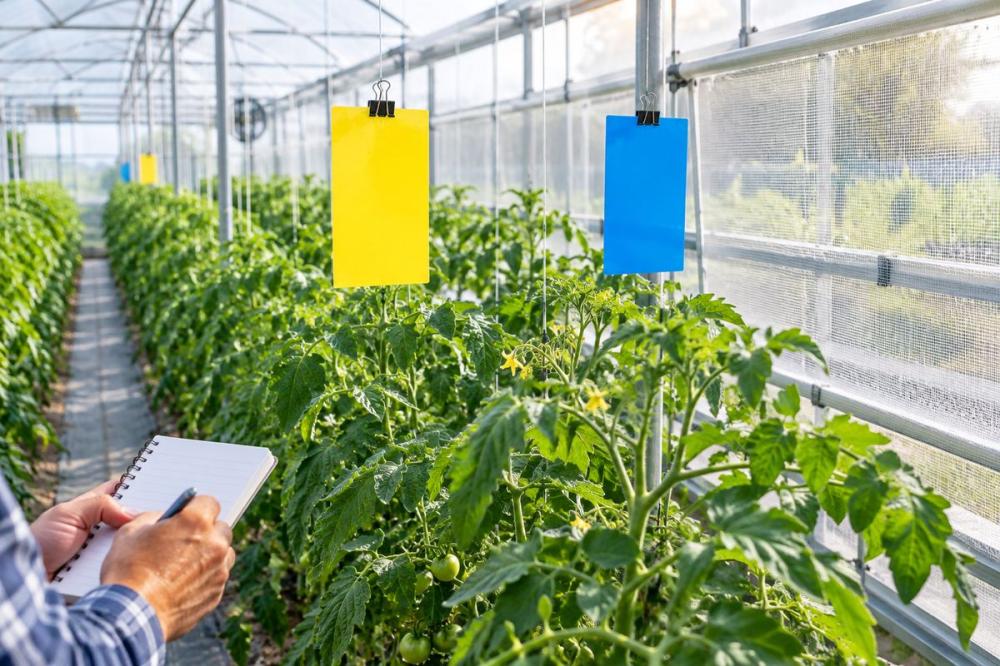

Many growers rely on spraying alone: see an insect, spray it. Over time the sprays multiply, results drop, and pests appear that the insecticide no longer touches. Integrated Pest Management (IPM) solves this. It combines prevention, monitoring, cultural and biological methods, and makes insecticide a planned last step rather than a first reaction.
In this article we explain what IPM is, its six steps in order, how to use sticky traps for monitoring, when to step in with an insecticide, and how to rotate insecticides so pests do not build resistance.
What is Integrated Pest Management?
- Definition: a programme that combines several control methods to keep a pest below the level that causes losses, rather than trying to kill every insect on the farm.
- The core idea: monitor first, act only when needed, and use the lightest method that works.
- Where it applies: greenhouses, open fields, gardens, and even homes and warehouses.
Why is IPM better than spraying alone?
- Slower resistance: repeated spraying with the same active ingredient lets pests adapt; variety keeps insecticides effective.
- Lower cost: fewer, well-timed sprays instead of many that do little.
- Protects natural enemies: beneficial insects such as ladybirds and parasitic wasps work for you for free.
- Cleaner produce: fewer pesticide residues on the crop.
Step 1: Prevention before pests appear
- Healthy seedlings: inspect seedlings before they enter the farm and reject any with insects or spots.
- Insect netting on greenhouse openings: fine netting on vents and doors keeps out whitefly, thrips and Tuta moths.
- Double door: a small entry room before the greenhouse door reduces insects coming in with workers.
- Hygiene: remove weeds around and inside the greenhouse, as they shelter insects and carry viruses, and clear old crop debris straight after harvest.
- Resistant varieties: if a variety tolerant to the pest or disease common in your area is available, choose it.
Step 2: Monitoring with traps and inspection
Monitoring is the heart of IPM, because it tells you when and where to act.
Sticky traps by colour
- Yellow: attracts whitefly, winged aphids and leafminer flies.
- Blue: attracts thrips more strongly than yellow.
- Black: designed for Tuta absoluta (the tomato leafminer moth), usually used with a pheromone lure.
How to hang the traps
- Small cards: about 20 to 30 cm above the plants, raised as the crop grows.
- Black Tuta rolls: higher, depending on the product, such as 40 to 60 cm or 60 to 100 cm above the soil.
- Numbers: for example, Koppert cards for Tuta: at least one card per 100 m²; Biobest black roll: one roll per 1,000 m².
- Placement: near doors and vents first, because that is where insects enter.
Weekly inspection
- Count the insects on the traps once a week and record them in a notebook or on your phone.
- Check the undersides of leaves on selected plants at the edges and centre of the greenhouse.
- Numbers rising week after week mean the infestation is growing and you need to act.
- Replace a trap when its surface is covered in insects or dust, because it catches less.
Step 3: Deciding when to act
- Not every insect needs a spray: a few insects are normal, and natural enemies can keep them in check.
- Act when: trap counts keep rising, damage starts to show on leaves or fruit, or a clear hotspot appears.
- Treat the hotspot: if the infestation is in one corner, treat that area instead of spraying the whole greenhouse.
Step 4: Cultural and mechanical methods
- Remove infested leaves: especially tomato leaves with Tuta mines. Put them in a sealed bag and dispose of them outside the farm.
- Mass trapping: the same sticky traps can be used in large numbers, for example hanging 2 to 3 black Tuta rolls per greenhouse.
- Water traps for flies: with an attractant such as Force Catch to reduce flies around livestock sheds and farms.
- Balanced watering and feeding: too much nitrogen makes plants soft and attractive to aphids and whitefly.
- Crop rotation: do not plant the same crop family in the same soil season after season.
Step 5: Biological control
- Natural enemies: such as ladybirds that feed on aphids, parasitic wasps that attack whitefly, predatory bugs that feed on Tuta eggs and larvae, and predatory mites that feed on spider mites and thrips.
- Protect them: do not spray broad-spectrum insecticides unnecessarily, because they kill beneficial insects before pests.
- Pheromones: used to lure male insects into traps and reduce mating.
Step 6: Smart chemical control
When you decide to spray, make it count:
- Choose the right insecticide for the pest: a systemic for sucking insects such as aphids and whitefly, and a contact or stomach insecticide for larvae.
- Stick to the rate: a higher dose does not work faster and speeds up resistance.
- Cover the undersides of leaves: most sucking insects live under the leaf.
- Respect the pre-harvest interval stated on each product.
Rotating insecticides by IRAC group
- Every insecticide has an IRAC group number that shows how it works, such as 4A for imidacloprid, 3A for pyrethroids like lambda-cyhalothrin and deltamethrin, and 22A for indoxacarb.
- The rule: do not use the same group for more than two sprays in a row. Switch to a different group for the next spray.
- Example: one spray with a group 4A insecticide against whitefly; if you need a second spray about two weeks later, use an insecticide from a different group.
- Group 4A example: Midbride 70% WDG (imidacloprid) at 15 to 25 g per 100 litres of water.
Common pest control mistakes
- Spraying on a schedule every week without monitoring.
- Hanging traps and forgetting them without counting or replacing them.
- Using the same insecticide every time because it "used to work".
- Leaving crop debris and weeds on the farm after harvest.
- Opening the greenhouse without netting during insect migration periods.
Products from Orkida
- Russell Optiroll Black Tuta Roll: hang 80 to 130 cm above the plants; 2 to 3 rolls per greenhouse, or one roll per about 2,000 m² in open fields.
- Biobest Black Sticky Roll: one roll per 1,000 m², 40 to 60 cm high.
- Biobest Black Sticky Board: for Tuta, 60 to 100 cm high.
- Koppert Sticky Cards: 20 to 30 cm above the crop, at least one card per 100 m² for Tuta.
- Biobest Yellow Sticky Board, 25 × 40 cm: for monitoring whitefly, winged aphids and leafminers.
- Biobest Yellow Sticky Roll: for mass trapping, 50 cm to 1 m high.
- Biobest Blue Sticky Board: for monitoring thrips.
- Russell Blue Sticky Roll: for thrips, about 20 to 30 cm above the crop.
- Midbride 70% WDG: imidacloprid (group 4A) for sucking insects, 15 to 25 g per 100 litres of water.
You can browse all monitoring supplies and traps in our IPM supplies category.
Frequently Asked Questions
What is the difference between IPM and chemical control?
Chemical control relies on insecticides alone. IPM combines prevention, monitoring, cultural and biological methods, and uses insecticides only when truly needed, in a way that slows resistance.
Are sticky traps enough on their own?
They are enough for monitoring and reduce numbers when used in large quantities, but heavy infestations need other methods as well.
Which trap colour should I choose?
Yellow for whitefly, aphids and leafminers, blue for thrips, and black for the Tuta moth.
How often should I replace sticky traps?
When the surface is covered in insects or dust and loses its stickiness, usually every two to four weeks depending on pest pressure and dust.
Does IPM work at home?
Yes. The same idea applies: hygiene and sealing entry points first, then monitoring, then baits or targeted treatment of infested spots only.