
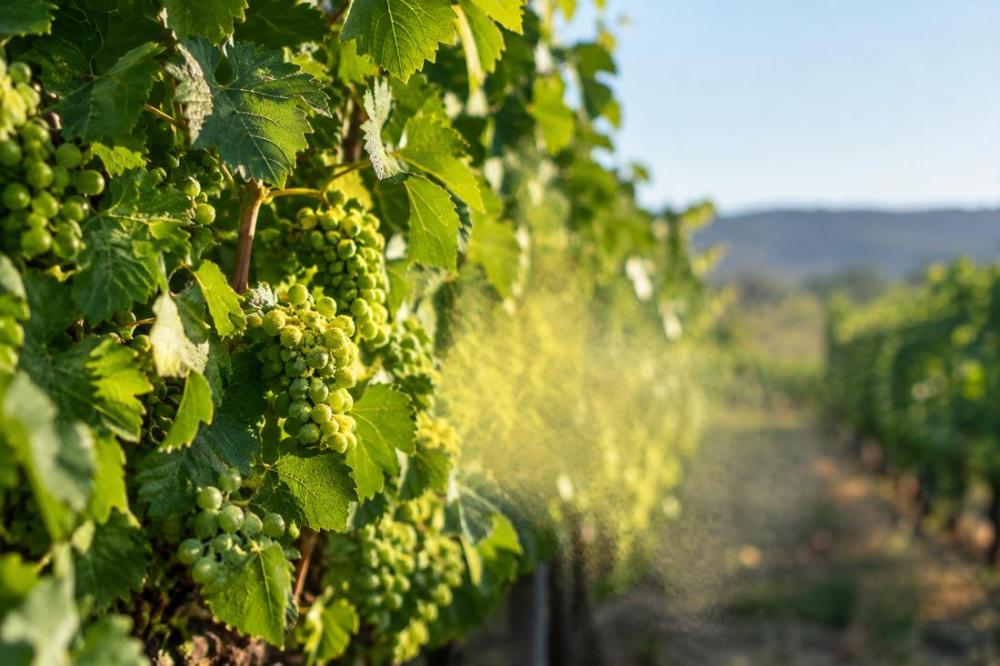

Sulphur is one of the oldest and cheapest answers to powdery mildew and mites, and dry dusting reaches places a spray cannot, with no water and no mixing. But dusting has a method: the right amount, the right duster and the right timing, otherwise the powder blows away or burns the plant.
In this article we explain when to dust sulphur, how many kilos you need for each area, how to use a sulphur duster step by step, and how to clean it.
When to use sulphur dusting
- Powdery mildew on tomato, pepper, grapes and cucurbits.
- Mites on vegetables, grapes and date palms.
- Crops that dislike moisture, because dusting is dry with no water.
- Organic growing, because sulphur is a natural material.
Amount per crop
- Tomato: 10 kg per 1,000 m² after transplanting, with a pre-harvest interval of 3 days.
- Pepper: 10 kg per 1,000 m² before flowering, with a pre-harvest interval of 3 days.
- Grapes: 10 kg per 1,000 m² after fruit set, with a pre-harvest interval of 7 days.
- Date palms: 0.5 kg per palm after fruit set against mites, with a pre-harvest interval of 7 days.
- In other words: the 1 kg pack covers roughly 100 square metres of tomato, pepper or grapes.
The TWISTER 6005 sulphur duster
- Capacity: about 12 L total, with about 10 L working capacity.
- Operation: manual lever, with no electricity, battery or petrol.
- Control: a MIN / MAX regulator for dusting density, with flow up to about 450 cc per minute.
- Coverage: up to about 1,500 square metres.
- Weight: 4.4 kg, worn on the back with padded straps.
How to dust, step by step
- Close the flow regulator before opening the lid.
- Fill the tank with fine, dry sulphur free of lumps, and close the lid tightly.
- Put the duster on your back and adjust the straps.
- Set the dusting density on the regulator to suit the crop and area.
- Work the lever steadily and walk at a constant pace, aiming the nozzle at the leaves and inner parts of the plant.
- Empty what is left and clean the tank, hose, nozzle and filter after work.
Important tips
- Dust early in the morning or before sunset, and never in extreme heat so the plant does not scorch.
- Do not dust in strong wind so the powder does not blow away.
- Do not overdo the density on sensitive plants.
- Wear a mask, gloves and goggles while filling and dusting.
- Do not leave powder in the duster for long, especially in humid weather, so it does not cake.
- The duster is for dry powder only, not for liquids.
Products from Orkida
- DiMartino TWISTER 6005 Agricultural Sulphur Duster: an Italian manual backpack duster.
- SAF Agricultural Dusting Sulphur, 1 kg: 10 kg per 1,000 m² for tomato, pepper and grapes.
- Force Catch Hand Duster, 250 g: for insecticide powder in cracks and corners indoors.
Frequently Asked Questions
How much dusting sulphur do I need for tomatoes?
10 kg per 1,000 square metres, which is roughly 1 kg per 100 square metres.
When can I harvest after sulphur dusting?
After 3 days for tomato and pepper, and 7 days for grapes and palms.
How much area does the TWISTER duster cover?
Up to about 1,500 square metres.
Can I use the duster for a liquid pesticide?
No, it is designed for dry powder only.
What is the best time to dust?
Early morning or before sunset, with no strong wind and away from extreme heat.