
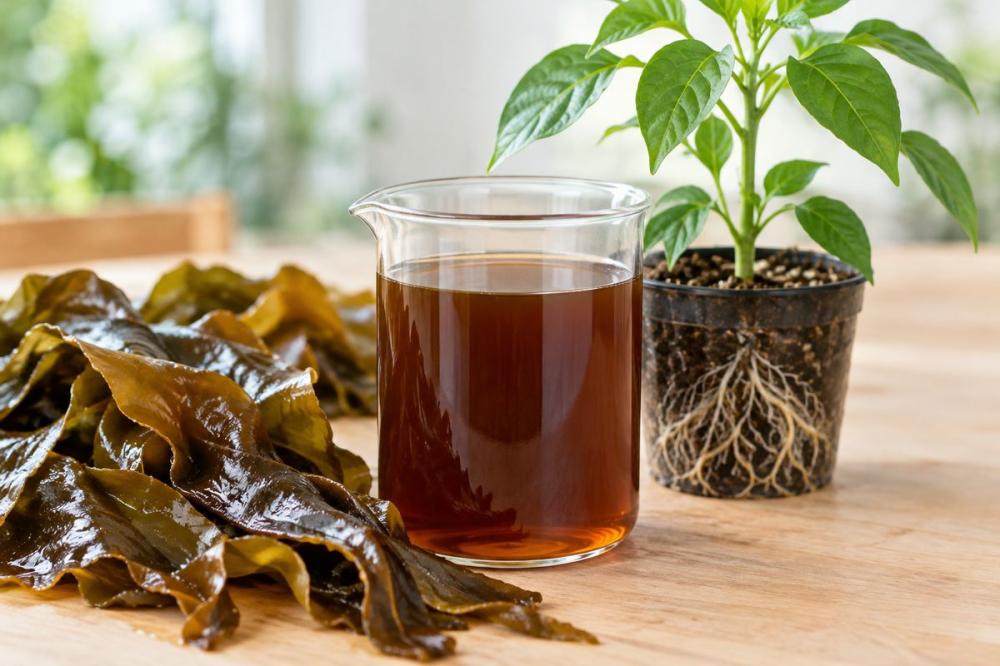

Seaweed fertilizer is one of the products farmers and gardeners ask about most. It is not an NPK fertilizer that feeds the plant in large amounts. It is a biostimulant that helps the plant cope with heat, salinity and transplanting, and strengthens roots and flowering.
In this article we explain what seaweed fertilizer is, its real benefits, when to use it, and how to spray it or apply it through irrigation, with rates.
What is seaweed fertilizer?
A natural organic fertilizer extracted from brown seaweed, most commonly:
- Ascophyllum nodosum: from the North Atlantic, the most widely used.
- Ecklonia maxima: from South Africa, known for strong root stimulation.
What does it contain?
- Natural growth regulators: auxins (for roots) and cytokinins (for cell division and growth).
- Carbohydrates such as alginates and mannitol, which help soil hold water and help plants withstand stress.
- Amino acids and micronutrients in small amounts.
Benefits of seaweed fertilizer
- Stronger roots: stimulates new root growth after transplanting or planting trees.
- Stress tolerance: helps the plant withstand heat, drought, salinity and cold.
- Better flowering and fruit set: reduces the drop of flowers and small fruit.
- Better fruit quality: improved size and colour in many crops.
- More efficient fertilizing: an active plant takes up nutrients better.
- Suitable for organic growing: because it is 100% natural.
Does it replace regular fertilizer?
No. Seaweed is a stimulant, and its NPK content is very low. Use it alongside your regular feeding programme, not instead of it.
When to use seaweed fertilizer
- Straight after transplanting: reduces transplant shock and speeds up root establishment.
- Before and during flowering: improves fruit set and reduces drop.
- Before or after heatwaves: helps the plant cope and recover.
- On saline land or with saline irrigation water.
- After a pest or disease attack or hard pruning, to get the plant growing again.
How to use it
Foliar spray
- General rate: 2 to 3 ml per litre of water for most liquid extracts, rising to 5 ml for some concentrated products used to stimulate roots.
- Spray early morning or late afternoon and cover the leaves fully.
- Repeat every 10 to 15 days, 3 to 4 times per season.
Through irrigation (drip or around the roots)
- General rate: 1 to 2 litres per 1,000 litres of irrigation water, or 2 to 4 litres per hectare.
- For house plants and pots: use the same dilution as the foliar spray and water it in around the roots.
For seedlings
- Dip the seedling tray or the roots of the transplant in a light solution before moving it, then water with it straight after planting.
Rates for our products
- Algifol (25% seaweed extract): spray 2 to 3 ml per litre every 10 to 15 days; by drip 2 to 4 litres per hectare.
- Kelpak (Ecklonia maxima): spray 2 to 5 ml per litre once every two weeks; through irrigation 1 to 2 litres per 1,000 litres once every 4 to 6 weeks. Very good for root stimulation.
- Acadian (100% natural seaweed): spray 2 to 3 ml per litre; through irrigation 1 to 2 litres per 1,000 litres, 3 to 4 times per season at 10 to 15-day intervals.
- Super Sixty (50% seaweed extract): spray 1 litre per 1,000 litres of water (1 ml per litre); through irrigation 2 to 4 litres per hectare depending on the crop, repeated every 14 days.
Mixing tips
- Most seaweed extracts are compatible with soluble fertilizers and amino acids.
- Before mixing with a pesticide, test a small amount in a container and check the solution stays clear.
- Do not mix with strongly alkaline solutions or mineral oils.
- Shake the container well before use.
Common mistakes
- Using it instead of fertilizer and expecting strong growth, leaving the plant short of nutrients.
- Raising the concentration because it is natural. Too much can cause unbalanced growth or mild burning.
- Spraying at midday in the heat.
- Using it only once. The results show with regular repeat applications.
Products from Orkida
- Algifol Seaweed Extract, 1 L: 2 to 3 ml per litre as a spray every 10 to 15 days; 2 to 4 litres per hectare by drip.
- Kelpak Seaweed Root Stimulant, 1 L: 2 to 5 ml per litre as a spray every two weeks; 1 to 2 litres per 1,000 litres through irrigation.
- Acadian 100% Natural Seaweed Fertilizer, 1 L: 2 to 3 ml per litre as a spray; 1 to 2 litres per 1,000 litres through irrigation.
- Super Sixty Seaweed Extract, 5 L: 1 litre per 1,000 litres as a spray; 2 to 4 litres per hectare through irrigation every 14 days.
Frequently Asked Questions
What does seaweed fertilizer do?
It strengthens roots, helps the plant cope with heat, salinity and transplanting, and improves flowering, fruit set and fruit quality.
How often should I spray seaweed fertilizer?
Roughly every 10 to 15 days, 3 to 4 times per season, or as the plant needs during stress.
Is seaweed fertilizer good for house plants?
Yes. Dilute it at 2 to 3 ml per litre and water it in around the roots or spray the leaves once every two weeks.
Can I mix it with 20-20-20 fertilizer?
Yes, most seaweed extracts are compatible with soluble fertilizers. Test the mix in a small amount first.
What is the difference between seaweed fertilizer and amino acids?
Seaweed contains natural growth regulators and carbohydrates that help with stress tolerance and root stimulation. Amino acids give the plant ready-made building blocks for protein. They are often used together.