
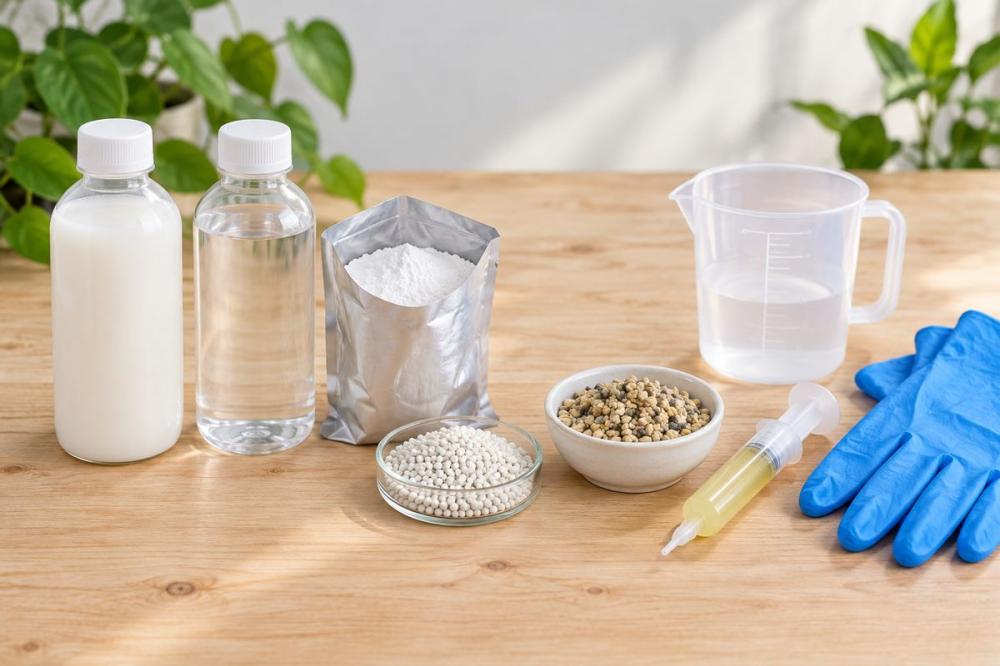

Ever seen letters like EC, SC, WP or WG on a pesticide label and wondered what they mean? These letters are the formulation type. They tell you how to mix the product, which surfaces it works on, how long it lasts, and whether it leaves a smell or stains.
The same active ingredient can come in several formulations, and each one suits a different job. In this article we explain the most common pesticide formulations, how they differ, and when to choose each one, with examples and rates from products we stock.
Why does the formulation matter?
- Preparation: some are liquids you dilute in water, some are powders or granules you dissolve, and some are ready to use.
- Surface: some formulations work on absorbent surfaces like wood and concrete, others on smooth surfaces like tiles and ceramics.
- Smell and stains: some formulations contain solvents with an odour, others are almost odourless.
- Residual life: some formulations leave a longer-lasting residue than others.
- Plant safety: some formulations can scorch sensitive leaves in hot weather.
Liquid formulations diluted in water
EC: Emulsifiable Concentrate
- What it is: the active ingredient dissolved in a solvent. When mixed with water, the solution turns milky white.
- Pros: easy to mix, fast-acting, widely available and affordable.
- Cons: solvent smell, quickly absorbed by concrete and wood, and can scorch sensitive plant leaves in intense heat.
- When to choose it: general spraying of livestock sheds, yards and outdoor areas, or when you want a fast knockdown.
- Example: Alfaquest 100 EC (alpha-cypermethrin 10%) at 10 to 25 ml per litre of water.
SC: Suspension Concentrate
- What it is: fine solid particles of the active ingredient suspended in water, without strong solvents.
- Pros: mild odour, usually safe on plants, and a good residual on absorbent surfaces.
- Cons: shake the container well before use, because the particles settle at the bottom.
- When to choose it: inside homes and restaurants, on walls, corners and absorbent surfaces.
- Example: Delmax 50 SC (deltamethrin 5%) at 8 ml per 10 litres for American cockroaches and 10 ml per 10 litres for flies; 10 litres covers 500 m².
EW: Emulsion, oil in Water
- What it is: a water-based emulsion with far less solvent than an EC.
- Pros: less odour, gentler on surfaces, and suitable for indoor and outdoor spraying.
- When to choose it: when you want EC-like speed with a milder smell.
- Example: Lambda Plus EW at 3 to 8 ml per litre for cockroaches and 2 to 8 ml per litre for flies and mosquitoes.
CS: Capsule Suspension
- What it is: the active ingredient enclosed in microcapsules that break down gradually.
- Pros: longer residual, low odour, and a slower but steadier effect.
- When to choose it: when you need longer protection, in agriculture or public health.
- Agricultural example: Warrior 10 CS (lambda-cyhalothrin) at 20 to 25 ml per 100 litres of water against aphids, caterpillars and whitefly.
SL: Soluble Liquid
- What it is: the active ingredient fully dissolved in water; the mix is clear after dilution.
- Pros: very easy to mix, well suited to systemic insecticides taken up by the plant, and usable as a spray or through irrigation.
- When to choose it: in agriculture, especially against sucking insects.
- Example: Imidor 200 SL (imidacloprid 20%) at 50 to 125 ml per 100 litres of water for aphids and whitefly in greenhouses.
Solid formulations dissolved in water
WP: Wettable Powder
- What it is: a fine powder mixed with water to form a suspension.
- Pros: no solvents, so almost no smell, and excellent on absorbent surfaces like concrete and brick because the powder stays on the surface.
- Cons: can leave a faint white mark on dark surfaces, and the mix must be agitated while spraying so it does not settle.
- Examples:
- Ferculon-L 100 WP (lambda-cyhalothrin 10%): 10 g in 10 litres of water per 500 m² for household use.
- Kick 100 WP powder: 4 g per litre of water; one litre covers about 100 m².
- Aquachem 25% WP (imidacloprid, agricultural): 0.2 to 0.3 g per litre for cucumber, pepper and aubergine.
WG / WDG: Water-Dispersible Granules
- What it is: small granules that break up quickly in water.
- Pros: no dust when weighing and mixing, so cleaner and safer than powders, with a high concentration.
- Examples:
- Advion WDG (indoxacarb): 10 g per 4 litres of water.
- Midbride 70% WDG (imidacloprid, agricultural): 15 to 25 g per 100 litres of water.
Ready-to-use formulations (no mixing)
Granules (GR) and granular baits
- What they are: granules spread as they are; most are baits the insect eats and carries back to the colony.
- Pros: easy, no sprayer needed, and they reach the nest.
- Examples:
- Zars 25 G (imidacloprid 2.5%) for ants: 2 g per square metre on ant trails and nest entrances. Do not spray insecticide in the same spot, or the ants will avoid the bait.
- Clean Fly 5 G for flies: 180 g per 100 m² spread thinly on a plate or tray.
Ready-to-use dusts (DP)
- What they are: powders applied directly without water.
- Pros: they reach cracks and voids that sprays cannot, such as behind appliances and under sinks.
- Examples:
- Shock DP (deltamethrin 0.05%): 15 g per 2 m².
- Fire 0.5% (indoxacarb): 2 g per square metre.
Gel
- What it is: a gel bait in a syringe, applied as small dots.
- Pros: no smell and no spraying, safe for kitchens and sensitive areas, and cockroaches spread it to others.
- Example: Maxforce Forte: 3 to 4 dots per m² for German cockroaches and 4 to 6 dots per m² for American and Oriental cockroaches.
How to choose the right formulation
By location
- Inside the home and kitchen: gel, SC, WP or EW, because they have a mild smell.
- Cracks and voids: dust.
- Gardens, yards and livestock sheds: EC, EW or CS.
- Ants on their trails: granular bait or gel.
- Farms and greenhouses: SL, SC, WG or CS depending on the pest.
By surface
- Absorbent surfaces (concrete, brick, unpainted wood): WP or SC. An EC soaks into the surface quickly and its effect drops.
- Smooth surfaces (tiles, ceramics, metal): most formulations work, and EC and EW give good results.
By odour
- Almost odourless: gel, WP, SC or granules.
- Odour does not matter (outdoors): EC.
Key mixing tips
- Shake the container before opening, especially SC and CS.
- Add half the water first to the sprayer, then the product, then top up with water.
- Powders (WP): make a thin paste with a little water in a cup first, then add it to the sprayer.
- Do not mix two products without testing a small amount in a container first to check for settling or clumping.
- Use the mix the same day, and do not store the diluted solution.
- Wear gloves and a mask when mixing and spraying.
Common mistakes
- Thinking a higher concentration is better: formulation and concentration are different things. Stick to the rate for each product.
- Spraying an EC on sensitive leaves at midday, which scorches the foliage.
- Spraying insecticide over a bait or gel, which makes insects avoid the bait.
- Not agitating a WP mix while spraying, so the product settles at the bottom and the spray comes out weak.
Products from Orkida
- Alfaquest 100 EC, 1 L: alpha-cypermethrin 10%, 10 to 25 ml per litre of water.
- Delmax 50 SC, 1 L: deltamethrin 5% with a mild odour, 8 ml per 10 litres for American cockroaches.
- Lambda Plus EW, 1 L: 3 to 8 ml per litre for cockroaches.
- Ferculon-L 100 WP, 25 g: wettable powder, 10 g in 10 litres per 500 m².
- Advion WDG, 10 g: water-dispersible granules, 10 g per 4 litres of water.
- Zars 25 G, 100 g: granular ant bait, 2 g per square metre.
- Shock DP, 500 g: ready-to-use dust, 15 g per 2 m².
- Maxforce Forte Gel, 30 g: 3 to 6 dots per m² depending on the cockroach species.
- Imidor 200 SL, 1 L: agricultural, 50 to 125 ml per 100 litres for aphids and whitefly.
- Warrior 10 CS, 250 ml: agricultural capsule suspension, 20 to 25 ml per 100 litres of water.
Frequently Asked Questions
What is the difference between EC and SC?
An EC is dissolved in a solvent, has a stronger smell and turns milky white in water. An SC is particles suspended in water with a mild smell, better suited to absorbent surfaces and indoor use.
What does WP mean on a pesticide?
Wettable powder: a powder you mix with water and spray. It contains no solvents, so it has little smell and lasts longer on concrete and brick.
Which is better for the home: liquid, powder or gel?
Gel is best for kitchens and sensitive areas, dust for corners and cracks, and SC or WP for general spraying of walls and under furniture because of their mild smell.
Can I mix two formulations together?
Sometimes, but test a small amount in a container first. If you see settling, clumping or separation, do not mix them.
Why did my pesticide mix turn white?
If the formulation is an EC, this is normal and means the emulsion has formed correctly.