
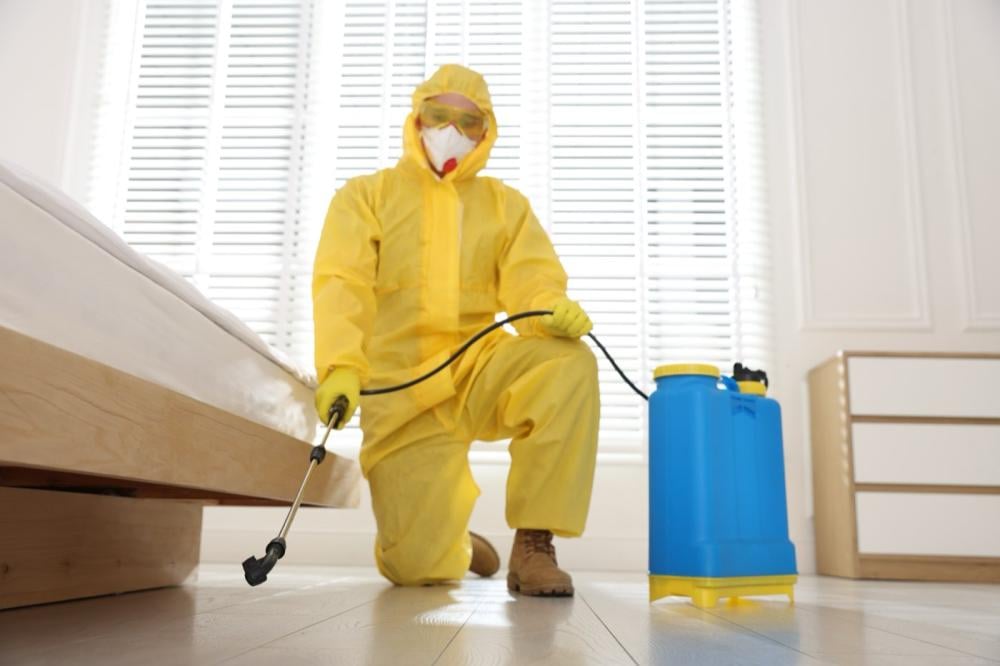

Odourless insecticide is what most households ask for now, especially homes with children or people sensitive to smell. The good news is that there are insecticides with very little odour that work just as well as regular ones, as long as you choose the right formulation and spray it the right way.
This article explains why some insecticides smell strongly, which types have a mild odour, and how to treat your home without the smell lingering for days.
Why do some insecticides smell so strong?
Most of the smell does not come from the active ingredient itself; it comes from the solvent the product is made with:
- Emulsifiable concentrates (EC): contain petroleum solvents and are the type most likely to smell.
- Ready-to-use aerosols: contain a propellant and a solvent, and the smell spreads through the room quickly.
- Water-based formulations: the carrier is water, so the odour is very mild or barely noticeable.
The same active ingredient can come in a strong-smelling formulation and a mild one.
Low-odour insecticide types
Capsule suspension (CS)
- The active ingredient sits inside tiny capsules suspended in water.
- Mild odour, sticks to surfaces and gives long residual activity.
- Suitable for bedrooms, living rooms and enclosed spaces.
Emulsion in water (EW)
- A water-based product instead of a petroleum solvent.
- Much less odour than a regular concentrate, suitable for spraying inside and around the home.
Water-dispersible granules (WG) and wettable powders (WP)
- Powder or granules you dissolve in water, with no solvent, so they are almost odourless.
- May leave a light white residue on dark surfaces.
Gels and baits
- No spraying at all, so nothing spreads through the air.
- Best for cockroaches and ants in kitchens and cupboards.
Dust
- Applied into cracks, voids and behind appliances, with practically no odour.
Glue traps
- No insecticide at all, useful for monitoring and catching crawling insects.
Which type for each pest?
| Pest | Low-odour option |
|---|---|
| Cockroaches | Gel + capsule spray around hiding places |
| Ants | Gel bait on ant trails |
| Bed bugs | Capsule or water-based spray on beds and cracks |
| Fleas | Capsule spray on carpets and sofas |
| Mosquitoes and flies | Water-based spray on resting surfaces |
| Insects in cracks | Dust |
How to spray without the smell lingering
- Stick to the mixing rate on the label, because a stronger mix means more smell without better results.
- Spray surfaces and cracks, not the air.
- Open windows and run fans once the spray is dry.
- Leave bedrooms until last and return only once they are completely dry and ventilated.
- Rinse the sprayer after each use so residues of an older, stronger-smelling product do not mix in.
For the full method, see How to Spray Pesticides at Home Yourself.
Is an odourless insecticide weaker?
No, smell has nothing to do with strength. Strength comes from the active ingredient, its concentration and how it is applied. Many capsule products actually give longer residual activity than regular concentrates because they stay on surfaces.
Note: odourless does not mean risk-free
- A low-odour product is still an insecticide, so keep children and pets away while spraying and until it dries.
- Never store it in food or drink containers, even if it has no smell.
- Read the label for warnings and re-entry time.
Products from Orkida
- Demand CS by Syngenta
- Optiguard Flex by Syngenta
- Aqua K-Othrine EW
- Advion cockroach gel by Syngenta
- Advion ant gel by Syngenta
- K-Othrine dust
Odourless insecticide FAQs
What is the best odourless insecticide for the home?
Usually a capsule suspension (CS) for spraying and gel for cockroaches and ants. Both have a mild odour and give strong results.
Can I sleep in the room after spraying a low-odour insecticide?
Yes, once the spray is completely dry and the room is ventilated. Do not sleep in a room while it is still wet.
Why did the insecticide smell last for days?
Usually because it was a solvent-based concentrate, the mix was too strong, or the room was not ventilated. Open windows, run fans, and next time use a water-based formulation.
Is an odourless insecticide safe for children?
No insecticide is completely safe. Keep children out while spraying, bring them back once it is dry and ventilated, and keep toys away from treated surfaces.