
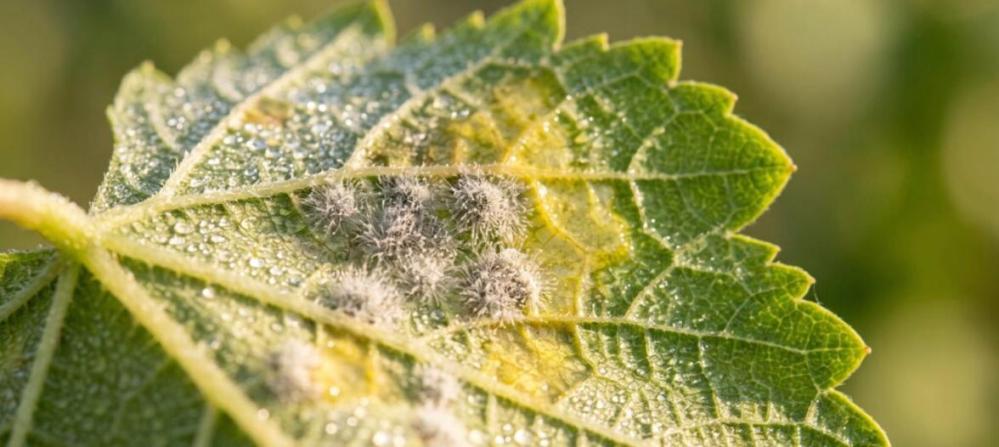

Metalaxyl is a systemic fungicide that specialises in one group of pathogens: the oomycetes. That means downy mildew, late blight, and the root rot and damping-off caused by Pythium and Phytophthora. On these diseases it is one of the strongest actives, and on anything else it is of no use.
This article explains how metalaxyl works, the difference between metalaxyl and metalaxyl-M, when to spray or drench it, and why most of its products are mixed with copper.
- Group: phenylamides, FRAC group 4.
- Type: fully systemic fungicide, absorbed by leaves and roots and carried with the sap.
- Works on: downy mildew, late blight, Pythium and Phytophthora.
- Does not work on: powdery mildew, Alternaria, rust and most true fungi.
- Common forms: wettable powder (WP) mixed with copper, or emulsifiable concentrate (EC) of metalaxyl-M at 48%.
How does metalaxyl work?
It stops RNA production inside the pathogen's cells, which halts growth of its threads and spore formation.
- Leaves and roots absorb it quickly.
- It moves upward with the sap, protecting new growth.
- A soil drench reaches the roots and stem, which is why it is so strong on root rot and damping-off.
Metalaxyl and metalaxyl-M: what is the difference?
Regular metalaxyl contains two forms of the molecule, and only one of them is active. Metalaxyl-M (sometimes called mefenoxam) is the active form alone, so its dose is roughly half that of regular metalaxyl for the same result.
Which diseases does it control?
- Propamocarb: The Fungicide for Root Rot and Downy Mildew, and How to Drench It
- Downy mildew: in cucumber, grapes, onion and lettuce.
- Late blight: in tomato and potato.
- Phytophthora blight and crown rot: in peppers and cucurbits.
- Root rot: caused by Pythium and Phytophthora in vegetables and citrus.
- Damping-off: in nurseries and new plantings.
When to spray or drench it
1. On leaves: preventive or at the first symptoms
For downy mildew and late blight, start when the weather is humid and relatively cool, before symptoms or at the first spot.
2. In the soil: at planting or at the first wilting
For root rot and damping-off, drench around the roots or apply through drip irrigation as the label directs, at transplanting or as soon as you see root-related wilting.
3. Do not rely on it alone on leaves
Pathogens develop resistance to metalaxyl very fast when it is sprayed alone. That is why most spray products mix it with copper or another protectant.
How to protect it from resistance
- Use ready mixes with copper or another protectant for leaf sprays.
- Limit the number of sprays per season as the label says, usually no more than two to four.
- Rotate with other groups effective on downy mildew, such as propamocarb, cymoxanil or copper.
- Do not use it as a cure once the infection has spread across the whole field.
Safety
- Wear gloves, goggles and a mask.
- Take care when mixing powders, because they become airborne.
- Respect the pre-harvest interval stated on the label.
Products from Orkida
- Uniform 446 SE, 250 ml: metalaxyl-M with azoxystrobin for root rot and damping-off.
- Armitel C WP, 1 kg: metalaxyl with copper oxychloride for downy mildew.
- Redoxil 480 EC, 250 ml: metalaxyl-M 48% for downy mildew and root rot.
- Vacomil Plus 50% WP, 1 kg: metalaxyl with copper oxychloride, preventive and curative.
- Vacomil 35% WP, 1 kg: metalaxyl 35% for downy mildew and late blight.
Frequently asked questions
Does metalaxyl work on powdery mildew?
No. Powdery mildew is a true fungus and needs actives such as difenoconazole, sulphur or azoxystrobin.
Why do most metalaxyl products contain copper?
Because pathogens resist metalaxyl quickly when it is used alone. Copper kills in a different way and protects metalaxyl from resistance.
Can I apply it through drip irrigation?
Yes. Liquid products such as metalaxyl-M 48% work through irrigation water for root rot, as the label directs.
When will I see results on root rot?
A badly infected plant may not recover. The benefit is that the infection stops spreading and new roots grow healthy within days to two weeks.