
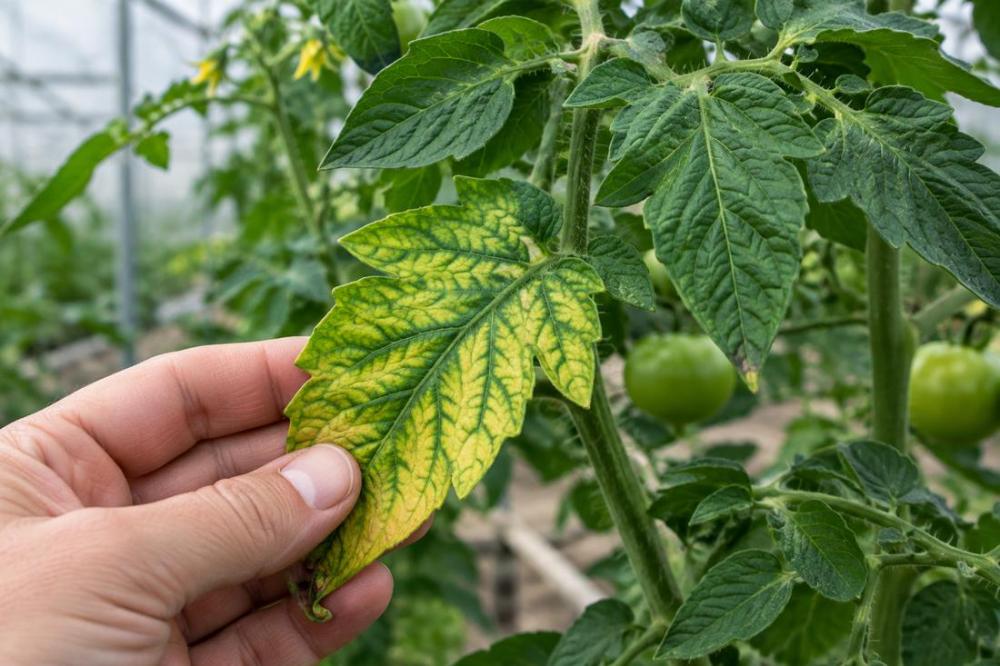

If the older lower leaves are turning yellow between the veins while the veins stay green, the plant is most likely suffering from magnesium deficiency. Magnesium sits at the heart of chlorophyll, and without it the plant cannot photosynthesise properly, so growth weakens and yields drop even when nitrogen and potassium feeding is adequate.
In this article we explain the symptoms of magnesium deficiency and how to tell it apart from iron deficiency, its causes, the difference between magnesium sulphate and magnesium nitrate, and the correct rate for each product.
Symptoms of magnesium deficiency
- Yellowing between the veins on older leaves first, while the veins stay green.
- Yellowing starts at the leaf edges and moves inwards, and leaves sometimes turn reddish or purple.
- Early drop of the lower leaves in severe cases.
- Smaller, poorer-quality fruit because the plant cannot make enough food.
Magnesium deficiency versus iron deficiency
- Magnesium: starts on the older lower leaves, because the plant moves it from old leaves to new ones.
- Iron: starts on the young upper leaves, because iron does not move within the plant.
- The simple rule: yellowing at the bottom usually means magnesium; yellowing at the top usually means iron.
Causes of magnesium deficiency
- Light sandy soils that irrigation leaches quickly.
- Excess potassium, calcium or ammonium, which compete with magnesium for uptake.
- Over-watering that washes nutrients away from the roots.
- Heavy-feeding crops such as tomatoes, peppers, cucumbers, grapes, date palms and citrus.
Magnesium sulphate or magnesium nitrate?
Magnesium sulphate (Epsom salt)
- Contains: 16% magnesium as MgO plus sulphur, which the plant also uses.
- Form: soluble powder, cheaper, and suitable for foliar spray and irrigation.
- Best for: correcting deficiency and routine feeding in most crops.
Liquid magnesium nitrate
- Contains: 15% magnesium as MgO and 11% nitrate nitrogen.
- Advantage: faster uptake, and the nitrate nitrogen helps magnesium absorption.
- Best for: cases where you want a quick response, and the vegetative growth stage.
Calcium and magnesium fertilisers
- Contain: calcium, magnesium and nitrogen in a single product.
- Best for: when the plant needs both nutrients, especially at flowering and fruit formation.
Rates by product
- EPSO TOP magnesium sulphate: foliar 0.5 to 0.75 kg per 100 L of water (5 to 7.5 g per litre), and through irrigation 1 to 1.5 kg per 1,000 L of water.
- Mg Sol magnesium sulphate with zinc: through irrigation 2 to 3 kg per 1,000 L of water, foliar 1 to 2 kg per 1,000 L repeated every 10 to 14 days, and in greenhouses 0.5 to 1 kg per 500 m² house.
- ADOB Magnesium: by drip 1 to 2 L per 1,000 L of water (up to 3 L in sandy soil or severe deficiency), and foliar 100 to 150 ml per 100 L of water repeated every 7 to 10 days.
- Super Mag magnesium: foliar 1 to 2 L per 1,000 L of water repeated every 10 to 14 days.
- CalciMAG: foliar 1 to 2 ml per litre of water, and through irrigation in greenhouses 1 to 2 L per 1,000 m².
- MegaCal 40 (17 L): foliar 1 to 2 L per 1,000 L of water, and by drip 5 to 10 L per hectare every 10 to 15 days.
Mixing and spraying precautions
- Do not mix magnesium sulphate with calcium nitrate in the same concentrated tank, as they form a precipitate.
- Magnesium nitrate and calcium-magnesium fertilisers must not be mixed with concentrated phosphate or sulphate fertilisers.
- Spray early in the morning or before sunset and avoid extreme heat.
- Do a jar test before mixing any two fertilisers.
- Magnesium will not fully green up old yellowed leaves, but it stops the deficiency and new leaves come through green.
Products from Orkida
- EPSO TOP 16% German Magnesium Sulphate, 25 kg: foliar 5 to 7.5 g per litre.
- Mg Sol Magnesium Sulphate, 25 kg: magnesium with sulphur and zinc.
- ADOB Magnesium Liquid Nitrate Fertiliser, 20 L: for a fast fix of deficiency.
- Super Mag Magnesium Liquid Nitrate Fertiliser, 20 L: 15% magnesium and 11% nitrogen.
- CalciMAG Liquid Fertiliser, 5 L: calcium, magnesium and nitrogen.
- CalciMAG Liquid Fertiliser, 20 L: for larger areas.
- MegaCal 40 Liquid Fertiliser, 17 L: 20% calcium and 5% magnesium.
- MegaCal 40 Liquid Fertiliser, 1 L: foliar 2 to 2.5 ml per litre.
Frequently Asked Questions
How do I know my plant is short of magnesium?
Yellowing between the veins on the older lower leaves while the veins stay green.
What is the best magnesium fertiliser?
Magnesium sulphate for correction and routine feeding, and liquid magnesium nitrate when you want a faster response.
Is Epsom salt the same as magnesium sulphate?
Yes, Epsom salt is magnesium sulphate.
How often should I spray magnesium?
Usually every 7 to 14 days depending on the product and how severe the deficiency is.
Can I mix magnesium sulphate with calcium nitrate?
No, in a concentrated tank they form a precipitate, so keep each in its own tank or irrigation.