
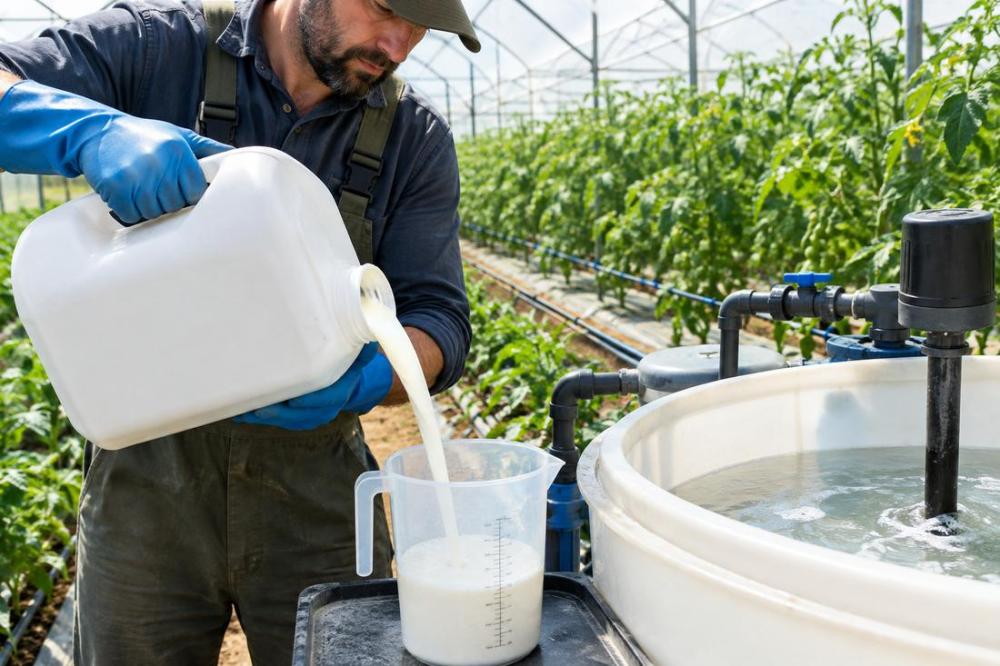

Suspension fertilisers are a type of liquid fertiliser that carries a higher nutrient concentration than clear liquid fertilisers, because part of the nutrients is suspended in the liquid rather than fully dissolved. The result is a fertiliser that is easy to pour and mix, dust-free, and highly concentrated in a single container.
In this article we explain what suspension fertilisers are, their advantages, how to choose the formula by plant stage, the correct rates, and the key precautions.
What is a suspension fertiliser?
- A thick liquid fertiliser with fine nutrient particles spread evenly through the liquid.
- More concentrated than ordinary liquid fertilisers, so you need less of it.
- It must be shaken before use so the nutrients are evenly mixed again.
- It is added through irrigation, and some types can also be sprayed on leaves.
Advantages of suspension fertilisers
- Easy to measure and pour with no powder to weigh and no dust.
- Disperses quickly in the fertiliser tank without lumps.
- The acidic formulas (such as Delta Grow at around pH 3) help with alkaline water.
- There are formulas for every stage from rooting to fruit sizing.
Choosing the formula by stage
Rooting and after transplanting
- Delta Grow 15-65-0: very high phosphorus to stimulate roots, best straight after transplanting, when roots are weak, and before flowering.
- Not for: the fruit fill and sizing stage.
Flowering and fruit set
- Delta Grow 0-52-34 and Libro 0-52-34: phosphorus and potassium for flowering, fruit set and early fruit formation.
All stages
- Delta Grow 20-20-20: balanced feeding through the different growth stages.
Fruit sizing and quality
- Delta Grow 10-6-60 and Libro 0-0-60: high potassium for after flowering and fruit formation, improving size and colour.
Rates
Delta Grow (irrigation only)
- General rate: 1 to 2 L per 1,000 L of water (1 to 2 ml per litre).
- Vegetables: 5 to 7 kg per hectare.
- Fruit trees: 7 to 8 kg per hectare.
- Date palms: 6 to 7 kg per hectare.
- Greenhouses (0-52-34, 20-20-20 and 10-6-60): 2 kg per 1,000 m².
- Frequency: 3 to 4 times per season.
Libro suspension (foliar and irrigation)
- Libro 0-52-34: foliar 3 to 5 g per litre of water, and through irrigation 4 to 8 kg per hectare for trees and 3 to 6 kg per hectare for vegetables and greenhouses.
- Libro 0-0-60: foliar 4 to 6 g per litre of water, and through irrigation 5 to 8 kg per hectare for trees and 5 to 7 kg per hectare for vegetables.
Important precautions
- Shake the container well before every use.
- Do not spray Delta Grow directly on leaves because of its high acidity; use it through irrigation only.
- Do not mix it with calcium fertilisers or alkaline materials, as they precipitate.
- Do a jar test before mixing it with any other product.
- Do not exceed the rate, so you do not raise salinity around the roots.
- Store the container somewhere cool and away from the sun.
Products from Orkida
- Delta Grow 15-65-0 Liquid Suspension Fertiliser, 20 kg: for rooting and after transplanting.
- Delta Grow 0-52-34 Liquid Suspension Fertiliser, 20 kg: for flowering and fruit set.
- Delta Grow 20-20-20 Liquid Suspension Fertiliser, 20 kg: balanced for all stages.
- Delta Grow 10-6-60 Liquid Suspension Fertiliser, 20 kg: for fruit sizing.
- Libro 0-52-34 Suspension Fertiliser, 20 kg: monopotassium phosphate, foliar and irrigation.
- Libro 0-0-60 Suspension Fertiliser, 20 kg: high potassium for better fruit quality.
Frequently Asked Questions
What is the difference between a suspension and an ordinary liquid fertiliser?
A suspension is more concentrated because part of the nutrients is suspended in the liquid, and it must be shaken before use.
Can suspension fertilisers be sprayed on leaves?
Some can, such as Libro 0-52-34 and 0-0-60; Delta Grow is for irrigation only because of its high acidity.
Why do I need to shake the container?
Because the suspended nutrients settle over time, and shaking makes them uniform again.
Which formula should I use after transplanting?
The high-phosphorus Delta Grow 15-65-0.
Can I mix it with calcium nitrate?
No, keep each in a separate irrigation so they do not precipitate.