
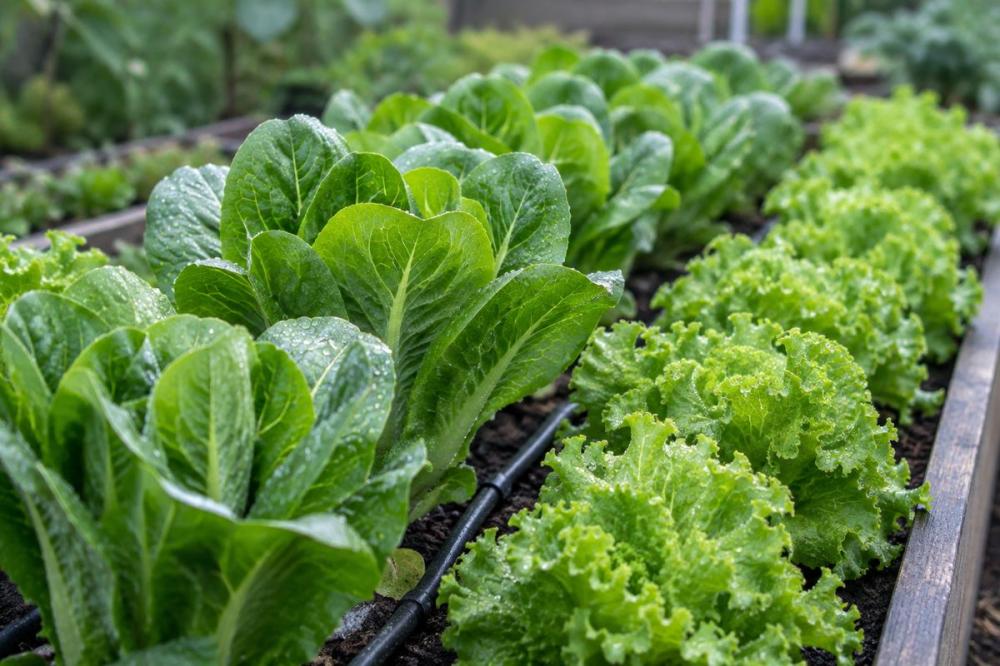

Lettuce is one of the easiest leafy vegetables to grow, and it does well in the garden, in pots and even on a balcony. But it loves cool weather: in the heat it turns bitter, bolts quickly and does not form a head.
In this article we explain how to grow lettuce from seed step by step: the types, the best time, raising seedlings and spacing, watering and feeding, when to harvest, and why lettuce turns bitter.
Types of lettuce
- Romaine lettuce: long, crisp leaves, the most popular for salads.
- Iceberg lettuce: a round, firm, very crisp head that needs cooler weather.
- Batavia lettuce: crinkled, crisp leaves, and more tolerant of changing weather than iceberg.
- Leaf lettuce such as Trocadero: a soft head or open leaves.
Best time to grow lettuce
- Mild areas: from autumn to spring.
- Hot areas: focus on winter and early spring plantings.
- Greenhouses: sowing can start earlier or run longer.
- Avoid heat: high temperatures cause early bolting, bitterness and poor head formation.
How to grow lettuce step by step
1. Sowing
- In seedling trays or directly in the ground.
- Depth: very shallow, about 0.5 cm, because lettuce seed needs light to germinate.
- Moisture: a fine mist keeps the surface moist.
2. Germination
- Within 7 to 10 days depending on temperature.
- Heat delays lettuce germination, so sow in cool weather or keep the tray somewhere cool.
3. Transplanting
- After 3 to 4 weeks, or once the fourth leaf appears.
4. Spacing
- Romaine: 30 to 35 cm between plants and 50 cm between rows.
- Iceberg and Batavia: 30 cm between plants and 50 cm between rows.
- Trocadero: 20 cm between plants and 30 cm between rows.
- In pots: one plant per pot 20 cm wide and 15 cm deep.
Watering lettuce
- Regular watering without drought or waterlogging: its roots are shallow and dry out quickly.
- Drought makes the leaves bitter and burns the leaf edges.
- Water early in the morning at the roots, and leave good airflow between plants to limit fungal diseases.
Feeding lettuce with rates
- Lettuce needs balanced leafy growth: 20-20-20 fertilizer at 1 to 2 g per litre as a spray or through irrigation, every 10 to 14 days.
- Do not overdo it: too much fertilizer produces soft leaves prone to disease and raises nitrate levels in the leaves.
- Stop feeding one to two weeks before harvest.
When to harvest lettuce
- Romaine: 50 to 60 days after sowing.
- Trocadero: 60 to 90 days depending on the variety.
- Iceberg and Batavia: when the head is fully formed and firm.
- How: cut the head at the base with a knife.
- Best time: early morning, when the leaves are crisp and cool.
- Leaf lettuce: you can pick the outer leaves in batches.
Common problems and their causes
Bitter lettuce
- Causes: heat, drought, or harvesting late after bolting has started.
A tall stem appears (bolting)
- Cause: heat and long days. Sow at the right time and harvest before the heat.
Burnt leaf edges
- Causes: drought, intense heat or calcium deficiency.
The head does not form
- Causes: heat, crowding or irregular watering.
Tiny insects in the heart of the lettuce
- Usually aphids. Check the heart and the undersides of leaves, and spray potassium soap at 10 ml per litre if needed.
Products from Orkida
- Romaine Lettuce Seeds, 8 g: 0.5 to 1 cm deep; transplant after 3 to 4 weeks; 30 to 35 × 50 cm spacing; harvest after 50 to 60 days.
- Iceberg Lettuce Seeds, 6 g: 0.5 cm deep; germinates in 7 to 10 days; one plant every 30 cm.
- Batavia Verde Green Lettuce Seeds, 7 g: no deeper than 0.5 cm; 50 × 30 cm spacing.
- Trocadero Lettuce Seeds, 6 g: 20 × 30 cm spacing; harvest after 60 to 90 days.
- Bavaria 20-20-20 Balanced Fertilizer, 2 kg: 1 to 2 g per litre every 10 to 14 days.
- Plant Care Potassium Soap, 1 L: for aphids, 10 ml per litre.
Frequently Asked Questions
When should I plant lettuce?
From autumn to spring, and in hot areas focus on winter and early spring.
Why is my lettuce bitter?
Because of heat, drought or harvesting too late.
How long does lettuce take from sowing to harvest?
Romaine takes 50 to 60 days, and some varieties 60 to 90 days.
Can I grow lettuce in a pot?
Yes, one plant per pot at least 20 cm wide and 15 cm deep.
How deep should I sow lettuce seeds?
Very shallow, about 0.5 cm, because the seed needs light to germinate.
Read next
- The Easiest Vegetable Seeds to Grow at Home for Beginners
- Starting Seeds in Seedling Trays: A Step-by-Step Guide to Strong Seedlings
- Aphids on Plants: Symptoms, Damage and Control
- Growing Spinach from Seed: Method, Watering and When to Harvest
- Growing Swiss Chard from Seed: Method, Watering and How to Pick