
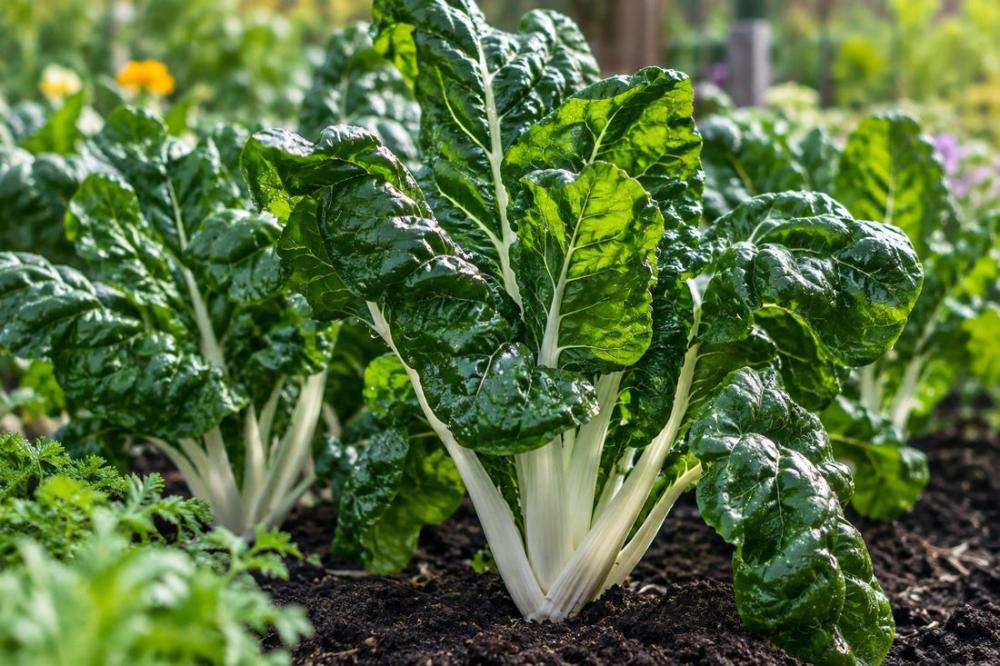

Swiss chard is a leafy green that gives a long harvest: you pick the outer leaves and the plant keeps producing new ones from the centre for weeks. It also tolerates mild heat better than spinach.
In this article we explain how to grow chard from seed: the best time, depth and spacing, watering and feeding, the picking method that keeps it producing longer, and its common problems.
Best time to grow chard
- Chard likes mild and cool weather.
- Best: from September to February.
- It tolerates early heat better than spinach and lettuce, but intense heat lowers leaf quality.
How to grow chard step by step
1. Soaking the seeds
- A chard seed is a cluster holding more than one seed, with a hard coat.
- Soak it in water for 12 hours before sowing to speed germination.
2. Preparing the ground
- Well-drained soil rich in organic matter.
- Add composted organic fertilizer before sowing.
3. Sowing
- Sow directly in the bed or rows.
- Depth: about 1 to 2 cm.
- Spacing: 25 to 30 cm between plants and 40 cm between rows.
- Germination: within one to two weeks.
4. Thinning
- Each cluster produces more than one seedling, so keep the strongest and remove the rest by cutting, not pulling, so you do not damage the roots of the one you keep.
Watering chard
- Regular watering, keeping the soil constantly moist.
- No waterlogging, as standing water rots the roots.
- Drought makes the leaves tough and stronger tasting.
Feeding chard with rates
- Once the plants are established: balanced 20-20-20 fertilizer at 1 to 2 g per litre every 10 to 14 days.
- After each large picking: a light feed helps new leaves come quickly.
When and how to pick chard
- First picking: roughly 50 to 60 days after sowing.
- Pick the large outer leaves at their base, leaving the heart leaves to grow on.
- Do not take more than a third of the plant at once.
- Regular picking keeps the plant producing for longer.
Common problems
Round brown spots on the leaves
- Leaf spot, more common with humidity and wetting the leaves when watering.
Small insects under the leaves
- Aphids. Spray potassium soap at 10 ml per litre.
Winding tunnels inside the leaf
- Leaf miners. Remove affected leaves as they appear.
The plant sends up a flower stalk
- Cause: intense heat or the end of the season, after which leaf quality drops.
Products from Orkida
- Egyptian Chard Seeds, 100 g: a leafy green picked several times a season, for fields and home beds.
- Bavaria 20-20-20 Balanced Fertilizer, 2 kg: 1 to 2 g per litre every 10 to 14 days.
- Plant Care Potassium Soap, 1 L: for aphids, 10 ml per litre.
Frequently Asked Questions
When should I plant chard?
From September to February, because it likes mild and cool weather.
Should I soak chard seeds?
Yes, for 12 hours in water before sowing, because the seed is a cluster with a hard coat.
Why do several seedlings come up from one seed?
Because a chard seed is a cluster of several seeds, so you thin and keep the strongest.
How do I pick chard so it keeps producing?
Pick the outer leaves at their base, leave the heart, and never take more than a third of the plant at once.
What is the difference between chard and spinach?
Chard has larger leaves and broader stems, tolerates heat better, and produces for longer.