
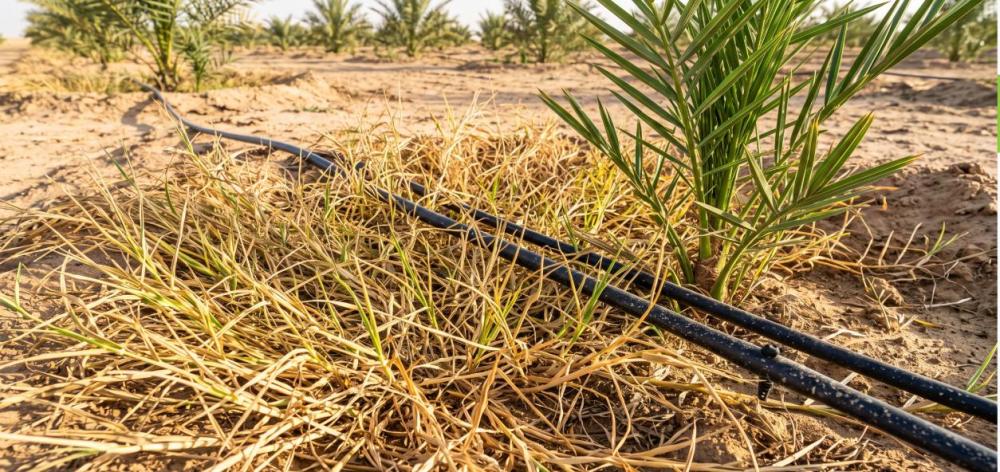

Glyphosate is the best-known herbicide in the world. It is sprayed on green weeds, moves down to the roots and kills the whole plant. That is why it is used to clear land before planting, between rows of palms and trees, and around fences and paths.
But glyphosate is non-selective: it kills any green plant it reaches, whether a weed or a crop. And the result does not show in a day. This article explains how it works, when to spray it, how to protect your crop from drift, and why it sometimes fails.
- Group: EPSPS enzyme inhibitors (HRAC group 9).
- Type: non-selective, systemic, post-emergence herbicide.
- Kills: annual and perennial weeds, both grasses and broadleaves.
- Common forms: soluble liquid (SL) at 48% or 360 g/L.
How does glyphosate work?
The green leaf absorbs the active, and it moves with the plant's sap to every part: the tips, the roots and the underground rhizomes. There it blocks an enzyme the plant needs to make essential amino acids, so growth stops and the plant dies gradually.
That is why:
- Perennial weeds such as Bermuda grass, which regrows from its roots, are reached down to the roots.
- The result is slow: annual weeds yellow within 4 to 7 days, and perennials take two weeks or more.
- Do not mow or plough straight after spraying; let the active move to the roots.
Glyphosate and the soil
Glyphosate binds to soil particles and stops working once it touches them. This means:
- It does not kill seeds in the soil, or weeds that have not emerged.
- It does not protect the ground from new weeds after spraying.
- Spraying bare soil with no green weeds is useless.
When to spray for results
1. When weeds are green and growing
The best time is when weeds are actively growing with enough leaves to absorb the active. Thirsty, dusty or cold-stressed weeds absorb less.
2. Do not mow before spraying
If you mow, there are fewer leaves to absorb the spray. Let new leaves grow, then spray.
3. Watch for rain and sprinkler irrigation
The active needs time to soak into the leaf. Rain or sprinkler irrigation straight after spraying washes it off. The label sets the time needed.
4. Water quality matters
Muddy or cloudy water reduces glyphosate's effect because it binds to the clay. Use clean water.
5. Dose according to the weed
Small annual weeds need a lower dose than tough perennials. Read the label and choose the dose for the type of weed.
How to protect your crop from drift
Because glyphosate kills any green plant, drift onto the crop causes clear damage.
- Do not spray in wind. Early morning is usually calmer.
- Low pressure and large droplets. High pressure produces fine droplets that drift far.
- Use a hooded or shielded nozzle to keep the spray on the weeds.
- Do not spray the green stems of young trees, or suckers and offshoots.
- Keep a dedicated herbicide sprayer, or wash it thoroughly before using it on a crop.
Glyphosate or a selective herbicide?
- Clethodim: The Grass Weed Herbicide You Can Spray Over Your Crop
- Glyphosate: for full clearing before planting, between rows while shielding the crop, or around fences and paths.
- A selective herbicide: when you want to kill a specific type of weed inside the crop without harming it.
Safety
- Wear gloves, a mask and goggles when preparing the mix.
- Keep animals away from the treated area until it dries.
- Do not wash the sprayer near water sources or crops.
- Store the pack sealed away from children and fertilisers.
Products from Orkida
- Touchdown 360 SL, 5 litres: glyphosate 360 g/L, a non-selective systemic herbicide.
- Tiller 480 SL, 1 litre: glyphosate 48% for annual and perennial weeds.
- Tiller 480 SL, 5 litres: the same product in a large pack for farms.
- Spectra 480 SL, 1 litre: glyphosate 48%, a non-selective systemic herbicide.
- Ken Up 48 SL, 1 litre: glyphosate 48% for grass and broadleaf weeds.
- Tillmaster 480 SL, 1 litre: glyphosate 48%, a post-emergence non-selective herbicide.
- Glystop 480 SL, 1 litre: glyphosate 48% for annual and perennial weeds.
- Glyfo 48 SL, 1 litre: glyphosate 48% that moves from the leaves to the roots.
Frequently asked questions
I sprayed glyphosate and saw nothing after two days. Is something wrong?
No, that is normal. Annual weeds start yellowing after 4 to 7 days, and perennials take two weeks or more.
Can I plant after spraying?
Glyphosate has no soil activity, but follow the interval written on the label before planting, and give the weeds time so the active reaches the roots.
Why did the Bermuda grass come back after spraying?
Usually the dose was lower than perennials need, the grass was mown or water-stressed when sprayed, or it was cut before the active reached the roots. Spray the new growth again.
Will it harm palms if I spray around them?
The old brown trunk does not absorb it, but green fronds, offshoots and suckers do and will be damaged. Spray carefully with a shielded nozzle.