
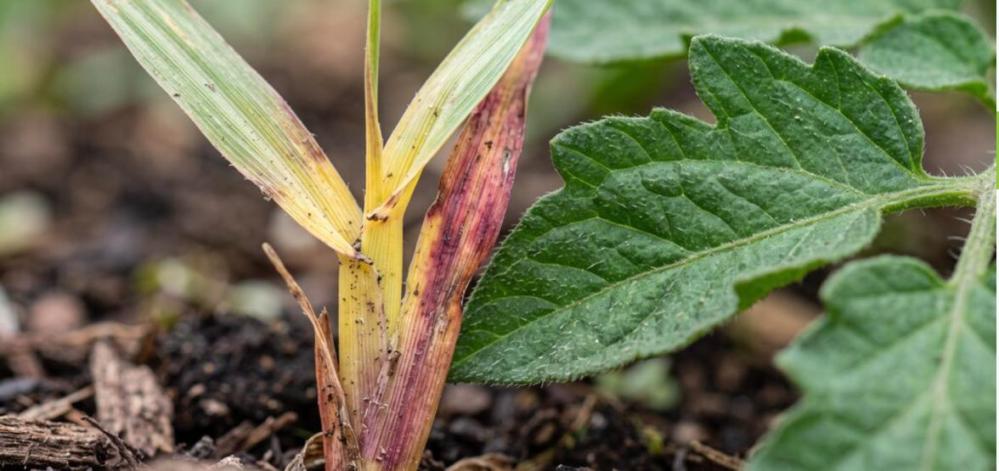

Clethodim is a selective herbicide that kills grass weeds, such as Bermuda grass, Johnson grass and wild oats, while they grow among broadleaf crops like tomato, potato, cotton and beans, without harming the crop. In other words, you can spray it over the crop itself.
This article explains how clethodim works, which weeds it controls and which it does not, when to spray it, and why the result takes days.
- Group: ACCase inhibitors, the "dim" family (HRAC group 1).
- Type: selective, systemic, post-emergence herbicide.
- Kills: annual and perennial grass weeds.
- Does not kill: broadleaf weeds or nutsedge.
- Common forms: emulsifiable concentrate (EC) at various strengths, including 125, 240 and 360 g/L.
How does clethodim work?
The green leaf absorbs it and it moves to the growing points of the weed. There it blocks an enzyme grasses need to make the fats that build new cells. Broadleaf plants are not affected because their enzyme is different, and that is the secret of its selectivity.
The symptoms go like this:
- Day one to three: the weed stops growing.
- After a week: new leaves turn yellow or red.
- After one to two weeks: the heart of the weed rots, and the central leaf pulls out easily.
- Within two to three weeks: the weed dies completely.
Which weeds does it control?
- Annual grasses: such as barnyard grass, wild oats, crabgrass and goosegrass.
- Perennial grasses: such as Bermuda grass and Johnson grass. They need a higher dose, and sometimes a second spray on regrowth.
It does not work on:
- Broadleaf weeds: such as purslane and wild beet.
- Nutsedge: because it is not a true grass.
Which crops?
Broadleaf crops listed on the label, such as:
- Vegetables: tomato, potato, onion, pepper and squash.
- Cotton.
- Legumes: broad beans, green beans and soybean.
- Alfalfa.
Do not spray it on wheat, barley, corn, rice or grass forage, because they are all grasses and will die.
When to spray it
1. While the grass is small and growing
The best time is when the grass weeds have 2 to 5 leaves and are actively growing. Large or water-stressed grass is harder to kill.
2. Add the adjuvant if the label asks for it
Most clethodim products need an oil or spreader so the leaf absorbs it better. For example, Reflect 360 EC is used at 500–1,000 ml per hectare once the grass has 2–3 leaves, with a non-ionic spreader.
3. Be careful mixing with broadleaf herbicides
Tank-mixing clethodim with some broadleaf herbicides weakens its effect on grasses. If you need both, spray them at different times instead of mixing them in the same tank.
4. Resistance
If you spray the same group every season, some grasses become resistant. Rotate with other methods: tillage, a pre-emergence herbicide, or another group.
Safety
- Wear gloves, goggles and a mask.
- Watch for drift if there is a wheat, corn or grass forage field next to you.
- Respect the pre-harvest interval on the label.
Products from Orkida
- Reflect 360 EC, 1 litre: clethodim 36% for grass weeds, a smaller amount per tank.
- Deltaherb 240 EC, 1 litre: clethodim 24% for annual and perennial grass weeds.
- Clodim 125 EC, 1 litre: clethodim 12.5% for grass weeds after emergence.
Frequently asked questions
I sprayed clethodim and saw nothing after two days. Is something wrong?
No. Growth stops quickly, but yellowing shows after about a week, and full kill takes two to three weeks.
Does it kill nutsedge?
No. Nutsedge needs a herbicide made for it.
Can I spray it over tomatoes?
Yes, if tomato is listed on the product label, because clethodim does not affect broadleaf crops.
How long must it stay dry after spraying?
Usually an hour is enough, and the label gives the exact time.