
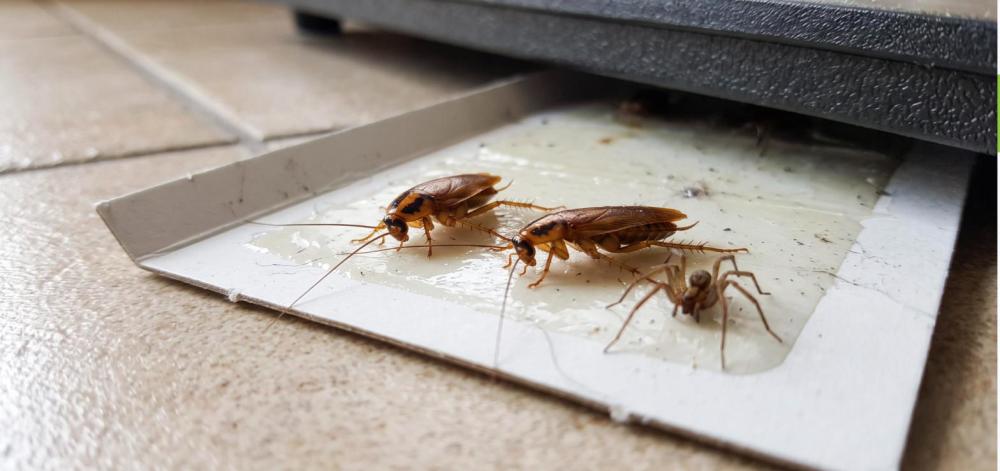

The glue trap is one of the simplest and cheapest pest control tools, and it works on mice, cockroaches, geckos and crawling insects. But many people put it in the wrong place, touch it with bare hands or leave it in the dust, and then say it catches nothing.
This article explains how to choose a glue trap for each pest, where to place it, how long it lasts, whether it is safe for children and cats, and how to dispose of it after a catch.
- What it is: a cardboard or plastic board coated with a strong glue that stays tacky and holds an animal or insect as soon as it walks on it.
- Works on: small mice, cockroaches, geckos, spiders and crawling insects. Large rats need large boards or snap traps.
- Advantage: no poison, and it shows you the type of pest, how many there are and where they move.
- Drawback: it does not solve a large infestation on its own, and it fails quickly in dust and humidity.
Choose the trap for the pest
For mice
- Small house mouse: a medium board or glue book, ideally two boards side by side so the mouse cannot jump over one.
- Large rat: a large board of about 70 × 36 cm. Small boards do not hold a rat; it drags them away or pulls free.
For cockroaches
Small box or house-shaped traps placed under the sink, behind the fridge and near appliances. These are most useful for monitoring and finding the nest. Killing the colony is the job of gel bait.
For geckos and snakes
A large board at yard entrances, along walls and under stairs. Geckos move on walls, so it is best to fix the board where the wall meets the floor or on the wall itself.
Where to place the trap
Mice and cockroaches move along walls, not across the middle of a room. So the first rule is: the trap goes on the travel path, against the wall.
- Behind the fridge, oven and washing machine: warm and hidden.
- Under the sink and lower kitchen cabinets: moisture and food residue.
- At pipe and air-conditioning openings: common entry points for mice.
- In stores and warehouses: in corners and under shelves.
- Where you find droppings or gnaw marks: the strongest sign of a path.
Mistakes that stop the trap from catching
- Touching the glue with bare hands: hand scent puts mice off, and dust kills the stickiness. Wear gloves.
- Placing it in the middle of the room: mice do not pass there.
- Using only one trap: place several on the same path, every one to two metres.
- Leaving it in dust or sun: dust covers the glue, and high heat makes it run or dry out.
- Too much bait: bait is usually not needed, and if you use it, a small piece in the centre is enough.
How long does a glue trap last?
Sealed in its box and kept somewhere cool and dry, it keeps for a long time. Once opened and placed, its life depends on the spot:
- Clean indoor spot: it keeps working for weeks.
- Dusty, humid or hot spot: it can fail within days.
A simple test: if dust has covered it, or it no longer sticks when you touch it with the tip of a stick, replace it.
Is a glue trap safe for children and cats?
The glue itself is usually not toxic, but the problem is a child or a cat getting stuck. So:
- Place it out of children's reach: behind appliances and under cabinets.
- For cats and birds: use covered traps, or put the board inside a box with a small mouse-sized opening.
- In the yard: do not leave large open boards where cats or birds pass.
If it sticks to your hand or a cat's fur
- Do not pull hard: you will hurt the skin or tear the fur.
- Use cooking oil: put vegetable oil on the glue, wait a little, and the glue loosens.
- Then wash with warm water and soap.
- Do not use petrol, thinner or solvents on skin or on an animal.
After a catch: how to dispose of it
- Always wear gloves when handling a trap with a mouse on it.
- Fold the board on itself or put it in a bag, seal the bag well and throw it out of the house.
- Clean the spot where the trap was with a disinfectant.
- Put a new trap in the same place, because that path is in use and there are likely other mice.
When a glue trap is not enough
- If there is a new catch every day: the problem is bigger than traps, and you need a full plan: sealed entry points, bait stations around the outside, and traps indoors.
- With large rats: a snap trap is more reliable.
- With cockroaches: the trap is for monitoring, and gel is what reaches the nest.
Products from Orkida
- Catchmaster glue trap (USA), 72 boards: ready-to-use boards for mice and crawling insects, suitable for homes, restaurants and warehouses.
- Catchmaster small glue trap: two glue boards for small mice behind appliances and under cabinets.
- Rat Hunter glue book: a folding glue book for mice and rats placed on the travel path.
- Force Catch large glue trap: two large boards for rats and mice.
- Force Catch glue board 70 × 36 cm: for geckos, snakes and large rats in yards and warehouses.
- Force Catch cockroach glue traps: 10 small traps for monitoring cockroaches under sinks and behind appliances.
Frequently asked questions
Why does the mouse walk past the trap without stepping on it?
Usually because the trap is new to it, smells of hands, or is not exactly on its path. Place it flush against the wall, leave it a few days and use more than one.
Should I put bait on a glue trap?
It is not necessary. If you do, use something small such as a peanut or a little peanut butter in the centre of the board.
How many traps do I need?
For an ordinary room, 2 to 4 traps along the wall paths. For kitchens and warehouses more, one every one to two metres along the path.
Do glue traps work outdoors?
Outdoors there is dust, sun and heat, so they fail quickly. For the outside perimeter, locked bait stations are better.