
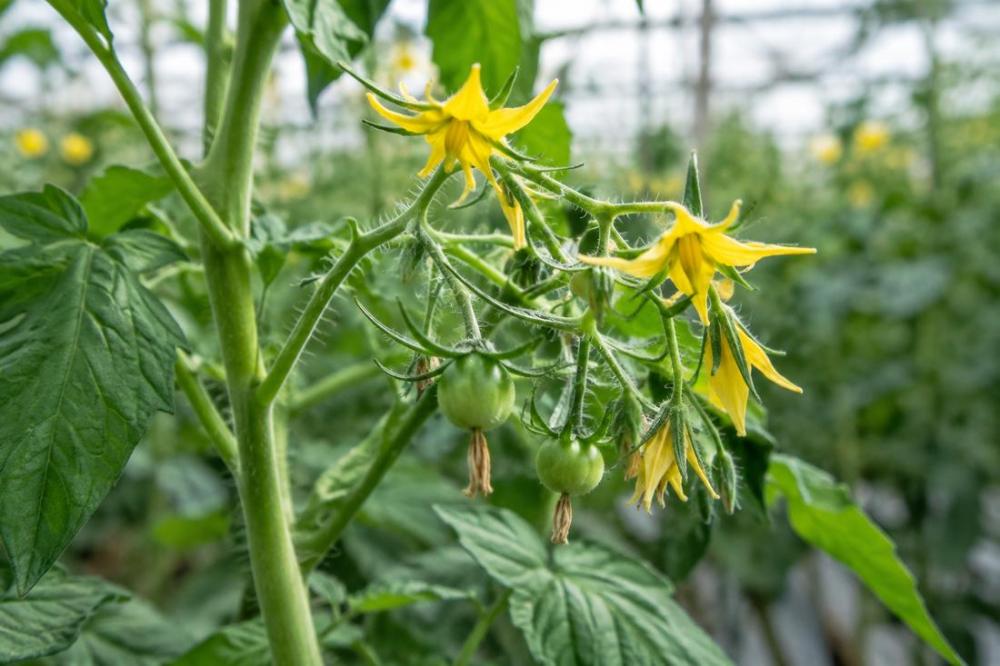

Your tomatoes or peppers flower well, and a few days later you find the flowers lying under the plant with only a few setting fruit. Flower drop and poor fruit set are among the biggest causes of lost yield, and most of the reasons are well known and treatable if you catch them early.
In this article we explain why flowers drop, what fruit-set boosters are, the rate and timing for each product, and the most important mistakes to avoid.
Why do flowers drop?
- Extreme heat at flowering weakens pollen so the flower is not pollinated.
- Drought or irregular irrigation makes the plant shed its flowers.
- Boron and calcium deficiency weakens the flower and its stalk.
- Too much nitrogen pushes the plant into leafy growth at the expense of flowers.
- Poor pollination in closed greenhouses.
- Insects such as thrips that feed on flowers.
What are fruit-set boosters?
- Plant growth regulators such as NAA and gibberellin that help the flower hold and turn into fruit.
- Sprayed at very small rates at the start of flowering or just before.
- They do not replace regular irrigation and balanced feeding, but they help under stress.
Rates and spray timing
G-Gna SP (500 g)
- Ingredients: gibberellic acid, alpha-naphthalene acetic acid and glycine.
- Tomato, pepper and watermelon: 1 g per litre of water as the flowers appear.
Amcotone SP (500 g)
- Active ingredients: NAA 0.45% and NAD 1.20%.
- Vegetables (tomato and watermelon): 1 g per 100 L of water at the start of flowering, repeated as needed.
- Grapes and fruit trees: 1 g per 100 L of water before flowering, repeated every two weeks.
- Date palms: 1 g per 100 L of water before flowering.
- Note: the Amcotone rate is far lower than G-Gna, so never swap the rates between the two products.
Codabor liquid boron (1 L)
- Foliar spray on vegetables: 1 to 1.5 L per hectare for prevention and 1.5 to 2 L for treatment, 2 to 3 sprays 15 days apart.
- Fruit trees and citrus: 1 to 1.5 L per hectare before flowering, at petal fall and at early fruit set.
- With the irrigation water: 1 to 3 L per hectare depending on the severity of deficiency.
Amino Aga Cap (calcium and boron with amino acids)
- Greenhouses: 8 to 10 L per hectare with the irrigation water, every 7 to 10 days from fruit formation until before harvest.
- Grapes: 7 to 8 L per hectare every 15 days.
- Strawberries: 8 to 10 L per hectare every 10 to 15 days.
Spraying tips
- Spray early morning or late afternoon, and avoid spraying in strong heat or wind.
- Dissolve the product well and stir so the solution is even.
- Do not raise the rate: too much growth regulator harms flowers and fruit instead of helping.
- Keep irrigation regular and look after boron and calcium before flowering.
Products from Orkida
- G-Gna SP Fruit-Set Growth Booster, 500 g: gibberellin, NAA and glycine.
- Amcotone SP Fruit-Set Growth Booster, 500 g: NAA and NAD.
- Codabor High-Concentration Liquid Boron, 1 L: for boron deficiency at flowering.
- Amino Aga Cap Calcium and Boron with Amino Acids, 1 L: for better fruit set and quality.
Frequently Asked Questions
Why do tomato flowers drop before setting fruit?
Usually extreme heat, drought, boron and calcium deficiency, or too much nitrogen.
What is the Amcotone rate?
1 g per 100 L of water at the start of flowering for vegetables, and before flowering for grapes, fruit trees and palms.
What is the G-Gna rate for tomatoes?
1 g per litre of water as the flowers appear.
When should I spray boron?
Before flowering, at petal fall and at early fruit set, with 2 to 3 sprays 15 days apart.
Should I raise the rate if flower drop is severe?
No, a higher rate causes harm; stick to the rate and fix the root cause such as irrigation or feeding.