
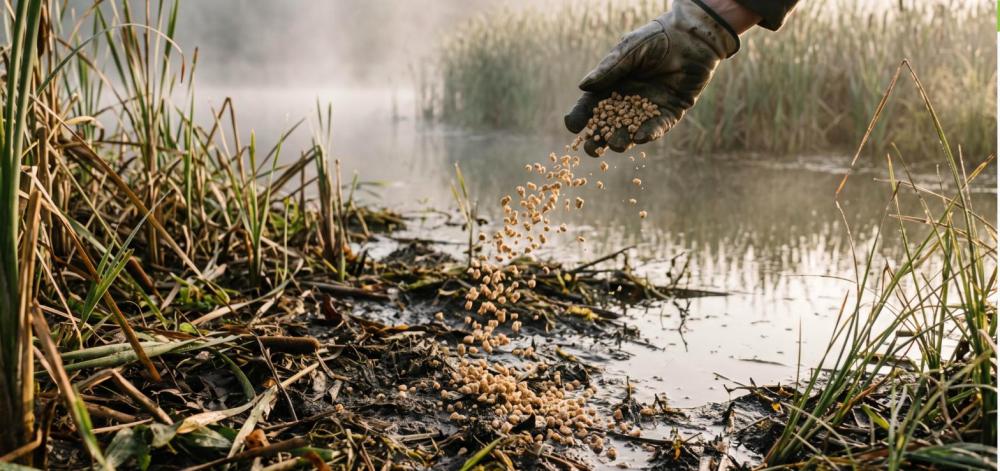

Bti bacteria are one of the safest and most targeted ways to control mosquito larvae. They are natural soil bacteria that produce proteins which kill mosquito larvae when they eat them, without affecting people, fish or most other organisms in the water.
This article explains what Bti is, how it kills larvae, its forms (tablets, granules, powder, liquid), and where to use each form.
- Scientific name: Bacillus thuringiensis subsp. israelensis.
- Group: biological insecticides (IRAC group 11A).
- Targets: mosquito larvae, and some black fly larvae.
- Speed: larvae stop feeding quickly and die within one to two days.
How does Bti kill larvae?
The bacteria produce protein crystals. Mosquito larvae eat them while feeding in the water, and the alkaline conditions in the larval gut dissolve the crystals and release toxins that punch holes in the gut wall. The larva stops feeding and dies.
This mechanism needs a gut with particular properties found in mosquito larvae and their relatives, which is why the bacteria are targeted and do not affect most other organisms.
Forms of Bti and where each one works
Tablets (DT)
- For small sites: tanks, barrels, basins, drain openings.
- Easy: drop the tablet in and it dissolves.
Granules (G)
- For water with plants or varying depth: marshes, pond edges, channels.
- They fall between plants and reach the water beneath.
Water-dispersible powder (WDG/DF)
- For large areas: mixed with water and applied with a sprayer.
- Suitable for channels and wide ponds.
Liquid concentrate (AS)
- For large programmes: applied with backpack sprayers or larger equipment over wide areas.
How to use it
1. Make sure there are larvae
You will see larvae near the water surface, diving down if you approach. If there are no larvae, treatment is not needed yet.
2. Choose the form for the site
Tablets for small sites, granules for water with plants, and powder or liquid for large areas.
3. How much to use
The amount depends on water area and larval density. For example, VectoBac G granules: 8–10 kg per hectare when larvae are few, and 11.2–22.4 kg per hectare in polluted water or heavy infestations. AquaBac 200G: 5–10 kg per hectare.
4. Repeat regularly
Bti has a short residual effect because it breaks down in water and sunlight. Most sites need retreatment every one to two weeks.
When to choose Bti
- Near people, animals and sensitive places.
- In ponds and channels with aquatic life.
- In regular control programmes for towns, farms and rest houses.
- As an alternative to chemical larvicides to delay resistance.
Its limits
- It does not kill adult mosquitoes.
- It does not kill pupae, because pupae do not feed.
- It needs frequent retreatment because of its short residual.
So the full plan is: Bti for larvae, treatment for adult mosquitoes, and draining standing water.
Storage and safety
- Store it somewhere cool and dry away from sunlight, because it is a biological product.
- Respect the expiry date.
- Wear gloves when handling it.
Products from Orkida
- VectoBac DT, 50 tablets: Bti tablets for tanks, barrels and small basins.
- VectoBac G, 18 kg: Bti granules for marshes and water with plants.
- VectoBac WDG, 25 kg: water-dispersible powder for large areas.
- VectoBac 12 AS, 10 litres: liquid concentrate for large mosquito larval control programmes.
- Aquabac DF 3000: a biological Bti product for mosquito larvae.
- Aquabac 200 G, 10 kg: Bti granules for mosquito larvae in marshes and channels.
Frequently asked questions
Is Bti harmful to people or animals?
The bacteria are specific to mosquito larvae and their relatives. Still, follow the label and do not put it in drinking water unless the label allows it.
Why did mosquitoes come back after two weeks?
Because its effect is short and mosquitoes lay new eggs. You need to retreat regularly and drain any water you can.
Does it work on large larvae?
It works on all larval stages, but it is strongest on young larvae. It does not work on pupae.
What is the difference between it and S-methoprene?
Bti kills the larva itself quickly. S-methoprene stops the mosquito from emerging from the pupa. You can rotate between them.