
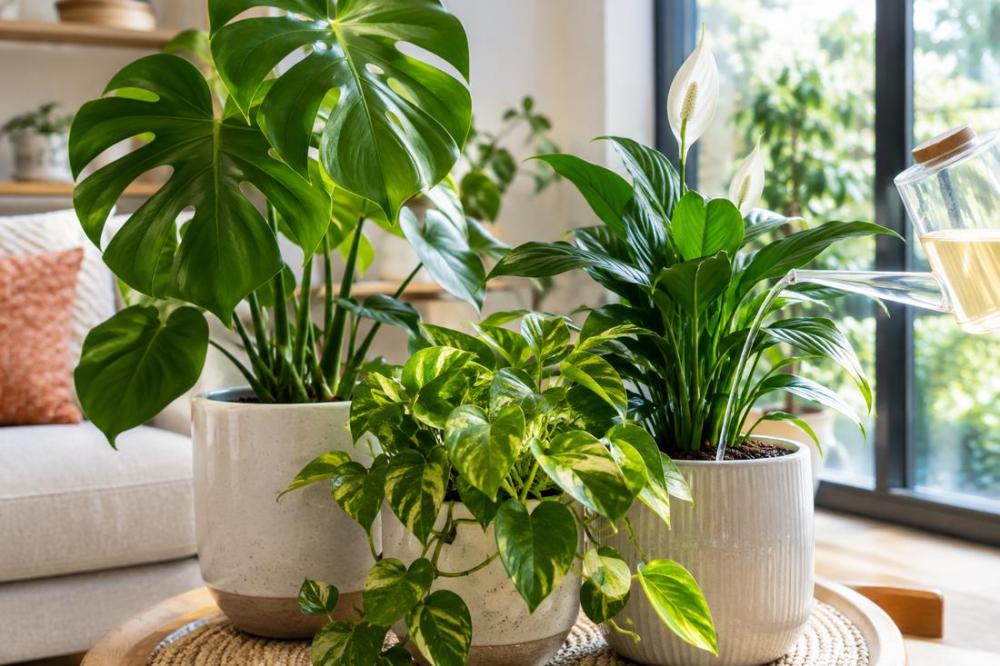

Houseplants live in small pots, and the soil in them runs out of nutrients with watering within weeks. That is why they need fertilizer, but only a light amount: too much burns the roots and yellows the leaves faster than too little.
In this article we explain the best fertilizer for houseplants, the difference between liquid and granular fertilizer, the right dose, how often to feed, and how to tell whether a plant is hungry or burned by fertilizer.
What does a houseplant need?
- Nitrogen (N): for green leaves and new growth.
- Phosphorus (P): for roots and flowering.
- Potassium (K): for plant strength and flower colour.
- Micronutrients such as iron, magnesium and zinc: a shortage shows as yellowing between the leaf veins.
Best type of fertilizer for houseplants
Balanced liquid fertilizer
- The easiest and safest choice at home, because you control the dose exactly.
- A balanced formula such as 7-7-7 with micronutrients suits most shade and ornamental plants.
- Method: mix it into the watering water or spray it on the leaves.
Water-soluble powder fertilizer
- Such as 20-20-20, which is more concentrated, so you use less.
- Suits you if you have many plants and want an economical pack.
Seaweed extract
- A natural stimulant that strengthens roots and helps the plant cope with heat, air conditioning and being moved.
- It does not replace the main fertilizer, it complements it.
Root stimulant
- Useful after repotting or when planting a new cutting or seedling.
The right dose and how often to feed
- 7-7-7 liquid fertilizer: 2 ml per litre of water every 10 to 14 days.
- 20-20-20 soluble fertilizer: 1 g per litre of water every two weeks.
- Seaweed extract: spray 2 to 3 ml per litre about once a month.
- Root stimulant after repotting: 1 to 2 ml per litre every 15 days.
- In winter, when growth is slow: cut feeding to once a month.
How to feed correctly
- Water the plant with plain water first, then water with the fertilizer solution, so you do not burn dry roots.
- Do not feed a plant that is wilting from thirst or sick; treat it first.
- Do not use chemical fertilizer right after repotting; wait 3 to 4 weeks and use only a root stimulant.
- Every few months water heavily until it drains from the bottom, to flush out built-up salts.
Signs a plant needs fertilizer
- Older leaves yellow from the bottom and new growth is small.
- The plant stops growing during the growing season.
- Leaf colour is dull and stems are weak.
Signs of too much fertilizer
- Brown, burned leaf tips.
- A white or yellow crust on the soil surface or the pot rim.
- Leaves wilt even though the soil is moist.
- Solution: stop feeding, flush the soil with plenty of water, and scrape off the white crust.
Products from Orkida
- Nours 7-7-7 Balanced Liquid Fertilizer, 1 L: with micronutrients, preferred for indoor plants, 2 ml per litre every 10 to 14 days.
- Bavaria 20-20-20 Balanced Fertilizer, 2 kg: 1 g per litre every two weeks.
- Acadian Seaweed Liquid Fertilizer, 1 L: spray 2 to 3 ml per litre to strengthen the plant.
- Root Master Root Stimulant, 500 ml: 1 to 2 ml per litre every 15 days after repotting or for cuttings.
Frequently Asked Questions
What is the best fertilizer for houseplants?
A balanced liquid fertilizer such as 7-7-7 with micronutrients, because it is easy, safe and easy to dose.
How often should I feed houseplants?
Every 10 to 14 days in spring and summer, and once a month in winter.
Should I fertilize after repotting?
Do not use chemical fertilizer for 3 to 4 weeks; use only a root stimulant.
Why have my plant's leaf tips turned brown?
Usually from too much fertilizer or salt build-up. Stop feeding and flush the soil with plenty of water.
Should I spray fertilizer on the leaves or add it to the soil?
The main feed goes in with the water, and leaf spraying is an extra for stimulants such as seaweed.
Read next
- Potting Soil and Peat Moss: Types of Ready-Made Growing Media and How to Choose the Right Mix
- Yellowing Plant Leaves and Nutrient Deficiencies: Causes, Diagnosis and Treatment
- Best Fertilizer for Strengthening Roots: How to Build a Healthy Plant
- Cacti and Aloe Vera: Care, Watering, Root Rot and Mealybugs
- Lucky Bamboo: Why Is It Turning Yellow? Care in Water and Soil
- Spider Plant Care: Brown Tips and Propagation